O
Fully annealed: softest and most formable. Used for deep drawing, spinning and severe bends.



Aluminium sheet is flat rolled aluminium from about 0.2 mm to 6 mm thick, supplied cut to standard or custom sizes from coil. The right sheet depends on three choices: the alloy series, the temper and the surface finish. Metline supplies every common sheet grade, from soft 1050 to aerospace 7075, in mill, coated, anodised and patterned finishes, to customers worldwide.
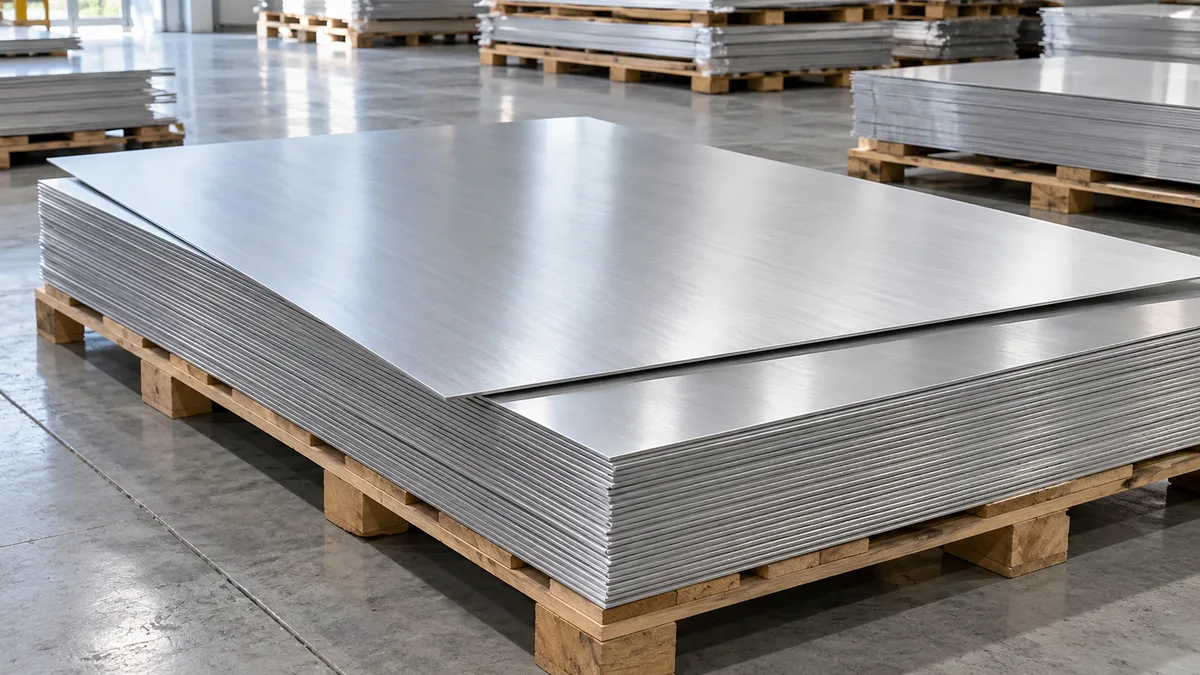
Sheet sits between foil and plate. ASTM B209 defines sheet as 0.006 – 0.249 in (about 0.15 – 6.3 mm) thick; European practice under EN 485 treats material up to 6 mm as sheet and strip. Thinner material is foil, thicker is plate. Sheet is cold rolled, which gives it a smoother surface and tighter thickness tolerance than hot-rolled plate, and it is cut into flat pieces from coil.
Because sheet is cold rolled, its strength is set either by the amount of cold work (the H tempers of 1xxx, 3xxx and 5xxx alloys) or by heat treatment (the T tempers of 2xxx, 6xxx and 7xxx alloys). That is why "aluminium sheet" can mean anything from a soft, deep-drawable 1050-O blank to a 7075-T6 aircraft skin five times stronger.
Most sheet is ordered in a handful of sizes, with 1220 × 2440 mm (4 × 8 ft) and 1250 × 2500 mm the most common worldwide. Coil-fed and cut-to-length lines also make any length to order, and slitting gives narrow strip. For definitions of each flat product, see our article on coil, strip, sheet and plate.
| Grade | Series | Character | Typical sheet uses |
|---|---|---|---|
| 1050 / 1060 / 1100 | Commercial purity | Very formable, high conductivity, low strength | Reflectors, signage, chemical equipment, flashing, deep-drawn parts |
| 3003 / 3105 | Al-Mn | Moderate strength, good forming, good corrosion resistance | Roofing, cladding, cookware, ducting, fuel tanks |
| 5005 | Al-Mg (low) | Excellent anodising, architectural colour match | Facades, panels, trims |
| 5052 / 5754 | Al-Mg | Higher strength, marine resistance, weldable | Boat parts, truck bodies, enclosures, tanks |
| 5083 | Al-Mg (high) | Highest non-heat-treatable strength, seawater resistant | Marine, cryogenic and pressure vessels |
| 6061 / 6082 | Al-Mg-Si | Heat-treatable, strong, machinable, weldable | Structural parts, frames, machined panels |
| 2024 | Al-Cu | High strength and fatigue, often clad | Aircraft skins, structural sheet |
| 7075 | Al-Zn-Mg-Cu | Highest strength | Aerospace, sports and high-stress parts |
Typical values are what the material usually achieves; ASTM B209 and EN 485-2 give the specified minimums used for design, which vary with temper and thickness.
| Grade and temper | Tensile strength | Yield strength (0.2 %) | Elongation | Density (g/cm³) |
|---|---|---|---|---|
| 1100-H14 | 125 MPa | 115 MPa | 9 % | 2.71 |
| 3003-H14 | 150 MPa | 145 MPa | 8 % | 2.73 |
| 5005-H34 | 159 MPa | 138 MPa | 8 % | 2.70 |
| 5052-H32 | 228 MPa | 193 MPa | 12 % | 2.68 |
| 5754-H22 (EN 485-2 minimum) | 220 MPa | 130 MPa | 7 – 10 % | 2.67 |
| 5083-H321 | 317 MPa | 228 MPa | 16 % | 2.66 |
| 6061-T6 | 310 MPa | 276 MPa | 12 % | 2.70 |
| 2024-T3 | 483 MPa | 345 MPa | 18 % | 2.78 |
| 7075-T6 | 572 MPa | 503 MPa | 11 % | 2.81 |
Typical values from Aluminum Association and ASM data. Mill certificates report the actual tested values of each lot.
Fully annealed: softest and most formable. Used for deep drawing, spinning and severe bends.
Strain-hardened only, from quarter-hard (H12) to full-hard (H18). H14 (half-hard) is the most common general sheet temper.
Strain-hardened then partially annealed. Same strength as H1x but with better elongation, so they bend more easily.
Strain-hardened and stabilised, used for magnesium alloys such as 5052 and 5005 to prevent age softening.
Special 5xxx tempers; H116 and H321 are tested for resistance to exfoliation and intergranular corrosion in marine use.
Heat-treated tempers for 2xxx, 6xxx and 7xxx sheet. T4 forms better; T6 gives full strength.
Sheet weighs 2.70 kg/m² per millimetre of thickness for 1xxx and 6xxx alloys (slightly less for 5xxx, slightly more for 2xxx and 7xxx). In the US, sheet is often described by gauge; aluminium uses the Brown & Sharpe (AWG) scale, so 10 ga is 2.588 mm, 12 ga 2.053 mm, 14 ga 1.628 mm, 16 ga 1.291 mm, 18 ga 1.024 mm and 20 ga 0.813 mm. Steel gauges are different, so always confirm the decimal thickness.
| Thickness (mm) | kg per m² | 1000 × 2000 mm (kg) | 1220 × 2440 mm (kg) | 1250 × 2500 mm (kg) |
|---|---|---|---|---|
| 0.5 | 1.35 | 2.70 | 4.02 | 4.22 |
| 0.8 | 2.16 | 4.32 | 6.43 | 6.75 |
| 1 | 2.70 | 5.40 | 8.04 | 8.44 |
| 1.2 | 3.24 | 6.48 | 9.64 | 10.12 |
| 1.5 | 4.05 | 8.10 | 12.06 | 12.66 |
| 2 | 5.40 | 10.80 | 16.07 | 16.88 |
| 2.5 | 6.75 | 13.50 | 20.09 | 21.09 |
| 3 | 8.10 | 16.20 | 24.11 | 25.31 |
| 4 | 10.80 | 21.60 | 32.15 | 33.75 |
| 5 | 13.50 | 27.00 | 40.19 | 42.19 |
| 6 | 16.20 | 32.40 | 48.22 | 50.62 |
Cold-rolled sheet is supplied to EN 485-4 or ASTM B209 (ANSI H35.2) tolerance tables. Thickness tolerance tightens for narrower and thinner sheet; flatness is specified as maximum deviation over a set length. Surface quality is agreed separately: decorative, anodising-quality and lithographic sheet carry stricter limits on streaks, roll marks and scratches than general engineering sheet.
Minimum bend radius depends on alloy and temper: 1050-O and 3003-O bend flat on themselves, 5052-H32 typically to about 1 × thickness, 6061-T6 needs about 1.5 – 3 × thickness. Bend across the rolling direction where possible.
Use 1xxx, 3003 or 5052 in O or H2x tempers. Earing and orange peel are controlled by grain size and texture.
1xxx, 3xxx, 5xxx and 6xxx sheet weld by TIG, MIG or laser. Thin sheet benefits from pulsed processes. 2024 and 7075 are normally riveted or bonded.
Shearing, laser, waterjet and CNC routing all work; see our guide to cutting aluminium sheet.
5005 and 1050 give the most consistent architectural anodised colour; 6061 anodises well for protection. Order anodising-quality sheet for visible parts.
Coil-coated PE or PVDF sheet avoids post-painting. Bare sheet needs a chromate-free conversion coating before powder coating.
Under ASTM B209, sheet is 0.006 – 0.249 in (about 0.15 – 6.3 mm) thick and plate is 0.250 in and above. European practice treats material up to 6 mm as sheet. Below about 0.2 mm the product is generally called foil.
3003-H14 and 5052-H32 are the usual choices for bent sheet-metal parts: they form well and hold their shape. For very tight bends use O or H2x tempers. 6061-T6 is stronger but needs larger bend radii.
A 1220 × 2440 mm sheet weighs about 8.04 kg per millimetre of thickness. A 1 mm sheet is about 8.0 kg, a 2 mm sheet about 16.1 kg and a 3 mm sheet about 24.1 kg.
For seawater, 5083 and 5052 (and 5086) are the standard marine grades. 1xxx and 3003 also resist general atmospheric corrosion very well. 2024 and 7075 need cladding or coating in corrosive service.
No. Aluminium sheet gauges follow the Brown & Sharpe (AWG) scale, while steel uses the Manufacturers' Standard Gauge. A 16 ga aluminium sheet is 1.29 mm, but 16 ga steel is 1.52 mm. Always order by decimal thickness.
Yes. Sheets can be supplied in standard sizes or cut to custom blanks by shearing, laser or waterjet, with mill certificates, and shipped worldwide.
Send grade, temper, thickness, size, finish and quantity. We will reply with availability, certification and a delivered price.





