Clad layer of brazing sheet
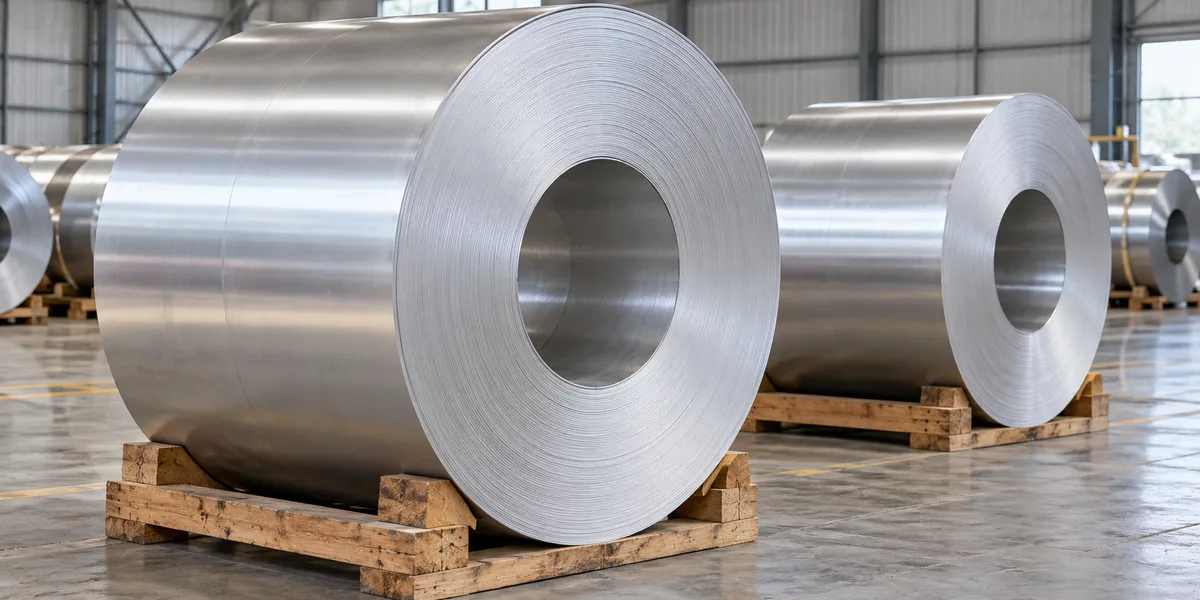
Roll-bonded to one or both sides of a 3xxx or 6xxx core, the Al-Si skin melts in the furnace and flows into the joints of fins, tubes and headers. Cladding is typically a small percentage of total thickness per side.



Сил2С (also written СИЛ2С, Sil2S or SIL2S) is a high-purity aluminium-silicon alloy with 8.5 – 9.5 % silicon, registered among the Al-Si wrought grades of GOST 4784. With its low iron and copper limits and a melting range just above the aluminium-silicon eutectic, it is a filler and cladding alloy rather than a structural one. This guide explains its chemistry, how it melts, where it fits against Western 4xxx alloys and how to order it correctly.
The name comes from the Russian word silumin, the traditional term for aluminium-silicon alloys. Сил2С and its sister grade Сил1С were added to the interstate standard GOST 4784-97 (wrought aluminium and aluminium alloys) by Amendment No. 2, in a separate table for the aluminium-silicon system alongside the forging alloy АК12Д. They have no four-digit GOST number and no ISO 209 cross-reference in that table, which is one reason buyers outside Russia and the CIS find them hard to place.
Chemically, Сил2С is very simple: aluminium with about 9 % silicon and tight limits on everything else. Iron is held to 0.20 % maximum, copper to 0.03 %, magnesium to 0.05 % and zinc to 0.08 %. That level of purity is unusual for an Al-Si alloy and points to its purpose. Silicon lowers the melting point of aluminium sharply, to a eutectic at 577 °C, so an alloy with 9 % silicon melts well below common base alloys such as 3003 or 1xxx aluminium. Keeping copper, iron and zinc low protects the corrosion behaviour and flow of the molten metal, which matters most when the alloy is used as a brazing filler or as the clad skin of brazing sheet.
The standard itself defines composition and density; it does not state an application. In practice, an alloy with this chemistry is ordered as filler metal (foil, strip, wire or preforms) or as the cladding layer bonded to a higher-melting core. It is not chosen for load-bearing parts: high silicon reduces ductility, and the alloy is not heat-treatable to any useful strength. If a drawing calls for Сил2С on a structural component, check the drawing, because the grade may have been confused with another one.
The limits below are those registered for Сил2С in the aluminium-silicon table of GOST 4784-97 (Amendment No. 2). Single values are maximums. Each Metline delivery carries a mill certificate reporting the actual analysis of the lot.
| Element | Limit (%) | Why it is controlled |
|---|---|---|
| Silicon (Si) | 8.5 – 9.5 | Lowers the melting range and gives fluidity; the defining addition |
| Iron (Fe) | ≤ 0.20 | Forms coarse Al-Fe-Si needles that reduce flow and ductility |
| Copper (Cu) | ≤ 0.03 | Kept very low so the filler does not become cathodic or corrosion-prone |
| Manganese (Mn) | ≤ 0.10 | Not needed; limited to keep the alloy pure |
| Magnesium (Mg) | ≤ 0.05 | Mg interferes with fluoride fluxes in controlled-atmosphere brazing |
| Zinc (Zn) | ≤ 0.08 | Limited so the filler does not shift the corrosion potential |
| Titanium (Ti) | ≤ 0.10 | Grain refiner |
| Calcium (Ca) | ≤ 0.10 | Controlled because it affects the silicon phase and melt behaviour |
| Others, each | ≤ 0.05 | |
| Aluminium (Al) | Remainder | About 90 – 91.5 % |
Density given by the standard: 2.67 kg/dm³. Сил1С, the companion grade, has 10.0 – 12.5 % Si, Fe ≤ 0.5 % and Mn ≤ 0.5 %, with a density of 2.66 kg/dm³.
The magnesium limit deserves attention. Fluoride fluxes used in controlled-atmosphere (nitrogen) brazing react with magnesium, which spoils wetting. Western brazing fillers for this process are likewise held to very low magnesium, whereas vacuum-brazing fillers deliberately contain magnesium as an oxygen getter. Сил2С therefore belongs with the flux-brazing family of fillers.
For a filler alloy, the melting range matters more than tensile strength. Aluminium-silicon alloys below 12.6 % silicon start to melt at the eutectic temperature of about 577 °C and are fully liquid at a temperature that falls as silicon rises. From the binary Al-Si phase diagram, an alloy with about 9 % silicon is fully molten at roughly 600 °C, so Сил2С melts over a range of a little over 20 °C.
| Property | Value | Basis |
|---|---|---|
| Density | 2.67 g/cm³ | GOST 4784 (Amendment No. 2) |
| Solidus | About 577 °C | Al-Si eutectic temperature |
| Liquidus | Roughly 600 °C | Binary Al-Si diagram at 9 % Si; check the producer datasheet |
| Typical brazing temperature | About 595 – 610 °C | Usual window for Al-Si fillers of this range |
| Heat treatment | Not heat-treatable | No Mg or Cu for precipitation strengthening |
| Supply tempers | Annealed (M) or work-hardened (N, N2) | Per the product standard and order |
These figures explain the design rule for brazing: the core or parent material must start to melt comfortably above the brazing temperature. Common cores such as 3003 (solidus around 640 °C) give a wide margin, while 6xxx cores such as 6951 leave a narrower window that needs tighter furnace control.
Tensile strength, elongation and hardness depend heavily on temper and thickness and are reported on the mill certificate for the delivered lot. We do not publish a single datasheet value for Сил2С: published figures in circulation vary widely and are not backed by the composition standard. If your drawing specifies mechanical minimums, send them with the enquiry so the material can be checked against them.
Roll-bonded to one or both sides of a 3xxx or 6xxx core, the Al-Si skin melts in the furnace and flows into the joints of fins, tubes and headers. Cladding is typically a small percentage of total thickness per side.
Thin unclad strip or foil placed between parts, or punched into shims and washers, for joints where clad sheet is not practical.
Drawn wire for torch brazing and formed rings for tube-to-fitting joints in heat exchangers and refrigeration circuits.
Maintenance of equipment originally built to GOST drawings, where the brazing procedure was qualified with this specific filler.
Radiators, condensers, evaporators, oil coolers and cold plates, where Al-Si fillers are the standard joining medium.
Trial lots for testing flow, fillet formation and corrosion before a production order is released.
The intermediate silicon content gives a practical compromise. Lower-silicon fillers (around 7 – 8 %) have a wider melting range and leave thinner fillets, while near-eutectic fillers (around 12 %) flow very freely but can erode thin cores more aggressively. A 9 % alloy sits between them, which is why grades in this range are used for clad layers on thin fin and tube stock.
No standard lists an official equivalent for Сил2С. The nearest Western alloys are the brazing-grade members of the 4xxx series. Compare silicon range and impurity limits, then decide whether the substitute is acceptable to the design authority.
| Grade | Si (%) | Fe max (%) | Cu max (%) | Typical role |
|---|---|---|---|---|
| Сил2С (GOST) | 8.5 – 9.5 | 0.20 | 0.03 | Brazing filler and clad layer |
| Сил1С (GOST) | 10.0 – 12.5 | 0.5 | 0.02 | Near-eutectic filler |
| 4343 (AA) | 6.8 – 8.2 | 0.8 | 0.25 | Clad layer on brazing sheet |
| 4045 (AA) / EN AW-4045 | 9.0 – 11.0 | 0.8 | 0.30 | Clad layer, foil, preforms |
| 4047 (AA) / EN AW-4047A | 11.0 – 13.0 | 0.8 | 0.30 | Free-flowing filler, BAlSi-4 type |
4xxx limits from the Aluminum Association registration; GOST limits from GOST 4784-97, Amendment No. 2.
Two differences stand out. First, the Сил2С silicon window overlaps the lower end of 4045 and the upper end of 4343 but matches neither exactly. Second, Сил2С is much purer: its iron and copper ceilings are a fraction of the 4xxx limits. A 4045 lot with silicon near 9 – 9.5 % and low impurities may meet the Сил2С chemistry, but that has to be shown on the certificate for each lot, not assumed from the grade name.
Availability of GOST-certified Сил2С varies by form; where it is not available, a documented 4xxx alternative can be proposed for approval.
Because the material is used as a filler, surface condition matters as much as dimensions. Heavy rolling oil, thick oxide or contamination from handling all reduce wetting in the furnace. For foil and strip, specify degreased surface, coil interleaving if needed, and sealed packing with desiccant for sea freight.
A GOST aluminium-silicon alloy with 8.5 – 9.5 % silicon and very low iron, copper, magnesium and zinc. It is used as a filler and cladding alloy for brazing aluminium, not as a structural material.
Its composition and density (2.67 kg/dm³) are given in the Al-Si table added to GOST 4784-97 by Amendment No. 2. Quote that standard and edition, or the edition named on your drawing, when ordering.
There is no official equivalent. Its silicon range falls between 4343 (6.8 – 8.2 %) and 4045 (9.0 – 11.0 %). A low-iron 4045 lot can sometimes meet the Сил2С chemistry, but the certificate must prove it and the design authority should approve the change.
It starts to melt at about 577 °C, the aluminium-silicon eutectic, and is fully liquid at roughly 600 °C. Brazing is normally carried out at about 595 – 610 °C, so the parent metal must melt well above that.
It is not a structural alloy. Its role is as filler metal or as the clad skin of brazing sheet. For welded structures choose a structural grade such as 5083 or 6061 with a suitable filler wire.
Its magnesium limit of 0.05 % suits flux brazing, including controlled-atmosphere brazing. Vacuum brazing usually relies on magnesium-bearing Al-Si fillers to break up the oxide film.
Yes. Metline supplies GOST and international aluminium grades worldwide, with mill certificates, slitting or cutting to size and moisture-protected export packing.
Send the grade, standard, form, sizes and quantity. We will confirm availability or a documented 4xxx alternative, with certification and a delivered price.





