Machining
Use sharp, polished carbide tools with high positive rake, high spindle speeds and flood coolant or mist. 6061-T651 forms short chips; O temper is gummy and should be avoided for machining.



6061 aluminium block is the default stock for machined parts that need good strength, stable machining, weldability and corrosion resistance at a reasonable price. It is cut from stretched 6061-T651 thick plate or, for very large sections, made as compression-stress-relieved T652 forged block. Metline supplies 6061 block saw-cut or milled to your sizes, certified to ASTM, AMS and EN, worldwide.
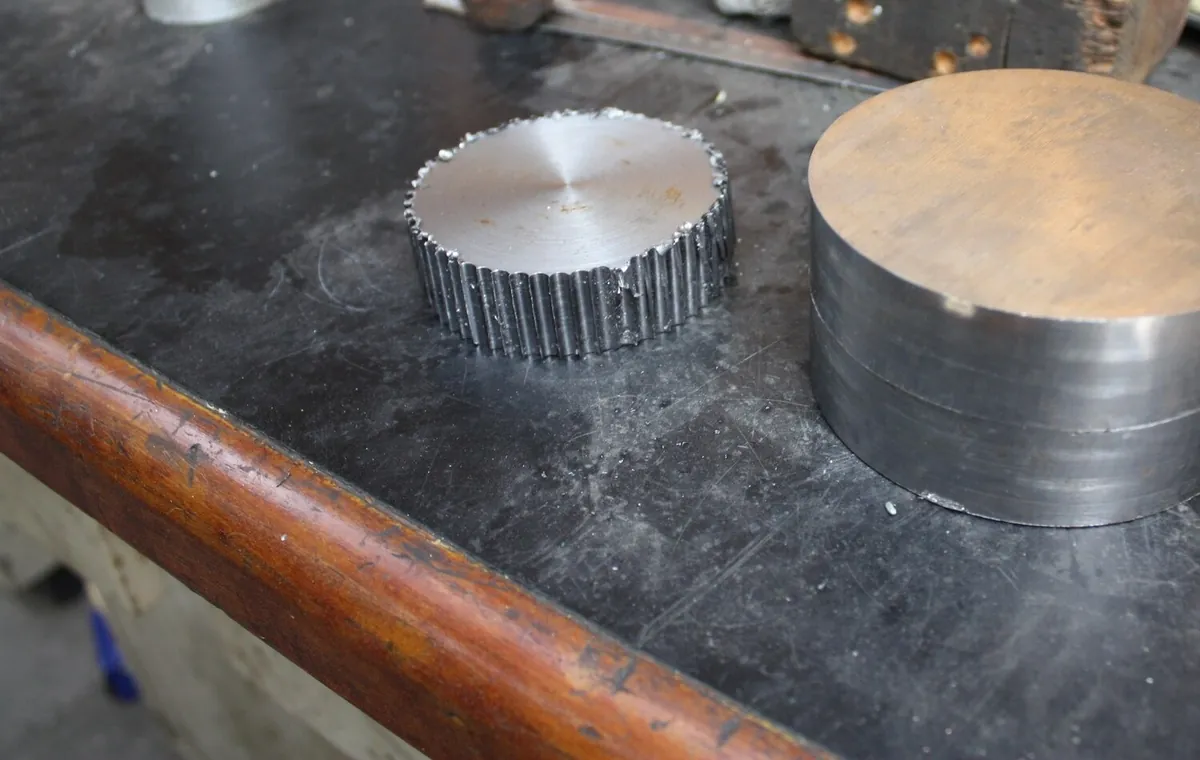
A 6061 block is a thick rectangular piece of 6061 cut from plate or forged to shape, bought as raw stock for CNC machining. Because it is the most widely produced heat-treatable aluminium alloy, 6061 block is easy to source in most sizes, machines predictably and can be welded or anodised after machining.
For blocks up to about 150 – 200 mm thick, the usual source is 6061-T651 plate. The "51" means the plate was stretched by roughly 1.5 – 3 % after quenching, which removes most of the quench stress. Without that step, a thick block would bow as material is removed from one side. Above the practical plate range, open-die forged blocks are used; they cannot be stretched, so they are compressed instead (T652) to achieve the same effect.
A third option, cast and precision-milled tooling plate, is sometimes offered as a "6061 alternative". Cast plate is flatter and more stable but weaker. Choose it for flat base plates and fixtures where strength is secondary, and choose wrought 6061-T651 when the part carries real load.
| Element | Minimum | Maximum |
|---|---|---|
| Silicon (Si) | 0.40 | 0.80 |
| Iron (Fe) | — | 0.70 |
| Copper (Cu) | 0.15 | 0.40 |
| Manganese (Mn) | — | 0.15 |
| Magnesium (Mg) | 0.80 | 1.20 |
| Chromium (Cr) | 0.04 | 0.35 |
| Zinc (Zn) | — | 0.25 |
| Titanium (Ti) | — | 0.15 |
| Others, each / total | — | 0.05 / 0.15 |
| Aluminium (Al) | Remainder |
Aluminum Association limits, identical to EN AW-6061 in EN 573-3.
Thick sections cool more slowly when quenched, so specified minimums for T651 plate decrease with thickness. Typical values are for moderate thicknesses; the certificate for each block lot gives the tested values for that plate.
| Temper / basis | Tensile strength | Yield strength (0.2 %) | Elongation | Hardness |
|---|---|---|---|---|
| T651, typical | 310 MPa / 45 ksi | 276 MPa / 40 ksi | 12 % | 95 HB |
| T651, specified minimum (moderate thickness) | 290 MPa / 42 ksi | 240 MPa / 35 ksi | ≈ 6 – 10 % | — |
| T651, very thick plate | Lower minimums by thickness band | Lower minimums | — | — |
| O (annealed) | 125 MPa / 18 ksi | 55 MPa / 8 ksi | 25 % | 30 HB |
| Type | Temper | Typical size range | Best for |
|---|---|---|---|
| Plate-cut block | T651 | Approx. 25 – 200 mm thick | Most machined parts; fastest and most economical |
| Forged block | T652 | Larger sections to drawing | Very thick or heavy parts needing wrought properties in all directions |
| Cast tooling plate | Cast, stress-relieved | Precision-milled thickness | Flat base plates, jigs, fixtures where strength is secondary |
| Extruded bar block | T6511 | Smaller sections | Small parts and long blanks |
Weight in kg = thickness × width × length (mm) × 2.70 ÷ 1,000,000.
| Block size (mm) | Weight (kg) |
|---|---|
| 50 × 100 × 200 | 2.70 |
| 50 × 300 × 300 | 12.15 |
| 75 × 200 × 400 | 16.20 |
| 100 × 200 × 300 | 16.20 |
| 100 × 300 × 500 | 40.50 |
| 150 × 300 × 600 | 72.90 |
| 200 × 400 × 600 | 129.60 |
| 250 × 500 × 1000 | 337.50 |
| 300 × 600 × 1200 | 583.20 |
Tip: if you are machining deep pockets from one face of a thick block, ask for the block to be cut with the rolling direction along the longest dimension of the part. It does not change strength much in 6061, but it does make distortion more predictable.
Use sharp, polished carbide tools with high positive rake, high spindle speeds and flood coolant or mist. 6061-T651 forms short chips; O temper is gummy and should be avoided for machining.
Rough all faces, let the part rest, then finish. Balance pockets on both sides where possible.
TIG or MIG with 4043 or 5356 filler. Expect strength loss in the heat-affected zone.
Excellent response, including hard anodising for wear surfaces and black anodising for optical parts.
Common for vacuum chambers and semiconductor parts because it machines cleanly and has low outgassing once cleaned.
Good in air and fresh water; anodise or paint for marine exposure.
| Property | 6061-T651 | 7075-T651 | 2024-T351 | 5083-H111 |
|---|---|---|---|---|
| Typical tensile strength | 310 MPa | 572 MPa | 470 MPa | 290 MPa |
| Machinability | Very good | Excellent | Very good | Fair |
| Weldability | Good | Poor | Poor | Excellent |
| Corrosion resistance | Very good | Fair | Fair | Excellent |
| Relative cost | Low | High | High | Moderate |
6061 is the right default. Move to 7075 when the part needs hardness and strength, to 2024 for fatigue, and to 5083 for marine or cryogenic service and welded structures. See also 6061 plate vs MIC-6 tooling plate.
T651 for plate-cut blocks and T652 for forged blocks. Both are stress-relieved, so the block stays stable during machining. Plain T6 thick sections can distort.
Typical values are about 310 MPa tensile and 276 MPa yield. Specified minimums fall slightly with thickness; the certificate gives the tested results.
Multiply thickness × width × length in mm by 2.70 and divide by 1,000,000. A 100 × 200 × 300 mm block weighs about 16.2 kg.
Yes, for prototype and short-run moulds. For longer runs or harder surfaces, 7075-T651 or mould steel is a better choice.
Yes. Blocks can be saw-cut with an allowance or milled on all six faces to tighter tolerances on request.
Yes. Metline supplies 6061 blocks worldwide with mill certificates and export packing.
Send the sizes, quantity, temper and finish. We will reply with availability and a delivered price.






