H321
Strain-hardened and thermally stabilised, with properties controlled so the plate passes exfoliation and intergranular corrosion tests. A standard hull-shell temper.



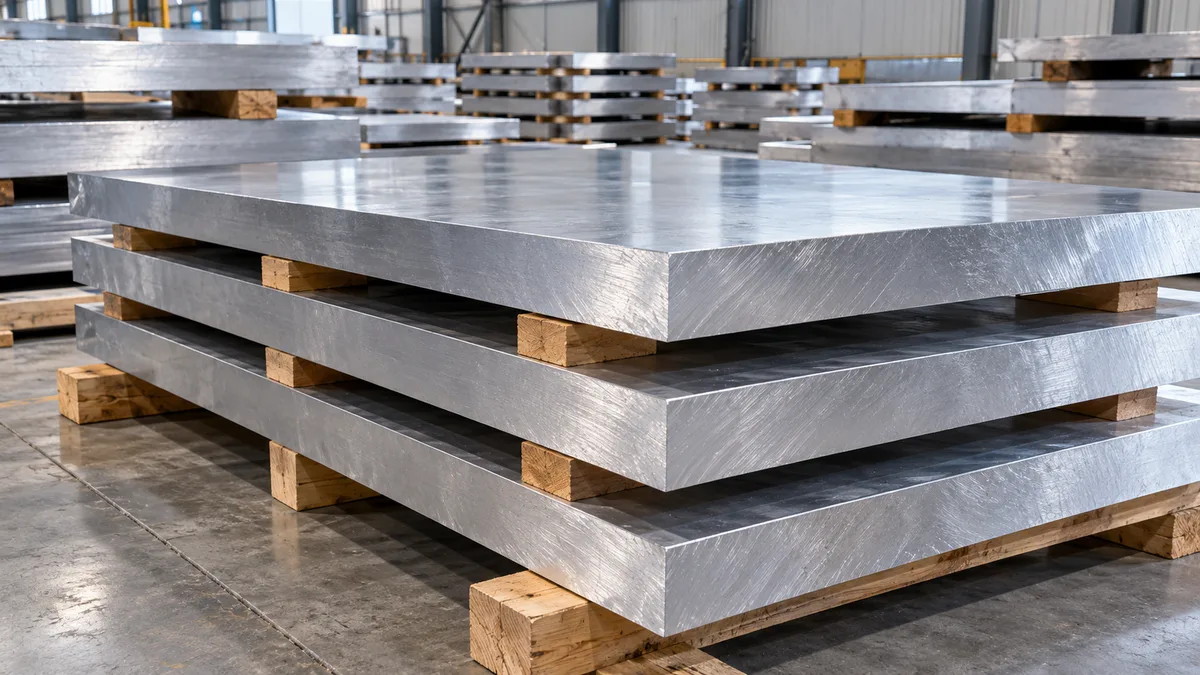
5059 is a high-magnesium marine alloy with zinc and zirconium additions that gives roughly 25 – 30 % more yield strength than 5083, both as delivered and after welding. Designers of fast ferries, patrol boats and large yachts use it to thin hull plating and save weight. Metline supplies 5059 plate in O, H111, H116 and H321, with class and corrosion-test documentation where the producing mill is approved.
5059 raises the magnesium content to 5.0 – 6.0 %, adds 0.40 – 0.90 % zinc and a zirconium addition, and keeps manganese for dispersoid strengthening. The result is the strongest of the established weldable aluminium-magnesium marine alloys.
Zirconium forms fine Al3Zr particles that resist recrystallisation and grain growth. Because they survive the heat of welding, the heat-affected zone of 5059 keeps more strength than that of 5083. Zinc helps the alloy tolerate its high magnesium content: it changes how magnesium-rich phases precipitate at grain boundaries and improves resistance to intergranular corrosion and exfoliation in the marine tempers.
In numbers, IACS UR W25 requires a minimum yield of 270 MPa for 5059-H116 or H321 plate up to 20 mm, against 215 MPa for 5083 in the same tempers. In the annealed condition, which approximates the heat-affected zone of a weld, the minimum is 160 MPa against 125 MPa. That margin lets designers reduce plate thickness in welded structure, often by one plate gauge, which adds up to a meaningful weight saving on a fast hull.
| Element (wt %) | 5059 | 5083 |
|---|---|---|
| Silicon (Si) | 0.45 | 0.40 |
| Iron (Fe) | 0.50 | 0.40 |
| Copper (Cu) | 0.25 | 0.10 |
| Manganese (Mn) | 0.6 – 1.2 | 0.40 – 1.0 |
| Magnesium (Mg) | 5.0 – 6.0 | 4.0 – 4.9 |
| Chromium (Cr) | 0.25 | 0.05 – 0.25 |
| Zinc (Zn) | 0.40 – 0.90 | 0.25 |
| Titanium (Ti) | 0.20 | 0.15 |
| Zirconium (Zr) | 0.05 – 0.25 | — |
| Others, each / total | 0.05 / 0.15 | 0.05 / 0.15 |
| Aluminium (Al) | Remainder | Remainder |
Single figures are maximums. Zirconium (5059: 0.05 – 0.25 %) is not counted in the "others" total. Limits as listed in IACS UR W25 Table 1.
The table gives the IACS UR W25 minimums for 5059 rolled products alongside 5083 for comparison. ASTM B928 and the individual class rules use the same or equivalent limits; check the order standard for thickness bands above 50 mm.
| Alloy | Temper | Thickness | Yield Rp0.2 min (MPa) | Tensile Rm (MPa) | Elongation A50 / A5 min (%) |
|---|---|---|---|---|---|
| 5083 | O / H111 | 3 – 50 mm | 125 | 275 – 350 | 16 / 14 |
| 5083 | H112 | 3 – 50 mm | 125 | 275 | 12 / 10 |
| 5083 | H116 | 3 – 50 mm | 215 | 305 | 10 / 10 |
| 5083 | H321 | 3 – 50 mm | 215 – 295 | 305 – 385 | 12 / 10 |
| 5059 | O / H111 | 3 – 50 mm | 160 | 330 | 24 / 24 |
| 5059 | H116 / H321 | 3 – 20 mm | 270 | 370 | 10 / 10 |
| 5059 | H116 / H321 | > 20 – 50 mm | 260 | 360 | — / 10 |
Source: IACS UR W25 Rev.4 Table 2, 3 mm ≤ t ≤ 50 mm. A50 elongation applies up to 12.5 mm and A5 above.
Strain-hardened and thermally stabilised, with properties controlled so the plate passes exfoliation and intergranular corrosion tests. A standard hull-shell temper.
Strain-hardened to meet the same strength and corrosion requirements through controlled rolling. Certified separately from H321.
Annealed and lightly strain-hardened. Used for parts that need forming or where welded properties govern anyway.
Fully annealed for the most severe forming. Same minimum values as H111 in UR W25 but a distinct process route.
Because 5059 contains more than 5 % magnesium, its marine tempers must prove resistance to exfoliation and intergranular attack. Under IACS UR W25, H116 and H321 plate is accepted by comparison with an approved reference micrograph or by testing each batch: no exfoliation and pitting rating PB or better in ASTM G66 (ASSET), and mass loss no greater than 15 mg/cm² in ASTM G67 (NAMLT).
Testing at the mill does not protect against what happens in service. Like 5083, 5059 should not be used for structure that stays above about 65 °C for long periods, such as exhaust trunks, engine-room uptakes or hot-water tanks, because the beta phase can still form over time. Design those areas with 5454 or with insulation.
| Thickness (mm) | kg per m² | 2000 × 6000 mm plate (kg) | 2500 × 8000 mm plate (kg) |
|---|---|---|---|
| 3 | 7.95 | 95 | 159 |
| 4 | 10.60 | 127 | 212 |
| 5 | 13.25 | 159 | 265 |
| 6 | 15.90 | 191 | 318 |
| 8 | 21.20 | 254 | 424 |
| 10 | 26.50 | 318 | 530 |
| 12 | 31.80 | 382 | 636 |
| 15 | 39.75 | 477 | 795 |
| 20 | 53.00 | 636 | 1060 |
| 25 | 66.25 | 795 | 1325 |
| 30 | 79.50 | 954 | 1590 |
| 40 | 106.00 | 1272 | 2120 |
| 50 | 132.50 | 1590 | 2650 |
Class rules set minimum underthickness tolerances for rolled marine plate. These are the UR W25 limits; tighter values can be agreed.
| Nominal thickness | Width ≤ 1500 mm | 1500 – 2000 mm | 2000 – 3500 mm |
|---|---|---|---|
| 3 – 4 mm | 0.10 mm | 0.15 mm | 0.15 mm |
| 4 – 8 mm | 0.20 mm | 0.20 mm | 0.25 mm |
| 8 – 12 mm | 0.25 mm | 0.25 mm | 0.25 mm |
| 12 – 20 mm | 0.35 mm | 0.40 mm | 0.50 mm |
| 20 – 50 mm | 0.45 mm | 0.50 mm | 0.65 mm |
ER5183 is the usual filler; zirconium-bearing fillers such as 5087 are also used to keep grain refinement in the weld. Do not use 4xxx fillers on 5059.
Class rules give separate design values for welded 5059. The heat-affected zone sits near the O-temper level, so the weld detail, not the parent plate, often governs.
Welding procedures and welders must be qualified for 5059; a procedure qualified on 5083 is not automatically valid.
Higher strength means more springback and larger bend radii than 5083. Form in H111 or O where shapes are severe.
Plasma, waterjet and saw cutting are normal. Remove the thermally affected edge of plasma cuts that will be welded or highly stressed.
Isolate from steel and copper alloys; use aluminium-compatible antifouling and anodes below the waterline.
| Property (UR W25 minimums) | 5083 | 5383 | 5059 |
|---|---|---|---|
| Yield, H116 / H321 (≤ 20 mm) | 215 MPa | 220 MPa | 270 MPa |
| Tensile, H116 / H321 (≤ 20 mm) | 305 MPa | 305 MPa | 370 MPa |
| Yield, O / H111 (welded approximation) | 125 MPa | 145 MPa | 160 MPa |
| Extruded H112 yield | 110 MPa | 190 MPa | 200 MPa |
| Relative cost and availability | Lowest, widely stocked | Moderate | Highest, made to order |
5083 remains the right answer for most hulls: it is cheaper, easier to obtain and familiar to every yard. 5383 offers a modest welded-strength gain at moderate cost. 5059 is worth its premium when the designer actually reduces scantlings to use the extra strength.
Yes. In the H116 and H321 tempers 5059 has a minimum yield of 270 MPa up to 20 mm, against 215 MPa for 5083, and its annealed (welded) yield is 160 MPa against 125 MPa.
Yes, with the same MIG and TIG processes, usually with ER5183 or a zirconium-bearing filler. Welding procedures must be qualified on 5059 itself.
Yes. 5059 is listed in IACS UR W25 for rolled and extruded hull material, and approvals are held by the producing mills for specific tempers and thicknesses.
It contains more alloying elements, is produced by fewer mills and is usually rolled to order. The cost is justified when the design takes advantage of the higher strength.
About 2.65 g/cm³, so a plate weighs roughly 2.65 kg per m² per millimetre of thickness.
Not for sustained service above about 65 °C, because high-magnesium alloys can become sensitised. Use 5454 or protect the structure thermally.
Send the thickness range, temper, plate sizes and classification requirement. We will reply with availability and documentation.





