Over-tight raw tolerances
Specifying machined-part tolerances on as-extruded pipe drives cost up or rules out suppliers. Order machining allowance instead.



Large diameter aluminium pipe from about 500 to 1000 mm outside diameter is made by three routes: heavy extrusion for sizes up to roughly 800 mm, forging and boring for thick-walled seamless cylinders, and roll-forming plate with longitudinal or spiral welds for thin walls and the biggest diameters. The route decides which alloys, wall thicknesses, lengths and tolerances are possible. Metline sources all three to drawing and ships them worldwide with full certification.
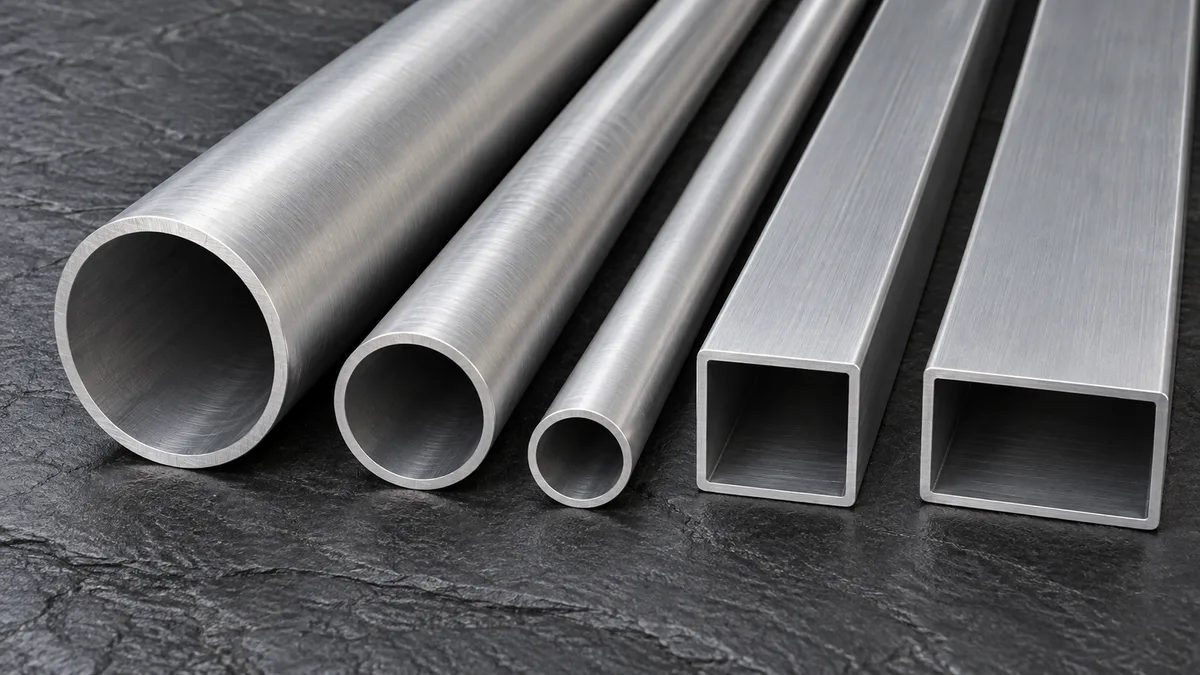
Small aluminium tubes are commodity items. Above about 300 mm diameter, the number of presses, forging lines and rolling mills able to make a sound, round, straight pipe falls sharply, and above 500 mm it becomes a project-by-project purchase. Getting it right starts with knowing which manufacturing route suits your diameter, wall and alloy.
Aluminium is chosen for big pipes for the same reasons as for small ones: one third the density of steel, no rust, good toughness at cryogenic temperatures, non-magnetic behaviour and high thermal and electrical conductivity. These properties make large aluminium cylinders valuable in cryogenic and LNG process lines, gas-insulated switchgear and transmission-line enclosures, vacuum chambers and particle-beam vessels, large rollers for film, paper and printing machines, offshore structures, marine ducting and aerospace tank and ring sections.
| Route | Typical diameter | Typical wall | Alloys | Best for |
|---|---|---|---|---|
| Seamless extrusion (mandrel or porthole on heavy presses) | up to about 600 – 800 mm | about 10 – 60 mm | 6061, 6063, 6082, 5083, 2024, 7075 | Long lengths with uniform properties; pressure and structural pipe |
| Forged and bored hollow / ring-rolled cylinder | up to about 1000 mm and beyond | about 30 – 150 mm | 6061, 2014, 2219, 5083, 7075 | Thick-walled, highly stressed or machined cylinders; short lengths |
| Roll-formed plate with longitudinal weld | 500 mm to several metres | about 3 – 40 mm | 5083, 5086, 5052, 6061, 3003 | Process piping, ducting, tanks, cryogenic lines |
| Spiral-welded from coil | 300 mm to over 2000 mm | about 2 – 10 mm | 3003, 5052, 1xxx | Ventilation, low-pressure ducts, culverts |
Lengths depend on the route too. Extruded pipe is commonly supplied up to about 6 m and sometimes longer; forged cylinders are usually limited to 1 – 3 m per piece; welded pipe can be made in long lengths and joined on site. If your design needs a seamless part, say so clearly, because welded pipe is cheaper and is often offered by default at large diameters.
Tight tolerances on a 1000 mm part are achieved by machining, not by the primary process. As-extruded and as-forged dimensions follow the tolerance tables of the order standard; for precision bores and outside diameters, order the pipe with machining allowance and specify finished dimensions on the drawing.
| Alloy and temper | Tensile min (MPa) | Yield min (MPa) | Character | Typical large-pipe uses |
|---|---|---|---|---|
| 5083-O / H112 | 270 | 110 – 125 | Excellent seawater and cryogenic performance, welds without strength loss | LNG and cryogenic lines, marine and offshore ducts |
| 5052-O / H112 | 170 | 65 | Good corrosion resistance, very formable | Chemical vessels, welded ducting |
| 6061-T6 | 260 | 240 | Best all-round heat-treatable grade, machinable, weldable | Structural cylinders, rollers, vacuum chambers, switchgear enclosures |
| 6063-T6 | 205 | 170 | Excellent extrudability and finish, lower strength | Architectural columns, lighter structural pipe |
| 2024-T3 / T351 | about 400 – 430 | about 270 – 290 | High strength and fatigue resistance, poor weldability | Aerospace structures, high-load bushings |
| 7075-T6 / T73 | about 470 – 540 | about 390 – 470 | Highest strength, needs corrosion protection | Aerospace and defence cylinders, high-stress rollers |
Values are indicative minimums for extruded or forged products from ASTM B221, B241 and B247 and depend on temper and wall thickness; very heavy walls can have lower guaranteed values. The certificate for each lot states actual results.
Chemistry follows the Aluminum Association limits, for example 5083 with 4.0 – 4.9 % Mg and 0.40 – 1.0 % Mn, 6061 with 0.8 – 1.2 % Mg and 0.40 – 0.8 % Si, and 7075 with 5.1 – 6.1 % Zn, 2.1 – 2.9 % Mg and 1.2 – 2.0 % Cu.
Weight per metre = π × (OD − wall) × wall × density. The table uses 2.70 g/cm³ (6061); multiply by 0.985 for 5083 or by 1.04 for 7075. Use the tube weight calculator for other sizes.
| Outside diameter | Wall 20 mm (kg/m) | Wall 30 mm (kg/m) | Wall 50 mm (kg/m) | Wall 80 mm (kg/m) | Wall 100 mm (kg/m) |
|---|---|---|---|---|---|
| 500 mm | 81 | 120 | 191 | 285 | 339 |
| 600 mm | 98 | 145 | 233 | 353 | 424 |
| 700 mm | 115 | 170 | 276 | 421 | 509 |
| 800 mm | 132 | 196 | 318 | 489 | 594 |
| 1000 mm | 166 | 247 | 403 | 624 | 763 |
A single 6 m length of 800 mm × 50 mm 6061 pipe weighs about 1.9 tonnes, so lifting points, packing and container loading need planning from the start.
| Standard | Scope |
|---|---|
| ASTM B241 / ASME SB-241 | Seamless aluminium pipe and seamless extruded tube |
| ASTM B221 | Extruded bars, rods, wire, profiles and tubes |
| ASTM B247 | Die forgings, hand forgings and rolled ring forgings |
| ASTM B547 | Formed and arc-welded round tube from sheet and plate |
| EN 755-1/-2/-8 | Extruded tube: delivery conditions, properties, tolerances |
| ASME B31.3 | Process piping design, including aluminium pipe |
| ASME B36.10M | Nominal pipe sizes and schedules used for pipe dimensions |
In nominal pipe sizes, the range on this page corresponds roughly to NPS 20 (508 mm OD), NPS 24 (610 mm), NPS 30 (762 mm), NPS 36 (914 mm) and NPS 40 (1016 mm). Schedule pipe in these sizes has walls of about 6 – 40 mm, so very thick walls are normally specified by OD and wall directly.
Specifying machined-part tolerances on as-extruded pipe drives cost up or rules out suppliers. Order machining allowance instead.
Welded 6061 loses strength next to the weld. For welded pipe in structural duty, consider 5083 or design for reduced allowable stress.
H112 and O tempers give very different yields in 5083; state the temper and the standard.
Pressure codes may call for seamless pipe. State it explicitly at enquiry stage.
Over-dimension pieces may need flat racks or break-bulk shipping. Share the destination early.
Agree NDT, hydrotest and witness points before production, not after.
Seamless extruded pipe generally reaches about 600 – 800 mm OD on the heaviest presses. Beyond that, seamless cylinders are forged and bored or ring-rolled, which can exceed 1000 mm in shorter lengths.
5083 is the usual choice. It keeps or gains strength and toughness at cryogenic temperatures and welds without losing strength, which suits long welded lines.
With a 50 mm wall in 6061, about 318 kg per metre, so a 6 m length is close to 1.9 tonnes. A 20 mm wall brings it down to about 132 kg per metre.
Yes. Order the pipe with machining allowance on OD and bore, and state finished dimensions on the drawing. Precision is achieved by turning and boring, not as extruded.
Seamless is preferred for high pressure, fatigue or uniform-property applications. Roll-formed welded pipe is economical for ducts, low-pressure process lines and very large diameters, provided the welds are inspected.
Alloy, temper, OD, wall or ID, length, quantity, governing standard, any pressure rating and the inspection plan, ideally with a drawing.
Send the drawing, alloy, temper, sizes and quantity. We confirm the feasible route, certification and delivered price.





