Compressive strength
Measured flatwise (in the T direction) to ASTM C365, either bare or "stabilised" with skins bonded on. Stabilised values are higher and are the ones used for panel design.



Aluminium honeycomb core is a lightweight cellular material made from thin aluminium foil bonded into hexagonal cells. Bonded between two skins it forms a sandwich panel that is very stiff for its weight. Metline supplies 3003, 5052 and 5056 honeycomb in standard cell sizes and densities, as expanded slices, unexpanded HOBE blocks or finished panels, to customers worldwide.
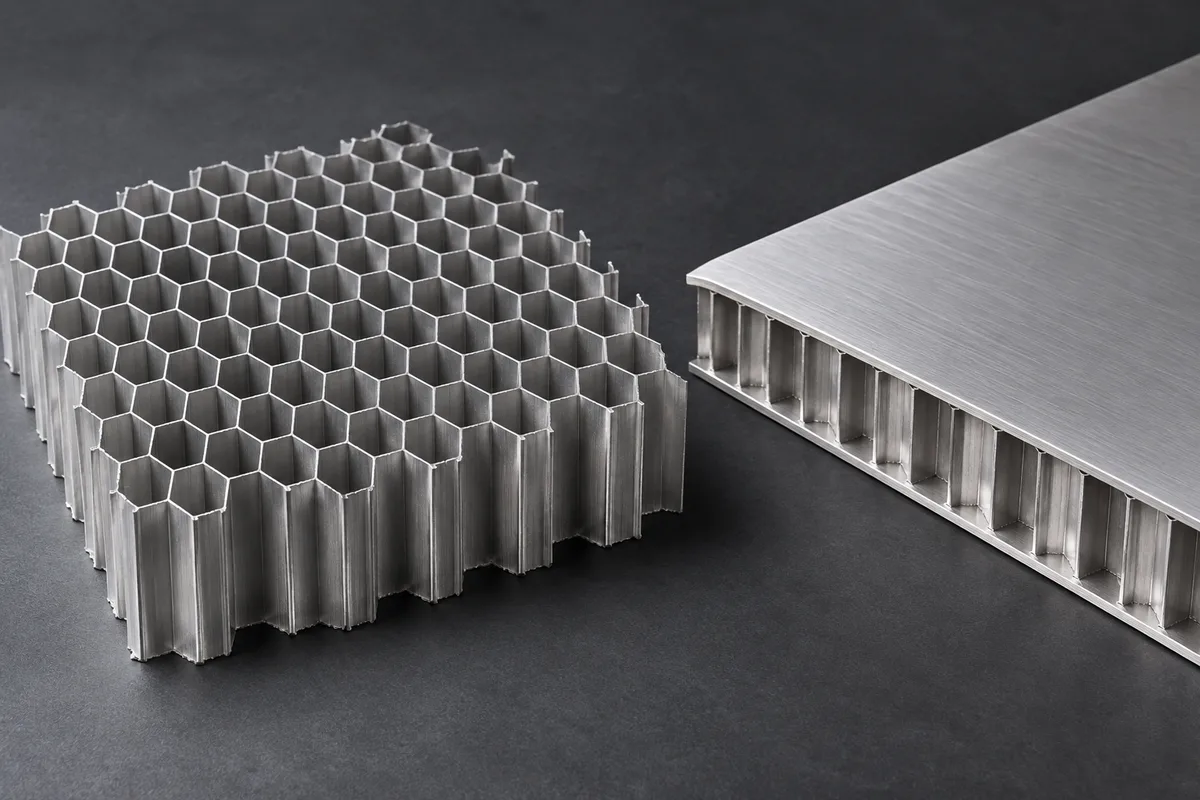
A honeycomb sandwich works like an I-beam: two thin, strong skins carry the bending loads and the core holds them apart and carries shear between them. Doubling the core thickness makes a panel several times stiffer while adding only a little weight, which is why honeycomb panels are used for aircraft floors, train interiors, building facades, clean-room walls and machine guards.
Most aluminium honeycomb is made by the expansion process. Lines of adhesive are printed on aluminium foil, the sheets are stacked with the lines offset, and the stack is cured under heat and pressure into a solid block called HOBE (honeycomb before expansion). Slices are cut from the block and pulled open to form the hexagonal cells. Very high-density cores and cores for high-temperature use are made instead by corrugating the foil and bonding or brazing the corrugated sheets together.
Honeycomb is anisotropic. The L direction (ribbon direction) runs parallel to the continuous foil ribbons and the double-thickness bonded walls; the W direction is perpendicular to the ribbons, the direction in which the core was expanded; the T direction is the cell depth, i.e. the core thickness. Shear strength and stiffness are higher in L than in W, so the ribbon direction must be shown on the panel drawing.
Aluminium core is described by four numbers, in a form widely used in North American specifications, for example 3/16-5052-.001 (3.1):
| Part of designation | Example | Meaning |
|---|---|---|
| Cell size | 3/16 | Diameter of a circle inscribed in the hexagon, in inches (3/16 in ≈ 4.8 mm) |
| Alloy | 5052 | Foil alloy: 3003, 5052 or 5056 |
| Foil gauge | .001 | Foil thickness in inches (0.001 in ≈ 25 µm) |
| Density | (3.1) | Nominal core density in lb/ft³ (3.1 pcf ≈ 50 kg/m³) |
Cell size and foil gauge together fix the density: smaller cells or thicker foil give a denser, stronger core. Metric buyers often specify cell size in millimetres (for example 6 mm cell, 0.06 mm foil), and the supplier converts to the equivalent designation. Specify the slice thickness (T), the L × W size of the sheet, and whether the core is perforated for venting or has a corrosion-resistant coating.
| Typical core | Cell size | Foil | Density (pcf) | Density (kg/m³) |
|---|---|---|---|---|
| 1/4-5052-.001 | 6.4 mm | 25 µm | 2.3 | ≈ 37 |
| 3/16-5052-.001 | 4.8 mm | 25 µm | 3.1 | ≈ 50 |
| 1/8-5052-.0007 | 3.2 mm | 18 µm | 3.1 | ≈ 50 |
| 1/8-5052-.001 | 3.2 mm | 25 µm | 4.5 | ≈ 72 |
| 3/16-5052-.002 | 4.8 mm | 51 µm | 5.7 | ≈ 91 |
| 1/8-5052-.002 | 3.2 mm | 51 µm | 8.1 | ≈ 130 |
| 3/8-5052-.003 | 9.5 mm | 76 µm | 4.2 | ≈ 67 |
Density combinations follow common catalogue values; densities are nominal with a manufacturing tolerance (often ±10 %). Confirm the exact grade and its typical properties from the core data sheet for your order.
| Alloy | Strength | Corrosion resistance | Typical use |
|---|---|---|---|
| 3003 | Lowest of the three | Good | Commercial panels, facades, doors, partitions, airflow straighteners |
| 5052 | Medium; the standard aerospace and industrial grade | Very good | Aircraft floors and interiors, rail and marine panels, clean rooms |
| 5056 | Highest; stronger than 5052 at equal density | Very good | Weight-critical aerospace structures, energy absorbers |
For aerospace programmes, 5052 and 5056 cores are usually ordered with a corrosion-resistant treatment of the foil and to AMS-C-7438 (formerly MIL-C-7438). For architecture and transport, 3003 or 5052 is normally chosen with a lower density, since the facing skins rather than the core usually govern the design. Our article on 3003 vs 5052 honeycomb covers the trade-offs in detail.
Core properties are measured on the core itself, with standardised specimens, and are always tied to a density. The main values on a core data sheet are:
Measured flatwise (in the T direction) to ASTM C365, either bare or "stabilised" with skins bonded on. Stabilised values are higher and are the ones used for panel design.
Measured in the L and W directions to ASTM C273. L-direction values are typically about one and a half to two times the W-direction values.
The plateau stress after initial buckling, used to design energy absorbers that crush at a near-constant force.
Tested on a bonded sandwich to ASTM C297; mainly checks the adhesive bond between skin and core.
Measured to ASTM C271; all strength values scale steeply with density.
A sandwich panel must be tested as built (skins, adhesive and core together), for example in flexure to ASTM C393.
Core properties do not prove panel performance. The facing skins, adhesive, edge closures and inserts all fail in their own ways: face wrinkling, core shear, core crushing at supports, and skin-to-core disbonding. Each needs checking for the actual panel design and loads.
Exact sizes and tolerances are confirmed with each order.
It is a honeycomb core with a 3/16 in (about 4.8 mm) cell size, made of 5052 foil 0.001 in (about 25 µm) thick. Its nominal density, often added in brackets, is 3.1 lb/ft³ (about 50 kg/m³).
5052 is stronger and is the standard for aerospace and demanding industrial panels. 3003 costs less and is adequate for facades, partitions and airflow straighteners where the core is lightly loaded.
Multiply the core volume by its nominal density, not by the density of solid aluminium. A 1 m² slice 20 mm thick at 50 kg/m³ weighs about 1 kg. Add the skins and adhesive for a panel weight.
L (ribbon) runs along the continuous foil ribbons; W is the expansion direction at right angles to it. The core is stiffer and stronger in shear in the L direction, so it should be aligned with the main span of the panel.
Standard hexagonal core bends easily in one direction but forms a saddle shape when bent. For compound curves, use over-expanded or flexible cell configurations, or machine the core to contour.
Yes. Besides bare core, we supply aluminium-skinned sandwich panels bonded to size, with edge closures and inserts on request.
Send the cell size, alloy, foil, thickness and sheet size. We will confirm the grade and quote a delivered price.





