O (annealed)
Softest condition for severe cold heading. The fastener maker solution-treats and ages the finished parts.



2024 aluminium wire is a high-strength copper alloy wire used mainly to make solid rivets, cold-headed bolts and screws, pins and small machined parts for aircraft and engineering. In the T4 temper it reaches a typical shear strength of about 283 MPa, far above general-purpose aluminium wire. Metline supplies 2024 wire and rod in coils and straight lengths, drawn to size and certified, to customers worldwide.
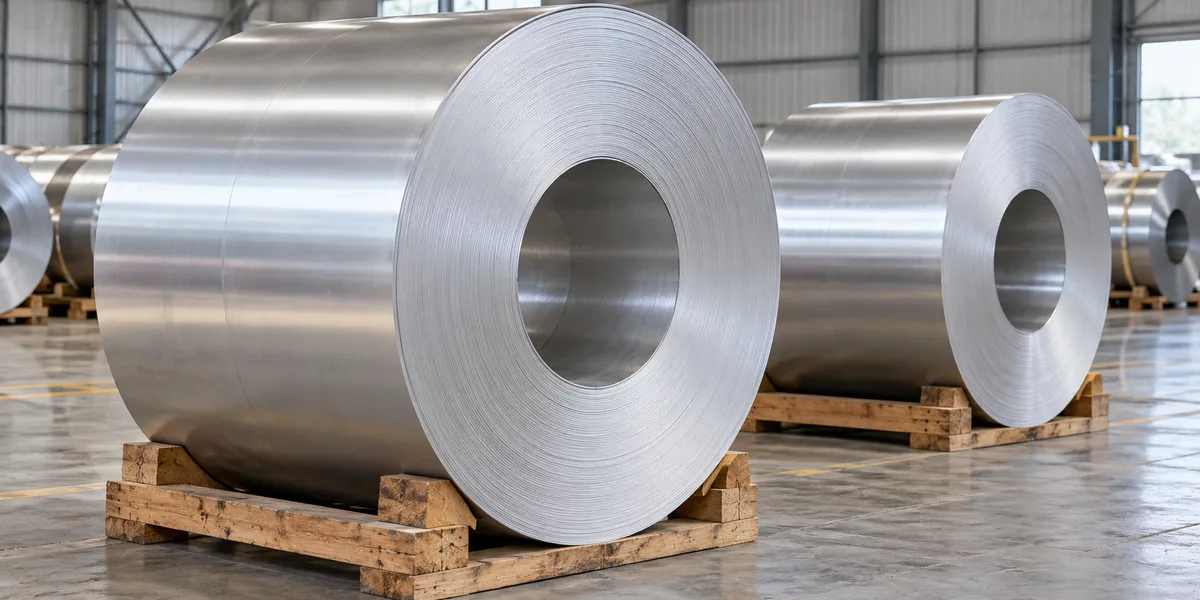
2024 is a heat-treatable aluminium-copper-magnesium alloy, one of the original high-strength aircraft alloys. As wire, it is drawn from extruded or rolled rod and supplied for cold heading, mainly into rivets and fasteners.
In aerospace, solid rivets made from 2024 are known as "DD" rivets. They are driven in the freshly solution-treated condition because 2024 age-hardens quickly at room temperature: once quenched, the rivets must be driven within a short time or kept refrigerated to delay ageing, which is why they are often called "ice-box" rivets. After driving they age naturally at room temperature and reach their full shear strength.
Outside aircraft, 2024 wire is cold-headed into high-strength bolts, screws and pins, and machined into small turned parts on automatic lathes. It is chosen when 5xxx or 6xxx wire is not strong enough and steel would be too heavy or cause galvanic problems in an aluminium assembly. Its main limitation is corrosion resistance: the copper content means parts are usually anodised, chromate-converted or primed.
| Element | Min | Max | Role |
|---|---|---|---|
| Silicon (Si) | — | 0.50 | Impurity |
| Iron (Fe) | — | 0.50 | Impurity |
| Copper (Cu) | 3.8 | 4.9 | Main strengthening element |
| Manganese (Mn) | 0.30 | 0.9 | Grain control and strength |
| Magnesium (Mg) | 1.2 | 1.8 | Accelerates natural ageing; adds strength |
| Chromium (Cr) | — | 0.10 | |
| Zinc (Zn) | — | 0.25 | |
| Titanium (Ti) | — | 0.15 | |
| Others each / total | — | 0.05 / 0.15 | |
| Aluminium | Remainder |
Aluminum Association limits, matching EN AW-2024 (AlCu4Mg1) in EN 573-3.
Wire for cold heading is often bought in the O or H13 condition and heat-treated by the fastener maker; the T4 values describe the finished rivet or fastener. Values are typical; specification minimums vary with diameter and are confirmed on the certificate.
| Temper | Tensile strength | Yield strength | Elongation | Shear strength |
|---|---|---|---|---|
| O, typical | 186 MPa / 27 ksi | 76 MPa / 11 ksi | 20 % | 124 MPa / 18 ksi |
| T4 / T42, typical | 469 MPa / 68 ksi | 324 MPa / 47 ksi | 19 – 20 % | 283 MPa / 41 ksi |
| H13 | Lightly cold-worked condition for cold-heading stock; properties per specification | — | — | — |
Softest condition for severe cold heading. The fastener maker solution-treats and ages the finished parts.
Lightly drawn condition used as rivet and cold-heading stock, giving better straightness and feeding than O.
Solution treated and naturally aged. T4 is heat-treated by the mill; T42 is heat-treated from O or F by the user.
Rivets driven freshly quenched and then naturally aged reach full T4-level shear strength in service.
| System | Designation / standard | Covers |
|---|---|---|
| ASTM | B211 / B211M | Rolled or cold-finished bar, rod and wire |
| ASTM | B316 / B316M | Rivet and cold-heading wire and rod |
| Aerospace | AMS-QQ-A-430 | Aluminium alloy rod and wire for rivets and cold heading |
| Rivets | NASM20470 / MS20470 (DD), NAS series | Finished rivet standards that call for 2024 |
| UNS | A92024 | |
| Europe | EN AW-2024 (AlCu4Mg1), 3.1355 | EN 573-3 chemistry; EN 754-2 drawn rod |
| Japan | A2024W | JIS H4040 (rod, bar and wire) |
Weight of round 2024 wire in kg per 1000 m = 0.785 × d² × 2.78, with d in mm.
| Diameter (mm) | kg per 1000 m | Metres per kg |
|---|---|---|
| 1 | 2.18 | 458.0 |
| 1.6 | 5.59 | 178.9 |
| 2 | 8.73 | 114.5 |
| 2.5 | 13.65 | 73.3 |
| 3 | 19.65 | 50.9 |
| 3.2 | 22.36 | 44.7 |
| 4 | 34.93 | 28.6 |
| 4.8 | 50.31 | 19.9 |
| 5 | 54.59 | 18.3 |
| 6 | 78.60 | 12.7 |
| 6.35 | 88.04 | 11.4 |
| 8 | 139.74 | 7.2 |
| 10 | 218.34 | 4.6 |
| 12 | 314.41 | 3.2 |
Rivet and cold-heading wire must be free of seams, laps and surface defects that would split during heading. Typical testing includes diameter and ovality checks along the coil, tensile tests, and for rivet wire, a heading or upset test and a driven-rivet shear test on samples after heat treatment.
| Alloy | Rivet code | Typical shear strength | Heat treat before driving? | Typical use |
|---|---|---|---|---|
| 2117-T4 | AD | about 195 MPa | No | General aircraft riveting |
| 2017-T4 | D | about 260 MPa | Yes (or ice-box) | Higher-strength joints |
| 2024-T4 | DD | about 283 MPa | Yes (ice-box) | Highest-strength solid rivets |
| 5056-H32 | B | about 180 MPa | No | Joining magnesium and corrosion-sensitive parts |
2024 gives the strongest solid aluminium rivets, at the cost of extra handling. Where the joint load allows, 2117 is far easier to use.
Mainly for high-strength solid rivets (DD rivets) and cold-headed fasteners such as bolts, screws and pins, plus small turned parts.
After solution heat treatment, 2024 hardens at room temperature within a short time. Keeping rivets refrigerated delays this ageing so they stay soft enough to drive.
Typical shear strength is about 283 MPa (41 ksi), the highest of the common aluminium rivet alloys.
Only moderately. The copper content lowers resistance, so 2024 fasteners are normally anodised, conversion coated or wet-installed with sealant.
In coils, spools or straight lengths, in O, H13 or T4 temper, drawn to diameter and certified to ASTM, AMS or EN specifications.
Send diameter, temper, specification, quantity and destination, and we will reply with availability and a delivered price.





