Forged round bar
The most common form; for shafts, axles, piston blanks, rollers and rotating parts. Supplied black (as forged), rough turned or peeled.



Forged aluminium bar is made by working a cast ingot between open dies until the whole cross-section is wrought, giving sound metal and even properties in sizes larger than extruded or rolled bar can reach. It is the usual starting stock for heavy shafts, aircraft fittings, landing-gear parts and large machined components. Metline supplies forged bar in 6061, 7075, 7050, 2024, 2014, 2219 and other alloys, heat treated and certified to AMS, ASTM or EN, to customers worldwide.
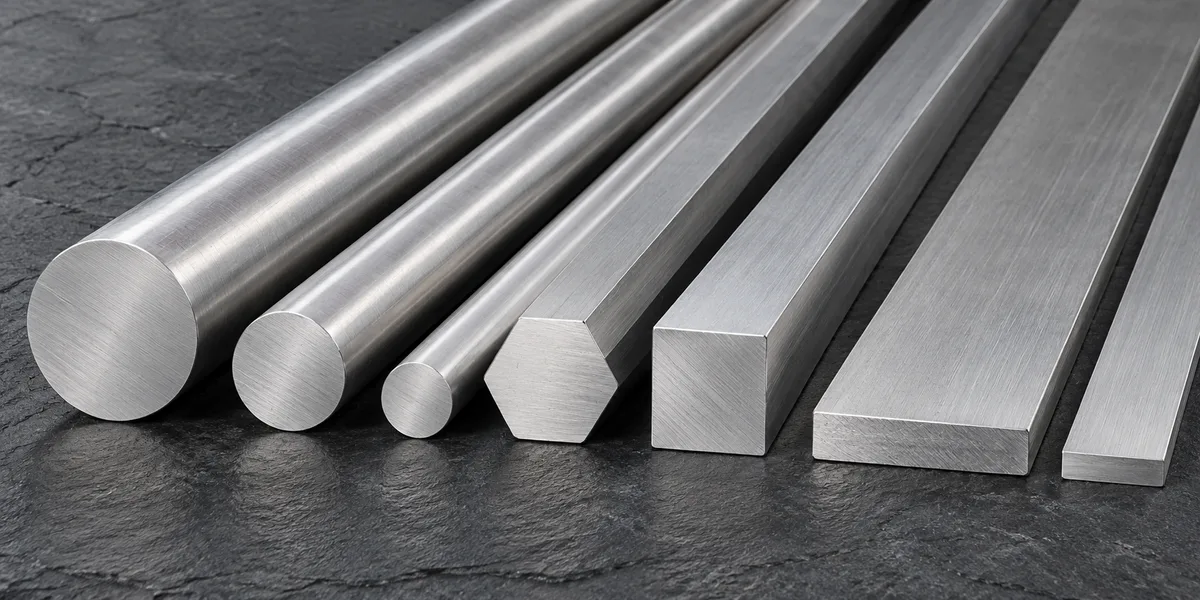
Forged bar is a hand (open-die) forging in a simple bar shape. A homogenised ingot is heated and repeatedly pressed, rotated and drawn out between flat or V-shaped dies until it reaches the required section. The process is sometimes called cogging.
Why not simply buy extruded or rolled bar? For small and medium diameters, extruded rod is cheaper and perfectly adequate. Forged bar earns its place in three situations: when the diameter is beyond the practical range of extrusion presses (large rod is commonly limited to roughly 300 – 400 mm); when the specification calls for a forging and its specific test directions; and when the part needs good properties through the whole section, not only along the length. Forging works the centre of the ingot as well as the surface, closing porosity and breaking up the cast structure where extrusion of very large sections can leave it under-worked.
Forged bar also avoids a problem common in extruded 2xxx, 7xxx and 6082 rod: a coarse recrystallised grain ring near the surface, which can lower fatigue strength and spoil the appearance of anodised parts. A properly forged and heat-treated bar has a more uniform grain structure from surface to core.
The most common form; for shafts, axles, piston blanks, rollers and rotating parts. Supplied black (as forged), rough turned or peeled.
For tooling bases, fixtures and blocks that will be milled on all faces.
For long fittings, rails, spars and machine members where width and thickness both matter.
Shafts and blanks forged with different diameters along the length to reduce machining and keep grain flow continuous.
Heavy sections for hubs, rollers and structural parts where the whole section carries load.
Bar sawn into blanks or discs to the customer's finished-part envelope.
| Alloy | Common tempers | Character | Typical forged-bar parts |
|---|---|---|---|
| 6061 | T6, T652 | Medium strength, very good corrosion resistance, weldable | Shafts, frames, vacuum and semiconductor parts, general CNC parts |
| 6082 | T6 | Slightly stronger than 6061, European standard choice | Machinery shafts, rail and crane components |
| 7075 | T6, T652, T73, T7352 | Very high strength; T73 tempers resist stress corrosion | Aircraft fittings, defence parts, high-load tooling |
| 7050 | T74, T7452 | High strength in thick sections, low quench sensitivity, good SCC resistance | Thick aircraft fittings, landing-gear and bulkhead parts |
| 2024 | T4, T6, T852 | High strength and fatigue resistance | Aircraft fittings, fatigue-loaded shafts |
| 2014 | T6, T652 | High strength, good forgeability, economical | Heavy brackets, truck and aircraft components |
| 2219 | T6, T852 | Keeps strength at elevated and cryogenic temperatures; weldable | Rocket and cryogenic tank parts, hot-running components |
| 4032 | T6 | High silicon, low thermal expansion, wear resistant | Forged pistons and compressor parts |
| 5083 | O, H112 | Excellent seawater and cryogenic performance, weldable | Marine shafts, cryogenic and pressure parts |
The 7xxx choice deserves care. 7075-T6 is the strongest but is prone to stress-corrosion cracking when loaded across the grain; for structural parts, T73 or T7352 is normally specified. In sections thicker than about 75 – 100 mm, 7050 keeps more of its strength at the centre because it is less quench-sensitive.
Values are typical for the alloy and temper in the longitudinal direction. Forging specifications set lower guaranteed minimums that fall as the section gets thicker and are lower again in the transverse directions. The certificate reports the actual results against the ordered specification.
| Alloy and temper | Tensile strength | Yield strength (0.2 %) | Elongation | Density |
|---|---|---|---|---|
| 6061-T6 | 310 MPa / 45 ksi | 276 MPa / 40 ksi | 12 % | 2.70 g/cm³ |
| 6082-T6 | about 330 MPa | about 280 MPa | 10 – 12 % | 2.70 g/cm³ |
| 2014-T6 | 483 MPa / 70 ksi | 414 MPa / 60 ksi | 13 % | 2.80 g/cm³ |
| 2024-T4 | 469 MPa / 68 ksi | 324 MPa / 47 ksi | 19 % | 2.78 g/cm³ |
| 2219-T6 | 414 MPa / 60 ksi | 290 MPa / 42 ksi | 10 % | 2.84 g/cm³ |
| 4032-T6 | 379 MPa / 55 ksi | 317 MPa / 46 ksi | 9 % | 2.68 g/cm³ |
| 7075-T6 | 572 MPa / 83 ksi | 503 MPa / 73 ksi | 11 % | 2.81 g/cm³ |
| 7075-T73 | 505 MPa / 73 ksi | 435 MPa / 63 ksi | 13 % | 2.81 g/cm³ |
Thick forged bar always has lower guaranteed properties at the centre than thin sections, particularly in quench-sensitive alloys such as 7075 and 2014. Ask for test locations representative of the finished part.
| Specification | Scope |
|---|---|
| ASTM B247 / B247M | Die forgings, hand forgings and rolled rings: general and aerospace use |
| SAE AMS 4127 | 6061-T6 forgings |
| SAE AMS 4126 | 7075-T6 forgings and rolled rings |
| SAE AMS 4141 | 7075-T73 die forgings |
| SAE AMS 4107 / AMS 4108 | 7050-T74 die forgings / 7050-T7452 hand forgings |
| AMS-QQ-A-367 / AMS-A-22771 | General requirements and heat treatment for aluminium forgings |
| EN 586-1/-2/-3 | European forgings standard: delivery, properties and tolerances |
| ASTM B594 / AMS-STD-2154 | Ultrasonic inspection of aluminium wrought products |
Aerospace bar is usually ordered to an AMS specification or an airframer standard that refers to them. Industrial bar is commonly ordered to ASTM B247 or EN 586. Give us the exact specification and revision and we will confirm compliance, test directions and documents before quoting.
Forged bar is made to order, so sizes are set by the finished part rather than a stock list. Round bar is typically supplied from around 100 mm diameter, where it starts to compete with extruded rod, up to very large diameters for heavy shafts and hubs; lengths are limited by ingot weight and handling. Send the finished dimensions and we will confirm the forged size and allowance.
| Diameter | 6061 (kg/m) | 7075 (kg/m) |
|---|---|---|
| Ø 100 mm | 21.2 | 22.1 |
| Ø 150 mm | 47.7 | 49.7 |
| Ø 200 mm | 84.8 | 88.3 |
| Ø 250 mm | 132.5 | 137.9 |
| Ø 300 mm | 190.9 | 198.6 |
| Ø 350 mm | 259.8 | 270.4 |
| Ø 400 mm | 339.3 | 353.1 |
| Ø 500 mm | 530.1 | 551.7 |
| Ø 600 mm | 763.4 | 794.5 |
| Ø 800 mm | 1357.2 | 1412.5 |
Theoretical weights for the nominal diameter: kg/m = π/4 × d² (mm) × density (g/cm³) / 1,000. As-forged bar carries a machining allowance, so its actual weight is higher than the finished size.
Metline operates an ISO 9001 certified quality management system. State inspection and testing requirements at the enquiry stage so they are built into the quotation and the forging plan.
| Factor | Forged bar | Extruded rod | Rolled or drawn bar |
|---|---|---|---|
| Size range | Large sections, beyond extrusion limits | Small to medium diameters | Small diameters and flats |
| Centre soundness | Fully worked through the section | Good; very large sizes can be under-worked | Good |
| Grain structure | Uniform; no peripheral coarse grain ring | Coarse grain ring possible in 2xxx, 7xxx, 6082 | Fine |
| Transverse properties | More uniform | Strongly directional | Directional |
| Tolerance | Needs machining allowance | Close as extruded | Close |
| Cost | Higher | Lowest | Low |
For standard diameters, extruded bar such as 6061 round bar or 7075 rod is the economical choice. Move to forged bar when size, specification or through-section properties demand it.
Extruded bar is pushed through a die and has strongly directional properties; it is economical in small and medium diameters. Forged bar is worked between open dies from an ingot, reaches larger sizes and has more uniform properties through the section.
Forged bar is made to order from the finished-part size. Round bar typically starts around 100 mm diameter and goes up to large heavy sections; send your dimensions and we will confirm feasibility and the forged size.
T7352 for structural parts that will be heavily machined or loaded across the grain, because it resists stress-corrosion cracking and is stress relieved. T6 or T652 only where maximum strength is needed and SCC risk is low.
It can be supplied as forged, rough turned or peeled, cut to length or rough machined to your drawing.
ASTM B247 and EN 586 for general use; AMS specifications such as AMS 4127 (6061-T6) and AMS 4126 (7075-T6) for aerospace.
It can be. Ultrasonic inspection to ASTM B594 or AMS-STD-2154 is specified per order, with the class stated on the purchase order.
Send the alloy, temper, size and specification. We will confirm the forged size, testing and delivered price.





