O
Annealed for bending, flaring and beading. The temper of aerospace fuel and hydraulic line tube to AMS 4069 and 4070.



5052 aluminium tube is a magnesium-alloyed, non-heat-treatable tube that is roughly twice as strong as 3003 in the annealed state, with very good resistance to seawater and fuels and excellent fatigue strength for its class. It is the standard choice for aircraft fuel and low-pressure hydraulic lines, marine tubing and bent tube assemblies. Metline supplies 5052 drawn seamless and extruded tube in O, H32, H34 and H38, worldwide.
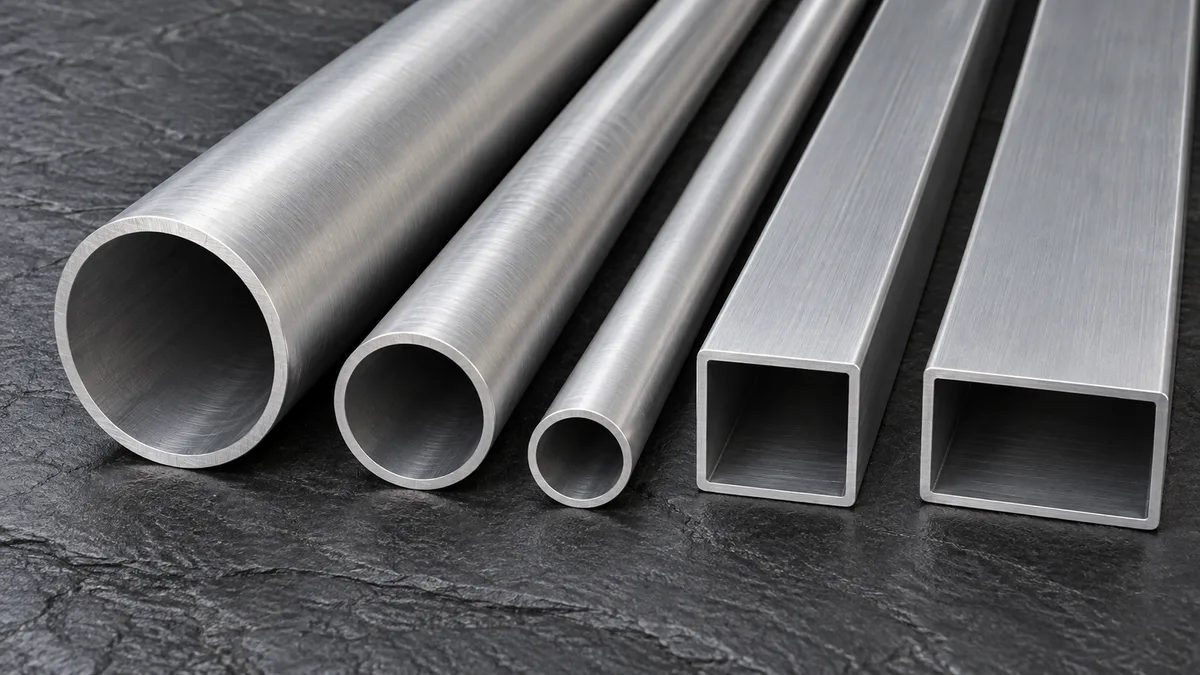
5052 contains about 2.5 % magnesium and 0.25 % chromium. Magnesium in solid solution makes it the strongest of the common non-heat-treatable tube alloys after 5083 and 5086, and chromium protects it against stress corrosion. Strength comes from cold work, designated by H3x tempers that include a stabilising treatment.
Tube made from 5052 sits in a useful middle ground. It is strong and tough enough for fuel, oil and hydraulic lines that vibrate, yet ductile enough in the annealed O temper to be bent, flared and beaded into complex routings. It does not depend on heat treatment, so welding and brazing do not destroy a carefully aged temper as they do with 6061; the weld zone simply returns to O-temper strength, which is still higher than most other non-heat-treatable alloys.
Its corrosion resistance is excellent in marine atmospheres, salt spray and many fuels and hydraulic fluids, which is why aircraft fuel and vent lines, boat fuel and water lines and offshore instrument tubing are commonly 5052. Annealed drawn seamless 5052 tube is specified for aerospace under AMS 4069 (close tolerance) and AMS 4070.
Registered limits for 5052, matching EN AW-5052 (AlMg2.5) under EN 573-3.
| Element | Minimum | Maximum | Role in the alloy |
|---|---|---|---|
| Silicon (Si) | — | 0.25 | Impurity |
| Iron (Fe) | — | 0.40 | Impurity |
| Copper (Cu) | — | 0.10 | Kept low for corrosion resistance |
| Manganese (Mn) | — | 0.10 | Impurity |
| Magnesium (Mg) | 2.2 | 2.8 | Solid-solution strengthening; seawater resistance |
| Chromium (Cr) | 0.15 | 0.35 | Grain control; resistance to stress corrosion |
| Zinc (Zn) | — | 0.10 | Impurity |
| Others, each / total | — | 0.05 / 0.15 | |
| Aluminium (Al) | Remainder |
Typical values from Aluminum Association and ASM data. Minimums for drawn tube are set by ASTM B210 (and AMS 4069/4070 for O-temper aerospace tube), and for extruded tube by ASTM B221 and B241.
| Temper | Condition | Tensile strength | Yield strength | Elongation | Hardness |
|---|---|---|---|---|---|
| O | Annealed | 193 MPa / 28 ksi | 90 MPa / 13 ksi | 25 % | 47 HB |
| H32 | Quarter hard, stabilised | 228 MPa / 33 ksi | 193 MPa / 28 ksi | 12 – 18 % | 60 HB |
| H34 | Half hard, stabilised | 262 MPa / 38 ksi | 214 MPa / 31 ksi | 10 – 14 % | 68 HB |
| H36 | Three-quarter hard | 276 MPa / 40 ksi | 241 MPa / 35 ksi | 8 – 10 % | 73 HB |
| H38 | Full hard, stabilised | 290 MPa / 42 ksi | 255 MPa / 37 ksi | 7 – 8 % | 77 HB |
Annealed for bending, flaring and beading. The temper of aerospace fuel and hydraulic line tube to AMS 4069 and 4070.
Light cold work plus stabilisation: a good compromise for straight runs that still need moderate bends.
Stiffer and stronger, for straight tube, handrails and structural uses.
Full hard for maximum strength in straight lengths, such as antenna and instrument tubing.
Extruded tube as pressed, for larger diameters and heavier walls.
The 3 means the tube was stabilised by low-temperature heating after cold work, which prevents the gradual softening that 5xxx alloys otherwise show at room temperature.
| System | Designation | Tube specification |
|---|---|---|
| SAE AMS | 5052-O drawn seamless | AMS 4069 (close tolerance), AMS 4070; AMS-WW-T-700/4 |
| ASTM / ASME | 5052 | B210 (drawn seamless), B234 (heat-exchanger tube), B221 and B241 (extruded), B483 |
| UNS | A95052 | — |
| European (EN) | EN AW-5052 (AlMg2.5) | EN 754-2, EN 755-2 |
| German Werkstoff | 3.3523 | — |
| Japan (JIS) | A5052 | JIS H4080 (A5052TD, A5052TE) |
Fluid-line tube is usually ordered in fractional-inch ODs with decimal-inch walls. Weight uses 2.68 g/cm³.
| OD (in) | Wall (in) | OD × wall (mm) | kg/m | lb/ft |
|---|---|---|---|---|
| 0.125 | 0.028 | 3.17 × 0.71 | 0.015 | 0.010 |
| 0.1875 | 0.028 | 4.76 × 0.71 | 0.024 | 0.016 |
| 0.25 | 0.035 | 6.35 × 0.89 | 0.041 | 0.027 |
| 0.3125 | 0.035 | 7.94 × 0.89 | 0.053 | 0.035 |
| 0.375 | 0.035 | 9.52 × 0.89 | 0.065 | 0.043 |
| 0.5 | 0.049 | 12.70 × 1.24 | 0.120 | 0.081 |
| 0.625 | 0.049 | 15.88 × 1.24 | 0.153 | 0.103 |
| 0.75 | 0.058 | 19.05 × 1.47 | 0.218 | 0.146 |
| 1 | 0.065 | 25.40 × 1.65 | 0.330 | 0.222 |
| 1.25 | 0.083 | 31.75 × 2.11 | 0.526 | 0.354 |
| 1.5 | 0.095 | 38.10 × 2.41 | 0.725 | 0.487 |
| 2 | 0.125 | 50.80 × 3.17 | 1.273 | 0.855 |
O-temper tube bends to tight radii on rotary-draw benders; H32 accepts moderate bends. Use mandrels on thin walls.
Accepts 37° flares and hose beads for fittings without cracking in O temper.
TIG and MIG weld well with ER5356 (higher strength, better colour match) or ER5554 for elevated temperature service. Avoid ER4043 if anodising.
Not recommended: the magnesium content interferes with flux-based brazing. Use 3003 if brazing is required.
Fair; harder tempers machine better than O. Use sharp tools and lubricant.
Anodises well with good colour uniformity; takes paint and powder coatings.
| Property | 3003-O | 5052-O | 5083-O | 6061-T6 |
|---|---|---|---|---|
| Typical tensile strength | 110 MPa | 193 MPa | 290 MPa | 310 MPa |
| Seawater resistance | Good | Excellent | Excellent | Fair–good |
| Weld-zone strength | O level | O level (unchanged) | O level (unchanged) | Large drop from T6 |
| Brazeable | Yes | No | No | Limited |
| Typical use | Heat exchangers | Fuel and marine lines | Marine, cryogenic pipe | Structural tube |
More on the trade-offs: 5052 vs 6061.
Yes, for low and medium pressure lines. Annealed drawn seamless 5052 tube to AMS 4069 or 4070 is widely used for aircraft fuel, oil and low-pressure hydraulic lines. High-pressure aircraft hydraulics normally use 6061-T6 tube, titanium or stainless steel.
Yes, by TIG or MIG with ER5356 filler. Because 5052 is not heat-treated, welds keep O-temper strength, about 193 MPa tensile, with no large loss.
Generally no. Its magnesium content makes flux brazing unreliable. Use 3003 tube for brazed heat exchangers.
O is fully annealed (about 193 MPa tensile) for maximum bendability. H32 is lightly cold worked and stabilised (about 228 MPa tensile), stiffer and better for straight runs.
Yes. It has excellent resistance to seawater and marine atmospheres and is common on boats. For heavy structural marine pipe, 5083 or 5086 offer more strength.
Yes. Metline supplies 5052 tube worldwide with mill certificates and export packing.
Send size, temper, specification, quantity and destination for availability and a delivered price.





