5052-H32
Quarter-hard, stabilised. The standard temper for general fabrication: brakes cleanly to tight radii, welds well and is strong enough for tanks, boxes and body panels.



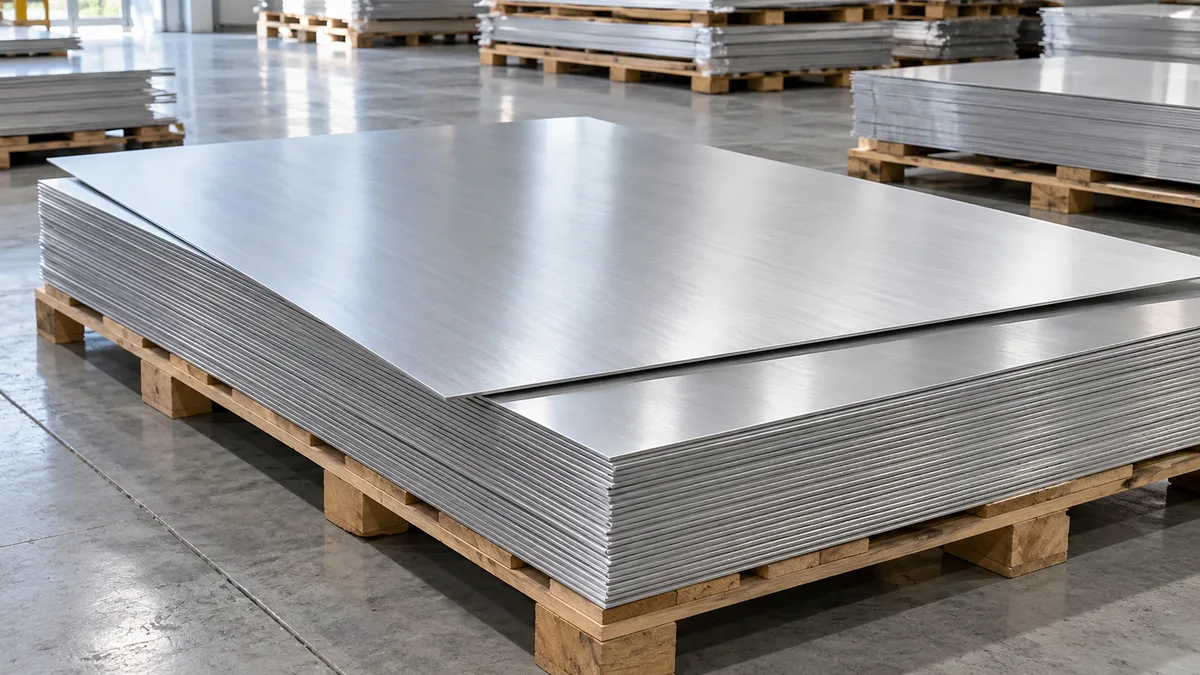
5052 is the strongest of the commonly stocked non-heat-treatable sheet alloys that still bends easily, and it resists seawater and fuels very well. That combination makes 5052-H32 the default sheet for tanks, enclosures, boats and vehicle bodies. Metline supplies 5052 sheet, plate and coil in O, H32, H34 and harder tempers to ASTM B209 and EN 485, cut to size and shipped worldwide.
5052 contains about 2.5 % magnesium and a small chromium addition. Magnesium in solid solution gives strength and seawater resistance; chromium refines the grain and improves resistance to stress corrosion. Strength is then raised by cold rolling into the H3x tempers.
In the H32 temper, 5052 offers roughly 50 % more tensile strength than 3003-H14 while still forming tight bends without cracking. It welds readily with no meaningful loss of strength in the O condition, and it does not suffer the sensitisation problem that affects higher-magnesium alloys in hot service, because its magnesium content is below about 3 %.
Those properties explain why 5052 appears in so many different industries: fuel tanks and pressure vessels, electronic enclosures, truck and trailer bodies, boat hulls under about 10 m, road signs, appliance panels and the honeycomb core used in sandwich panels. It is one of the most widely stocked aluminium sheet grades in the world, which keeps availability high.
Limits are the Aluminum Association values, followed by ASTM B209 and by EN 573-3 for EN AW-5052 (AlMg2.5). The actual analysis of each lot appears on the mill test certificate.
| Element | Minimum | Maximum | Role |
|---|---|---|---|
| Silicon (Si) | — | 0.25 | Impurity |
| Iron (Fe) | — | 0.40 | Impurity |
| Copper (Cu) | — | 0.10 | Kept low for corrosion resistance |
| Manganese (Mn) | — | 0.10 | |
| Magnesium (Mg) | 2.2 | 2.8 | Main strengthening element |
| Chromium (Cr) | 0.15 | 0.35 | Grain control, stress-corrosion resistance |
| Zinc (Zn) | — | 0.10 | |
| Others, each / total | — | 0.05 / 0.15 | |
| Aluminium (Al) | Remainder | About 96 – 97.5 % |
Typical values are what the alloy usually achieves; ASTM B209 and EN 485-2 set minimum or banded values that you should design to. The minimums for H32 sheet, for example, are 215 MPa tensile and 160 MPa yield.
| Temper | Typical tensile | Typical yield (0.2 %) | Elongation (1.6 mm) | Brinell hardness | Fatigue strength |
|---|---|---|---|---|---|
| O | 193 MPa | 89 MPa | 25 % | 47 HB | 110 MPa |
| H32 | 228 MPa | 193 MPa | 12 % | 60 HB | 117 MPa |
| H34 | 262 MPa | 214 MPa | 10 % | 68 HB | 124 MPa |
| H36 | 276 MPa | 241 MPa | 8 % | 73 HB | 131 MPa |
| H38 | 290 MPa | 255 MPa | 7 % | 77 HB | 138 MPa |
Typical values from ASM / Aluminum Association data; fatigue strength at 5×10⁸ cycles (R. R. Moore). Not design allowables.
Quarter-hard, stabilised. The standard temper for general fabrication: brakes cleanly to tight radii, welds well and is strong enough for tanks, boxes and body panels.
Half-hard, stabilised. Higher strength and stiffness for flat panels, covers and signage, with a slightly larger bend radius.
Annealed. Used for deep drawing, spinning and heavy forming such as tank heads and complex pressings.
Three-quarter and full-hard. For springy parts, fins and strip that will not be formed sharply.
As-fabricated plate above about 6 mm, with properties from hot rolling; used where the plate is machined or welded rather than formed.
Slightly strain hardened after annealing; behaves much like O temper with marginally higher strength.
| System | Designation | Sheet / plate standard |
|---|---|---|
| Aluminum Association / ASTM | 5052 | ASTM B209 (ASME SB-209) |
| Aerospace (SAE) | 5052-O / H32 / H34 | AMS 4015, AMS 4016, AMS 4017 |
| UNS | A95052 | — |
| European (EN) | EN AW-5052 / AlMg2.5 | EN 485-1/-2/-4, EN 573-3 |
| German Werkstoff | 3.3523 | DIN EN 485 |
| ISO | AlMg2.5 | ISO 6361 |
| Japan (JIS) | A5052P | JIS H4000 |
| China (GB) | 5052 | GB/T 3880, GB/T 3190 |
| India (IS) | 52000 (closest) | IS 737 |
In Europe, 5754 is often stocked in place of 5052. The two are close but not identical: 5754 has slightly more magnesium and manganese, so check the drawing before substituting.
5052 weighs 2.68 kg per m² per millimetre of thickness, slightly less than 6061. The table gives common sheet weights; use the weight calculator for others.
| Thickness (mm) | kg per m² | 1220 × 2440 mm (kg) | 1250 × 2500 mm (kg) | 1500 × 3000 mm (kg) |
|---|---|---|---|---|
| 0.5 | 1.34 | 4.0 | 4.2 | 6.0 |
| 0.8 | 2.14 | 6.4 | 6.7 | 9.6 |
| 1 | 2.68 | 8.0 | 8.4 | 12.1 |
| 1.2 | 3.22 | 9.6 | 10.1 | 14.5 |
| 1.5 | 4.02 | 12.0 | 12.6 | 18.1 |
| 2 | 5.36 | 16.0 | 16.8 | 24.1 |
| 2.5 | 6.70 | 19.9 | 20.9 | 30.2 |
| 3 | 8.04 | 23.9 | 25.1 | 36.2 |
| 4 | 10.72 | 31.9 | 33.5 | 48.2 |
| 5 | 13.40 | 39.9 | 41.9 | 60.3 |
| 6 | 16.08 | 47.9 | 50.2 | 72.4 |
| 8 | 21.44 | 63.8 | 67.0 | 96.5 |
| 10 | 26.80 | 79.8 | 83.8 | 120.6 |
| 12 | 32.16 | 95.7 | 100.5 | 144.7 |
| 16 | 42.88 | 127.6 | 134.0 | 193.0 |
| 20 | 53.60 | 159.6 | 167.5 | 241.2 |
Unless the order states otherwise, 5052 is supplied to the standard tolerance tables of ASTM B209 (ANSI H35.2) or EN 485-4 (cold-rolled sheet) and EN 485-3 (hot-rolled plate). Cut-to-size blanks can be held to about ±0.5 mm.
5052-H32 sheet up to about 3 mm typically bends to an inside radius of 0.5 – 1 × thickness; H34 needs about 1 – 1.5 × t. Use O temper for very tight forming.
MIG and TIG weld easily. ER5356 is the usual filler; ER5554 is preferred for service above 65 °C. The weld zone falls to about O-temper strength.
Gummy in soft tempers. Use sharp, polished, high-rake tools, high speeds and plenty of lubricant; harder tempers machine better.
Anodises well with a slightly yellow tint compared with 5005; good for protective and coloured finishes.
Takes powder coat and liquid paint after suitable conversion coating.
Very good in seawater and marine air. Isolate from steel and copper fasteners with washers and sealant.
| Property | 5052-H32 | 3003-H14 | 5754-H22 | 5083-H111 | 6061-T6 |
|---|---|---|---|---|---|
| Typical tensile | 228 MPa | 150 MPa | ≈ 245 MPa | ≈ 300 MPa | 310 MPa |
| Typical yield | 193 MPa | 145 MPa | ≈ 185 MPa | ≈ 150 MPa | 276 MPa |
| Formability | Very good | Excellent | Very good | Good | Limited in T6 |
| Weld strength retention | High | High | High | High | Low (HAZ softens) |
| Seawater resistance | Very good | Good | Very good | Excellent | Fair–good |
| Above 65 °C service | Yes | Yes | Yes | No | Yes |
Choose 5052 over 6061 when the part is bent, welded or exposed to seawater; choose 6061 when it is machined from thick plate and needs higher yield. Move up to 5083 for large welded marine structures.
Yes. 5052 resists seawater and marine atmospheres very well and is widely used for small boats, fuel tanks and fittings. For large welded hulls, 5083 or 5086 in H116 or H321 is normally specified because those tempers are tested for exfoliation resistance.
H32 is quarter-hard (typical 228 MPa tensile) and bends more easily; H34 is half-hard (typical 262 MPa) and is stiffer. Choose H32 for formed parts and H34 for flat panels needing more strength.
No. It is strengthened only by cold work. Heating to about 345 °C anneals it to the O temper.
No. 6061-T6 has a typical yield of 276 MPa against 193 MPa for 5052-H32. But 5052 bends and welds without the strength loss that 6061 suffers in the heat-affected zone.
At 2.68 g/cm³, a 1220 × 2440 × 2 mm sheet weighs about 16.0 kg and a 1250 × 2500 × 3 mm sheet about 25.1 kg.
EN AW-5052 (AlMg2.5, Werkstoff 3.3523). 5754 (AlMg3) is the more common European stock grade and is often accepted as an alternative after engineering review.
Send the temper, thickness, size, quantity and destination. We will reply with availability, certification and a delivered price.





