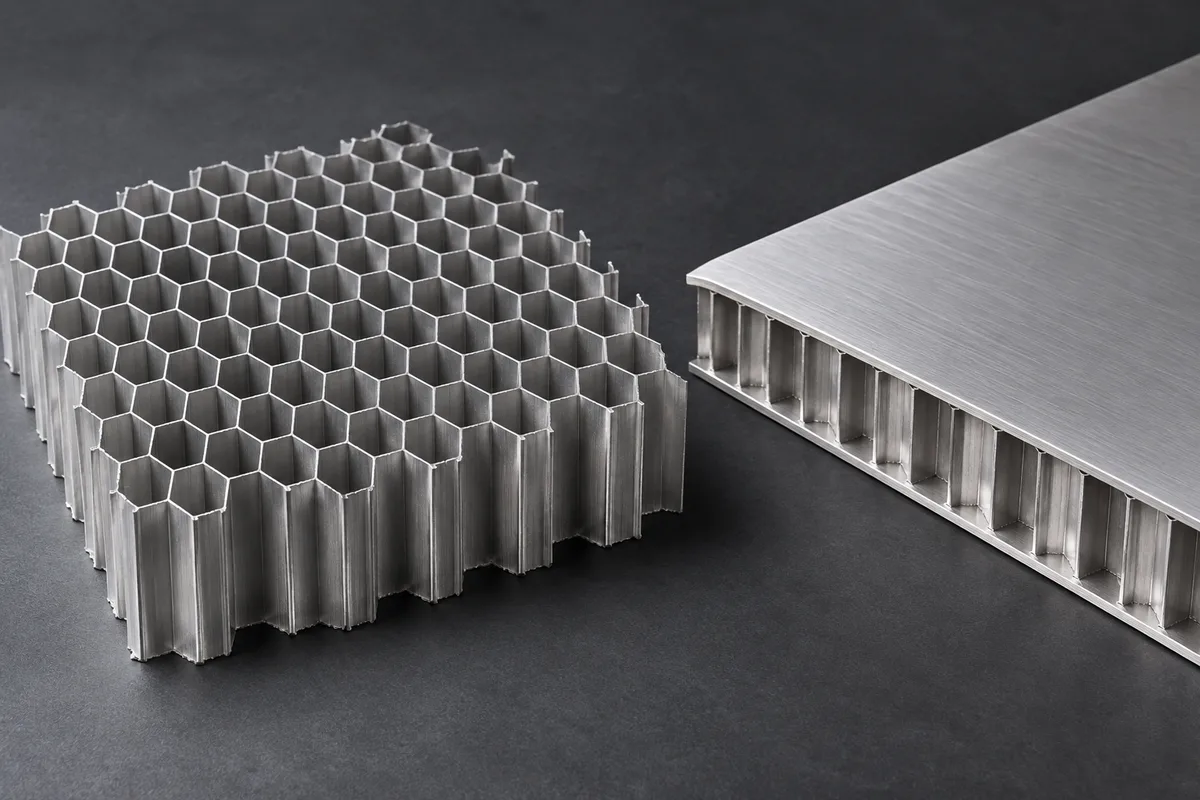
Aluminium honeycomb core is a lightweight cellular material made from thin aluminium foil, bonded into hexagonal cells and sandwiched between two skins to make panels that are very stiff for their weight. Its performance is set by four choices: alloy (3003 for commercial panels, 5052 or 5056 for aerospace and demanding structures), cell size, foil gauge and the resulting density. This guide explains each, with typical strength data, coatings, configurations and supply forms.
A sandwich panel behaves like an I-beam: the two skins carry bending as tension and compression, and the core holds them apart and carries shear between them. Doubling the core thickness roughly quadruples stiffness while adding very little weight. Honeycomb is the most efficient core because almost all of its material sits in thin vertical walls that resist crushing and shear, while the open cells weigh almost nothing.
Aluminium honeycomb is made from foil typically between about 18 and 100 µm thick. Strips of foil are printed with lines of adhesive, stacked and cured into a solid block, then sliced and pulled open (expanded) so the bonded lines become the cell nodes. The result is a hexagonal cell structure with double-thickness walls in one direction and single walls in the others.
Compared with foam or balsa cores, aluminium honeycomb offers higher shear strength and stiffness per unit weight, does not absorb moisture, does not burn, conducts heat and electricity, and crushes in a stable, predictable way, which makes it valuable for energy absorption as well as structure. Its main limitations are susceptibility to corrosion if unprotected, galvanic issues with carbon-fibre skins, and that it cannot be shaped as freely as foam without special cell geometries.
L, W and T directions, cell size and density
Honeycomb is anisotropic, so every specification refers to three directions and three geometric parameters. Getting them right on the drawing avoids the most common ordering errors.
Term
Meaning
Why it matters
L (ribbon) direction
Parallel to the continuous foil ribbons and the double-wall bonded nodes
Strongest and stiffest in shear; typically about 1.5–1.8 × the W-direction shear strength
W (transverse) direction
Perpendicular to the ribbons, the direction of expansion
Weaker in shear; easier to curve the core in this direction
T (thickness) direction
Cell depth, perpendicular to the skins
Compressive strength and crush strength act in T
Cell size
Diameter of the inscribed circle of a cell, e.g. 1/8, 3/16, 1/4, 3/8 in
Smaller cells give better skin support and finish, but more foil and cost
Foil gauge
Foil thickness, e.g. 0.0007, 0.001, 0.0015, 0.002 in (about 18–50 µm)
Thicker foil raises density, strength and stiffness
Density
Mass of the expanded core per volume, in pcf or kg/m³ (1 pcf = 16.02 kg/m³)
The main driver of all mechanical properties
A standard way to describe aerospace core is cell size, alloy, foil gauge and density, for example 3/16-5052-.001-3.1: 3/16 in cells, 5052 foil, 0.001 in foil gauge, 3.1 pcf (about 50 kg/m³). For a regular hexagonal core, density rises roughly in proportion to foil thickness divided by cell size, so halving the cell size at the same foil gauge roughly doubles the density.
Always state whether a cell size is quoted in inches or millimetres, and whether a density is nominal or minimum. Standard density tolerance is commonly ±10 % of nominal.
Alloy selection
3003, 5052 and 5056 honeycomb: which alloy?
Alloy
Grade
Strength at equal density
Corrosion resistance
Typical uses
3003 (also 3104, 3105)
Commercial
Lowest
Good
Facades, partitions, doors, furniture, signage, transport interiors, airflow and lighting grilles
5052
Aerospace / specification
Higher than 3003
Very good
Aircraft interiors and secondary structure, rail, marine, high-performance commercial panels
5056
Aerospace / specification
Highest of the three
Very good
Primary and secondary aerospace structure where maximum shear and compressive strength per weight are needed
3003 commercial core
Al-Mn foil that forms and bonds easily at the lowest cost. Strength is adequate for most architectural and transport panels, where skins and adhesive usually govern. Often supplied in larger cells and thicker foil with a mill or lightly treated surface.
5052 core
Al-Mg foil with higher strength and better corrosion resistance than 3003. The most widely used specification-grade core, available in a broad range of cell sizes and densities and usually with a corrosion-inhibiting coating.
5056 core
Higher magnesium content than 5052, giving roughly 10–30 % higher shear and compressive strength at the same density. Chosen when the core is the critical element in an aerospace sandwich. AMS 4349 covers corrosion-inhibited 5056 core for service to 177 °C (350 °F).
For a detailed treatment of each grade, see the alloy pages for 3003 honeycomb core, 5052 honeycomb core and 5056 honeycomb core. Where specified by drawing, Metline can also supply core to other national aerospace alloy designations.
Typical data
Typical mechanical properties of 5052 and 5056 honeycomb
The figures below are typical values published by a major aerospace core producer for corrosion-inhibited hexagonal core, tested at room temperature on 0.625 in (15.9 mm) thick specimens. Stabilised compressive strength is measured with skins bonded to the core (ASTM C365); plate shear strength and modulus in the L and W directions are measured to ASTM C273. Use them for comparison and preliminary sizing only, and design to the minimum values of the core you actually buy.
5052 core (cell-alloy-density)
Density (kg/m³)
Stabilised compression (MPa)
Crush (MPa)
L shear (MPa)
L modulus (MPa)
W shear (MPa)
W modulus (MPa)
1/8-5052-3.1
50
2.07
0.90
1.45
310
0.90
152
1/8-5052-4.5
72
3.93
1.79
2.34
483
1.52
214
1/8-5052-6.1
98
7.03
3.10
3.86
676
2.34
283
3/16-5052-3.1
50
2.31
0.90
1.45
310
0.86
152
3/16-5052-4.4
70
3.79
1.72
2.28
469
1.48
207
3/16-5052-5.7
91
5.93
2.69
3.17
621
2.07
265
1/4-5052-2.3
37
1.45
0.52
0.97
221
0.59
112
1/4-5052-3.4
54
2.55
1.03
1.59
345
0.97
165
1/4-5052-4.3
69
3.72
1.59
2.21
455
1.38
205
3/8-5052-1.6
26
0.66
0.28
0.59
145
0.34
76
3/8-5052-2.3
37
1.38
0.52
0.93
221
0.55
112
3/8-5052-3.0
48
2.14
0.83
1.38
296
0.86
146
5056 core (cell-alloy-density)
Density (kg/m³)
Stabilised compression (MPa)
Crush (MPa)
L shear (MPa)
L modulus (MPa)
W shear (MPa)
W modulus (MPa)
1/8-5056-3.1
50
2.41
1.17
1.72
310
1.07
138
1/8-5056-4.5
72
4.76
2.21
3.03
483
1.76
193
3/16-5056-2.0
32
1.38
0.52
0.97
186
0.59
90
3/16-5056-3.1
50
2.83
1.17
1.83
310
1.03
138
3/16-5056-4.4
70
4.62
2.14
2.93
469
1.69
186
3/16-5056-5.7
91
6.89
3.31
3.90
648
2.28
248
1/4-5056-2.3
37
1.83
0.69
1.24
221
0.69
103
1/4-5056-3.4
54
3.31
1.38
2.00
345
1.21
152
1/4-5056-4.3
69
4.27
2.07
2.76
462
1.59
186
Converted from typical values in psi and ksi in Hexcel's HexWeb CR III product data sheet (1 psi = 0.006895 MPa); rounded. Values for a given lot vary, and minimum values are lower. Commercial 3003 core has lower strengths than 5052 at the same density; request the producer's data sheet for the exact core.
Three patterns stand out. First, density is what matters: 1/8 and 3/16 in cores of the same density have almost identical properties. Second, L-direction shear is consistently about 1.5–1.8 times W-direction shear, so orient the ribbon along the main shear path. Third, 5056 is stronger than 5052 at equal density, particularly in compression and L shear, which is why it is chosen for structural aerospace parts.
Selection method
How to select cell size, foil and density
Find the core shear stressFor a simply supported panel, the core carries roughly the shear force divided by the distance between skin centroids. Compare that stress with the core's W-direction shear strength (the weaker direction) unless the ribbon can be aligned with the load.
Check flatwise compression and local loadsPoint loads, fasteners and foot traffic crush the core locally. Use higher density, potted inserts or local doublers where loads are concentrated.
Choose cell size for skin supportThin skins can dimple into large cells under compression (intracell buckling) and show a "telegraphed" pattern on the surface. Thin skins and visible surfaces call for smaller cells, typically 1/8 to 3/16 in; thicker skins can use 1/4 to 3/8 in cells.
Choose foil gauge to hit the densityAt a given cell size, foil gauge sets the density. Pick the lowest density that meets the strength and crushing checks.
Pick alloy and coating3003 for commercial panels, 5052 for general specification work, 5056 for highest strength. Choose a corrosion-inhibiting coating for humid, marine or long-life service.
Confirm thickness and formSlice thickness, block size, expanded or unexpanded, perforated or not, and any machining.
Corrosion protection and bonding surface treatments
Bare aluminium foil can corrode at the nodes in humid or salty environments, weakening the bond between cells. Specification-grade core therefore uses foil that is treated before it is formed into honeycomb.
Treatment
What it is
Benefit
Typical use
Corrosion-inhibiting conversion coating with organic polymer topcoat
Chemical conversion layer on the foil, sealed with a thin polymer film
Strong resistance to salt spray and humidity; meets AMS-C-7438 corrosion-inhibited requirements
Aerospace, marine and rail structures
Phosphoric acid anodising (PAA)
Thin, porous anodic oxide formed on the foil in phosphoric acid
Excellent adhesive bond durability in hot, wet conditions, as well as corrosion resistance
Primary bonded aerospace structure and high-durability panels
Chromate-free conversion coatings
Trivalent or other non-hexavalent treatments
Corrosion protection with lower environmental impact
Commercial and rail panels where hexavalent chromium is restricted
Untreated or degreased foil
Cleaned mill-finish foil
Lowest cost
Dry interior architectural and furniture panels, airflow grilles
Ask for the treatment by its function and the specification it must meet, not just by a brand name, and confirm whether hexavalent chromium is permitted in your market under REACH or RoHS rules.
Configurations
Hexagonal, overexpanded, flexible and reinforced core
Standard hexagonal
Regular hexagon cells. Highest shear strength for its density and the most common choice for flat panels.
Overexpanded (OX)
Expanded beyond regular hexagons into roughly rectangular cells. Lower L shear but higher W shear, and it curves easily in the W direction for cylindrical parts.
Flexible-cell core
A special cell shape that bends in both directions without anticlastic curvature, used for compound curves such as fairings and radomes.
Reinforced core
An extra flat foil sheet bonded along the nodes in the ribbon direction, raising density and strength for local hard points, insert areas and edge members.
Square or rectangular cell
Corrugated foil stacked with flat sheets. Used for airflow straighteners and specialised panels.
Slanted cell core
Cells angled at, for example, 30°, 45° or 60° to the face, used for directional airflow, light control and shielding.
Micro-cell core
Very small cells, around 1–3 mm, for smooth surfaces under very thin skins, precision panels and flow straightening.
Perforated core
Small holes in the cell walls that let air and gases escape during curing and allow pressure equalisation in flight.
Machined core
Blocks carved, tapered, chamfered or contoured by CNC to the shape of a part before bonding.
Working with core
Bonding, inserts, edges and machining
The core is only as good as the panel built around it. Most sandwich failures start at the skin-to-core bond, at inserts or at unsealed edges rather than in the honeycomb itself, so fabrication details deserve as much attention as core selection.
Skin-to-core bonding
Film adhesives are standard for aerospace panels because they form a controlled fillet up each cell wall; liquid epoxies and polyurethanes are common for architectural and transport panels. Clean, treated skins and adequate pressure during cure matter more than the adhesive brand. Flatwise tension (ASTM C297) and drum peel (ASTM D1781) tests verify the bond.
Inserts and hard points
Fasteners need potted inserts: the cells around the hole are filled with a structural potting compound before the insert is installed. Higher-density or reinforced core is used locally where loads are high, and edge members or extrusions take hinge and mounting loads.
Edge closeouts
Open edges let moisture into the core and leave the skins unsupported. Edges are sealed with potting, folded skins, bonded channels or extruded aluminium edge profiles, depending on the application.
Machining and cutting
Expanded core is cut with sharp knives, band saws with scalloped blades, waterjet or ultrasonic cutters. Contours and tapers are CNC machined with special honeycomb cutters while the core is held by vacuum, double-sided tape or a temporary filler.
Forming curved panels
Standard hexagonal core curves into a saddle shape when bent. Overexpanded core suits single curvature and flexible-cell core suits compound curvature; heat forming is also used on some grades.
Galvanic isolation
With carbon-fibre skins, add a glass-fibre ply or a continuous adhesive layer between skin and core so the aluminium never touches the carbon, and seal the panel edges against moisture.
Honeycomb also has a second life as an energy absorber. When crushed in the T direction it first reaches a peak stress, then collapses at an almost constant crush strength over most of its thickness. That flat force plateau, listed as crush strength in the tables above, lets engineers size crash pads, rail buffers, drop-test attenuators and packaging precisely. Pre-crushing the core removes the initial peak when a smooth force profile is needed. Because crush strength scales with density, the same cell size can be ordered in several foil gauges to tune the force level of an absorber without changing its outside dimensions.
Supply range
Supply forms, sizes and tolerances
Form
Description
When to choose it
Unexpanded block (HOBE)
Bonded foil stack before expansion
Lowest freight volume; for buyers who slice and expand in-house
Unexpanded slices
Thin slices cut from the block, ready to expand
Compact shipment; expanded on site to the required thickness
Expanded sheets
Ready-to-bond core sheets at the ordered thickness
Panel production without expansion equipment
Cut-to-size pieces
Expanded core cut to panel dimensions
Kitted panel production
Machined parts
Contoured, chamfered or pocketed core details
Aerospace parts, fairings, curved panels
Typical size range
Cell size
About 1 mm micro-cell up to 25 mm (1/32 to 1 in); aerospace core most often 1/8, 5/32, 3/16, 1/4 and 3/8 in
Foil thickness
Aerospace: about 0.0007–0.004 in (18–102 µm). Commercial: about 0.03–0.10 mm
Core thickness
From about 2 mm slices to blocks of 200 mm and more
Expanded sheet size
Depends on cell size and producer; large-cell commercial core is available in long expanded lengths
Thickness tolerance
Typically a few tenths of a millimetre on sliced core; tighter by machining
Density tolerance
Commonly ±10 % of nominal
Exact sizes depend on cell size, alloy and foil. Send the core designation and panel size and we will confirm the available sheet dimensions.
Standards and test methods for honeycomb core
Standard
Scope
AMS-C-7438 (formerly MIL-C-7438)
Aluminium honeycomb core for sandwich construction: materials, designations, properties and quality requirements
AMS 4349
Corrosion-inhibited 5056 honeycomb core for sandwich construction, 177 °C (350 °F) service
ASTM C365
Flatwise compressive properties of sandwich cores (bare and stabilised)
ASTM C273
Shear properties of sandwich core materials (plate shear in L and W)
ASTM C297
Flatwise tensile strength of sandwich constructions (skin-to-core bond)
ASTM D1781
Climbing drum peel test for adhesive bond between skin and core
ASTM C271
Density of sandwich core materials
ASTM B117
Neutral salt spray testing of corrosion-inhibiting treatments
Typical incoming inspection checks density, cell size, thickness, node bond strength and, for specification core, compressive and shear properties per lot. Metline supplies honeycomb core with a certificate of conformance and test results for the lot as required by the order.
Comparison
Aluminium honeycomb compared with aramid, foam and stainless cores
Core
Strengths
Limitations
Typical choice
Aluminium honeycomb
Highest shear strength and stiffness per weight among common cores, non-flammable, conducts heat, predictable crush
Needs corrosion protection, galvanic risk with carbon skins, less formable
Aircraft structure and floors, rail, facades, energy absorbers
Aramid (Nomex-type) honeycomb
Excellent toughness and damage tolerance, low thermal conductivity, no corrosion, radar transparent
Lower stiffness at equal density, higher cost, absorbs some moisture
Lower shear stiffness per weight, temperature limits, flammability
Marine hulls, wind blades, composite tooling
Stainless steel honeycomb
High temperature resistance, corrosion resistance, EMI shielding
Much heavier and more expensive
High-temperature, EMI vent and flow-straightener applications
Aluminium core is usually the default for flat, stiffness-driven panels with metal skins; aramid is preferred with carbon-fibre skins and for parts that must tolerate impact or avoid corrosion entirely. See our aramid honeycomb core guide for the non-metallic alternative.
What is the difference between 3003, 5052 and 5056 aluminum honeycomb core?
3003 is a commercial-grade core for architectural, transport and furniture panels. 5052 is stronger and more corrosion resistant and is the most common specification grade. 5056 has the highest strength at a given density and is used for structural aerospace sandwich parts.
What do L and W mean on honeycomb core?
L is the ribbon direction, parallel to the continuous foil strips and bonded nodes; W is the expansion direction at right angles to it. Shear strength in L is typically about 1.5–1.8 times that in W, so the L direction is aligned with the main shear load where possible.
How do I read a designation such as 3/16-5052-.001-3.1?
It means 3/16 in cell size, 5052 alloy foil, 0.001 in foil thickness and a nominal density of 3.1 lb/ft³ (about 50 kg/m³).
Should I choose perforated or unperforated core?
Perforated core lets air escape during curing and allows pressure equalisation, which is common in aerospace panels. Unperforated core keeps each cell sealed, which helps resist moisture migration. Choose according to the curing process and service environment.
What is unexpanded honeycomb core?
It is the bonded foil block or slice before it is pulled open into cells. It ships in a fraction of the volume of expanded core and is expanded by the panel maker to the required size.
Is aluminium honeycomb suitable for marine and outdoor use?
Yes, if it is a corrosion-inhibited 5052 or 5056 core with properly sealed panel edges. Untreated commercial core should be reserved for dry interior uses.
What temperature can aluminium honeycomb core withstand?
The aluminium itself tolerates high temperatures, but the node adhesive usually limits service. Common corrosion-inhibited aerospace cores are specified for use up to about 177 °C (350 °F); higher-temperature cores use different adhesives or brazed or welded constructions.
Sourcing aluminium honeycomb core?
Send the alloy, cell size, foil gauge or density, thickness, form and quantity. We reply with availability, test documentation and a delivered price.