Stiffness and strength
Bending stiffness is set mainly by skin thickness and core depth; strength by skin strength, core shear strength and bond quality. Panel makers verify these by beam flexure testing (ASTM C393) on the actual construction.



A fiberglass honeycomb panel is a sandwich of two thin glass-fibre reinforced plastic (FRP) skins bonded to a lightweight aluminium honeycomb core. The result is a flat, stiff, corrosion-resistant panel weighing roughly 3 – 6 kg/m², used for truck and reefer bodies, rail interiors, marine bulkheads, cleanroom walls and equipment housings. This guide explains how the panels are built, how to specify them and where their limits lie.
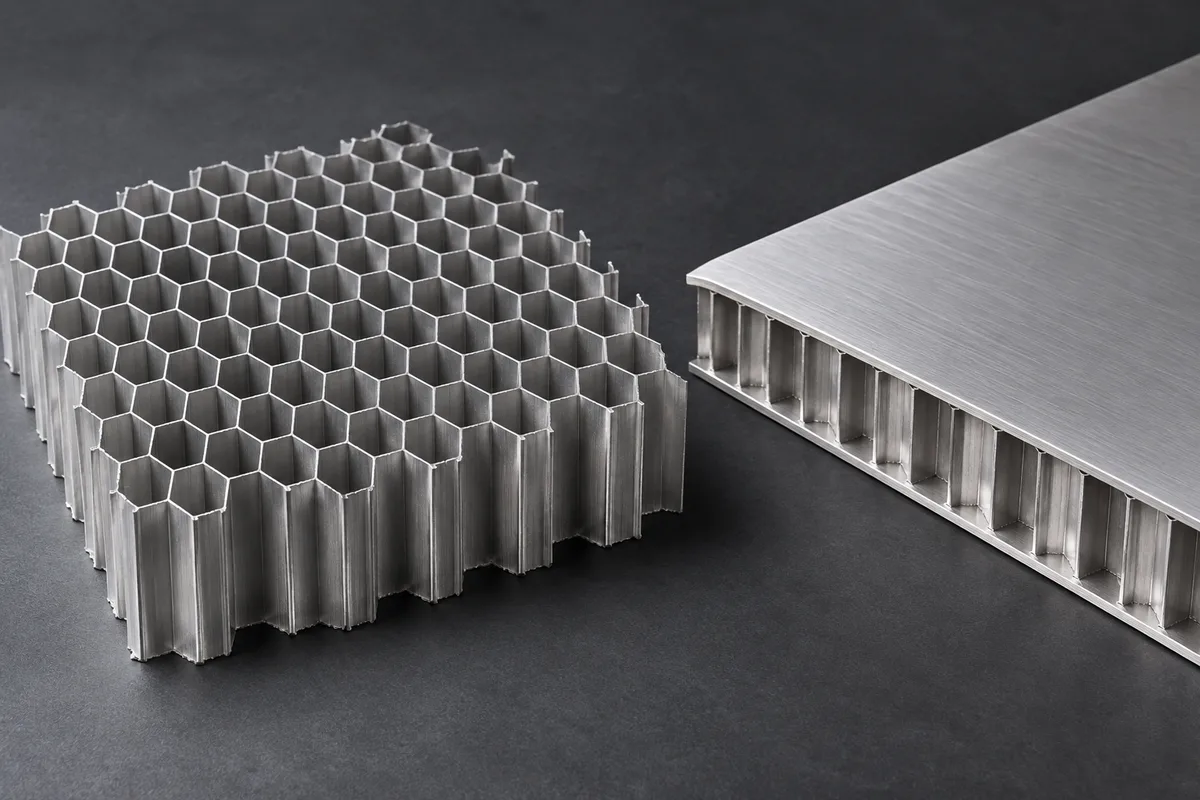
Sandwich panels work like an I-beam spread over an area. The two skins carry bending loads as tension and compression, while the core keeps them apart and carries shear. Doubling the core thickness roughly quadruples the bending stiffness for only a small increase in weight, which is why a 20 mm honeycomb panel can be as stiff as a much heavier solid sheet.
In an FRP honeycomb panel, the skins are glass-fibre fabric impregnated with epoxy (or sometimes polyester or phenolic) resin, and the core is an expanded aluminium honeycomb made from 3003 or 5052 foil. The FRP faces resist impact, scratching, moisture and chemicals and can be gel-coated, textured or coloured. The aluminium core provides high shear and compressive strength, does not absorb water and does not creep under sustained load the way polypropylene or paper cores can.
Compared with all-aluminium honeycomb panels, FRP skins give better resistance to dents, a non-conductive and thermally less conductive surface, and an easy-to-clean finish for hygienic or refrigerated spaces. Compared with panels on plastic cores, the aluminium core keeps the panel flat and dimensionally stable over a wide temperature range.
| Layer | Typical options | Function |
|---|---|---|
| FRP skins | 0.5 – 1.0 mm glass fabric with epoxy resin; thicker or multi-ply on request | Carry bending loads, resist impact and wear, provide the finished surface |
| Adhesive | Epoxy film or liquid structural adhesive | Transfers shear between skin and core; bond quality decides panel strength |
| Honeycomb core | 3003-H18 or 5052-H18/H19 aluminium; cell size about 6, 8 or 10 mm | Separates skins, carries shear and compressive loads |
| Core thickness | About 6, 10, 15, 20 and 25 mm | Sets stiffness; total panel about 8 – 30 mm |
| Edges and inserts | Aluminium edge profiles, potted inserts, foam or solid edge fills | Provide fixing points and seal the core against moisture |
| Surface finish | Gloss or matt gel coat, textured anti-slip, coloured or primed for paint | Appearance, cleanability and grip |
Panels may be built double-sided (FRP on both faces) for self-supporting walls and floors, or single-sided, with FRP on the visible face and a thin aluminium or glass skin on the back, where the panel is bonded to a frame. 5052 cores are stronger and more corrosion resistant than 3003 and are preferred for marine and transport use; 3003 cores are economical for interior and architectural panels. Our 3003 vs 5052 core comparison explains the difference in more detail.
Tolerances and temperature limits depend on resin system and construction; confirm them on the panel datasheet for your order.
Weight can be estimated from the layers. The table assumes glass/epoxy skins at about 1.9 g/cm³, aluminium core densities of 37 or 54 kg/m³ (typical of 6 mm cells in thin and medium foil gauges) and about 0.25 kg/m² of adhesive per face. Treat the results as estimates for early design.
| Core thickness (mm) | Core density (kg/m³) | Each FRP skin (mm) | Estimated weight, double-sided (kg/m²) |
|---|---|---|---|
| 10 | 54 | 0.5 | 2.9 |
| 10 | 54 | 1.0 | 4.8 |
| 15 | 54 | 1.0 | 5.1 |
| 20 | 37 | 0.5 | 3.1 |
| 20 | 54 | 1.0 | 5.4 |
| 25 | 54 | 1.0 | 5.7 |
Bending stiffness is set mainly by skin thickness and core depth; strength by skin strength, core shear strength and bond quality. Panel makers verify these by beam flexure testing (ASTM C393) on the actual construction.
The honeycomb's flatwise compressive strength (ASTM C365) decides how well floors resist wheels, feet and pallet jacks. Smaller cells and heavier foil raise it.
Neither the aluminium core nor cured epoxy absorbs significant water, but edges must be sealed so water cannot travel through the cells. Unsealed cut edges are the most common cause of panel failure outdoors.
FRP skins do not corrode. 5052 cores resist humidity and salt spray well; for marine use specify corrosion-protected core foil and sealed edges.
FRP faces conduct heat far less than aluminium skins. For insulated reefer bodies, honeycomb panels are combined with foam layers because the open aluminium core itself is not an insulator.
Aluminium honeycomb does not creep at normal service temperatures, so floors and shelves keep their flatness under sustained loads.
Fire is where FRP panels need the most care. The aluminium core is non-combustible, but epoxy and polyester resins burn and produce smoke. Standard FRP honeycomb panels are therefore not suitable where non-combustible materials are required, for example on many building facades. Flame-retardant resin systems and phenolic skins improve performance substantially, and the right test depends on the application:
| Application | Typical fire standard | Note |
|---|---|---|
| Railway vehicles (Europe) | EN 45545-2 | Hazard levels HL1 – HL3; flame-retardant or phenolic skins usually needed |
| Ships | IMO FTP Code (2010) | Surface flammability, smoke and toxicity for interior linings and bulkheads |
| Buildings (Europe) | EN 13501-1 reaction-to-fire classes | Facade and escape-route rules may exclude combustible panels |
| Buildings (US) | ASTM E84 flame spread and smoke index | Interior finish classes A, B, C |
| Aircraft interiors | 14 CFR 25.853 | Normally phenolic-glass skins on aramid or aluminium cores |
Always ask for a fire test report on the exact construction (skin, resin, adhesive, core and thickness). A report for a different build does not transfer.
For more on joining methods and their effect on panel strength, see honeycomb core joining methods.
| Core | Strength and stiffness | Creep and temperature | Moisture | Typical use |
|---|---|---|---|---|
| Aluminium honeycomb | High shear and compressive strength for its weight | No creep; stable over a wide range | Does not absorb water; edges must be sealed | Vehicle floors and walls, marine, equipment |
| Polypropylene honeycomb | Much lower than aluminium at similar density | Softens with heat, can creep | Does not absorb water | Low-cost panels, light partitions |
| Paper / kraft honeycomb | Low | Creeps under load | Absorbs water and loses strength | Doors, furniture, dry interiors |
| PET or PVC foam | Moderate; continuous bond area | Some grades creep at high temperature | Closed-cell, low absorption | Marine hulls, wind blades, insulated bodies |
| Aramid honeycomb | High; good fatigue and impact | Good to elevated temperatures | Low absorption | Aircraft interiors and structures |
Metline supplies the aluminium honeycomb core and aluminium-cored panels. For a direct comparison with aramid cores, read aluminium vs aramid honeycomb core.
A typical example is a delivery-van side wall: a 20 mm panel with 1 mm FRP skins on a 5052 core weighs a little over 5 kg/m², takes rivnut or bonded fixings at potted hardpoints, and gives a smooth face for graphics.
In the panels described here the core is expanded aluminium honeycomb in 3003 or 5052 alloy, typically with 6 – 10 mm cells. Some panels on the market use polypropylene, paper or aramid cores, which behave differently in strength, creep and moisture.
Roughly 3 – 6 kg/m² for common builds. A 20 mm panel with 1 mm glass/epoxy skins on a medium-density aluminium core weighs about 5.4 kg/m².
Yes, provided all edges are sealed and the gel coat or surface finish is UV resistant. FRP skins and aluminium cores do not corrode, but water entering through open cut edges must be prevented.
No. The aluminium core does not burn, but standard resins are combustible. Flame-retardant or phenolic skins can meet rail, marine and many interior fire standards; check the test report for the exact construction and application.
It depends on the use. FRP skins resist dents and chemicals and give a washable, insulating surface. Aluminium skins are stiffer for the same thickness, non-combustible as a face material, and easier to coat for architectural finishes.
Yes, with carbide or diamond tools and dust extraction. Seal cut edges afterwards and use potted inserts or reinforced hardpoints for any fixing that carries load.
Send the size, thickness, skin and core preferences, fire requirement and quantity. We will propose a construction and delivered price.





