Stiffness to weight
Like all sandwich panels, a brazed panel separates two thin skins with a light core, giving very high bending stiffness for its weight.



A brazed aluminium honeycomb panel is a sandwich of two aluminium skins and an aluminium honeycomb core joined by a brazing alloy instead of glue. Because every joint is metal to metal, the panel contains no organic adhesive, tolerates far higher temperatures than bonded panels, can be welded at its edges and is fully recyclable. That makes it a strong candidate for rail, marine, building facade and other uses where fire performance and long-term durability matter.
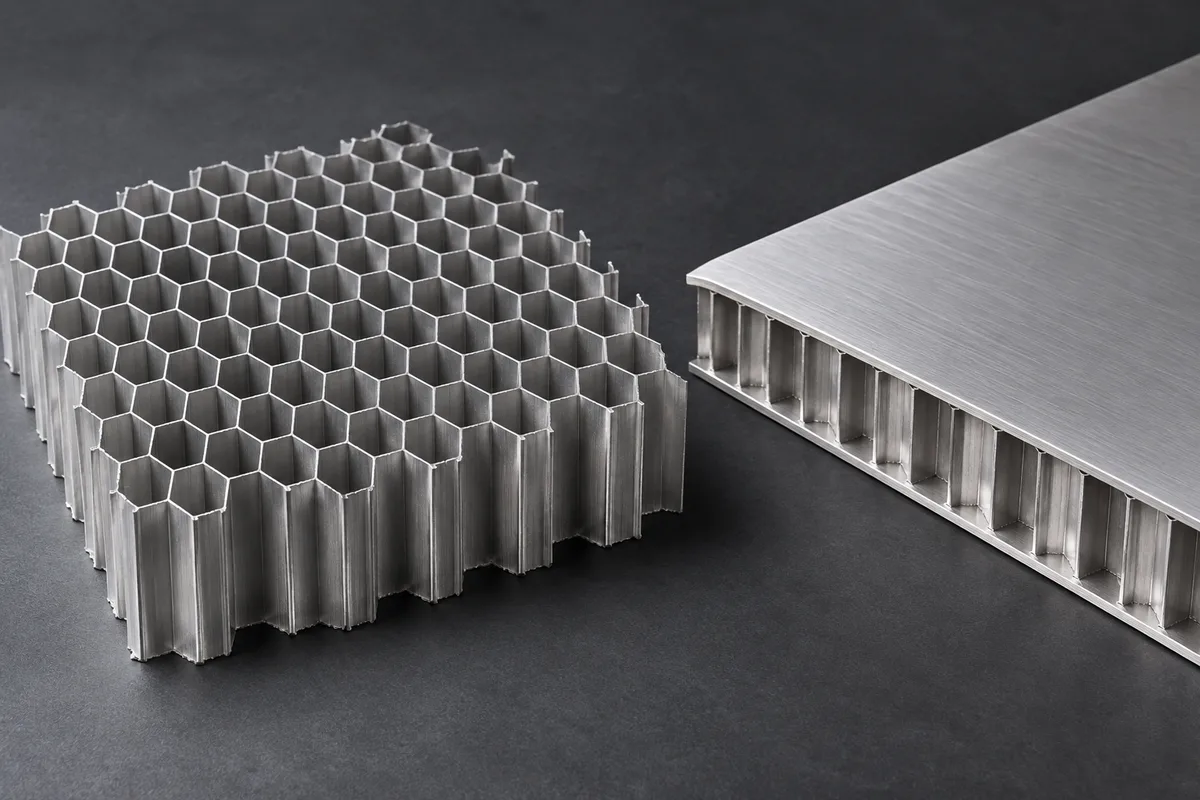
Most aluminium honeycomb panels are made by laminating skins to a core with epoxy or polyurethane film adhesive. The adhesive is the weak link: it softens with heat, can age in humidity and burns in a fire. A brazed panel replaces it with an aluminium-silicon filler metal that melts at around 577 – 600 °C, flows into the contact lines between core cell walls and skins, and solidifies as a continuous metallic fillet.
The result is a single all-aluminium structure. The core no longer depends on a polymer to transfer shear, so strength is maintained at temperatures where a bonded panel would delaminate, and there is nothing in the panel to emit smoke or toxic gases. The same metallurgical joint lets fabricators weld edge profiles, inserts and frames directly to the panel, something that would destroy an adhesive bond.
The trade-offs are cost and size. Brazing needs a large furnace, careful fixturing and tight control of temperature, so brazed panels are more expensive per square metre than bonded panels and are limited by furnace dimensions. They are chosen when fire, heat, outgassing or weldability requirements rule out adhesives.
| Factor | Adhesive-bonded panel | Brazed panel |
|---|---|---|
| Core-to-skin joint | Epoxy, polyurethane or film adhesive | Al-Si braze fillet, metallurgical |
| Service temperature | Limited by adhesive, often below about 120 – 180 °C | Limited by the aluminium itself; holds shape far above adhesive limits |
| Fire behaviour | Adhesive contributes fuel and smoke | All-metal, no organic content to burn |
| Peel strength | Set by the adhesive and surface preparation | Typically high; failure tends to occur in the core foil rather than the joint |
| Welding of edges and inserts | Not possible without damaging the bond | Possible with controlled heat input |
| Humidity ageing | Adhesive can degrade over years | No polymer to age |
| Outgassing | Possible from adhesive | Negligible; suits clean rooms and vacuum |
| Recycling | Adhesive must be separated | Single material family, straightforward to remelt |
| Cost and size | Lower cost, very large sizes | Higher cost, limited by furnace size |
In short, bonded panels remain the economical choice for interior partitions, signage and general cladding. Brazed panels earn their premium in rail car floors and walls, ship accommodation and fire divisions, high-temperature enclosures, clean and vacuum equipment, and facades where a non-combustible panel with a long life is required.
| Component | Common alloys | Why |
|---|---|---|
| Honeycomb core foil | 3003 (Al-Mn) | Good brazeability, corrosion resistance and strength after the brazing cycle; melts well above the filler |
| Brazing filler | 4004 / 4104 (vacuum brazing), 4343 / 4045 / 4047 (flux brazing) | Al-Si alloys with a melting range below the core and skins |
| Skins | Brazing sheet with a 3003 or 6xxx core and Al-Si cladding, or plain skins with separate filler foil | Cladding places filler exactly at the joint and simplifies assembly |
| Edge profiles and inserts | 6xxx extrusions or 3003 sections | Brazed in the same cycle or welded afterwards |
Vacuum brazing uses magnesium-bearing filler such as 4004 or 4104; the magnesium evaporates and breaks up the oxide film without flux, leaving a clean surface with no residue. Controlled-atmosphere brazing with a non-corrosive fluoroaluminate flux uses 4343 or 4045 filler and is less sensitive to furnace vacuum but leaves a thin flux residue. High-magnesium 5xxx alloys are generally avoided for brazed panels because magnesium interferes with wetting and lowers the solidus close to the brazing temperature.
Brazing heats the whole panel close to 600 °C, which fully anneals work-hardened skins. Design calculations should use annealed (O-temper) properties for non-heat-treatable skins.
Joint quality depends on flatness of the core faces, cleanliness, uniform temperature across a large panel and correct filler quantity. Too little filler leaves unbonded cell walls; too much can erode thin core foil. Ultrasonic or tap testing and destructive peel tests on sample coupons are used to confirm bonding.
Like all sandwich panels, a brazed panel separates two thin skins with a light core, giving very high bending stiffness for its weight.
Metallurgical fillets typically make the joint stronger than the core foil, so peel tests usually tear the core rather than the joint.
With no organic adhesive, the panel keeps its integrity at temperatures far above bonded panels and adds no fuel to a fire. Fire classification still depends on the full system tested.
Thicker skins and smaller cells resist point loads such as heel and trolley traffic on floors.
Sound and heat transmission depend on thickness, cell size and any infill; values must come from tests on the specific build.
3003 core and skins resist atmospheric and humid exposure well; flux-free vacuum brazing leaves no residue to cause corrosion.
Published figures for brazed panels vary widely with skin thickness, core density and test standard, so buyers should ask for test reports on the exact construction (panel weight, flexural strength, flatwise compression and tension, climbing drum peel, and the relevant fire test) rather than relying on generic numbers.
| Standard | What it covers |
|---|---|
| ASTM C393 / C365 / C297 | Sandwich flexure, flatwise compression and flatwise tension of the core |
| ASTM D1781 | Climbing drum peel test for adhesive or brazed skin-to-core joints |
| EN 13501-1 | Reaction-to-fire classification of construction products (classes A1 to F) |
| EN 45545-2 | Fire protection requirements for materials in railway vehicles |
| IMO FTP Code | Fire test procedures for materials on ships, including non-combustibility |
| ISO 10140-2 | Laboratory measurement of airborne sound insulation |
| ISO 9227 | Salt-spray corrosion testing |
If you only need the core, plain honeycomb core in 3003 or 5052 can be supplied for your own bonding or brazing; see the related links below.
It has no adhesive. The core and skins are joined by an aluminium-silicon braze, so the panel is all metal: it tolerates high temperatures, adds no fuel to a fire, does not age like a polymer and can be welded at its edges.
Yes. Edge profiles, frames and inserts can be TIG or MIG welded with controlled heat input, because there is no adhesive bond to damage. Welding very close to thin core foil still needs care.
They contain no organic adhesive, which is the main fuel source in bonded panels. A formal classification such as EN 13501-1 A1 or an IMO non-combustibility rating depends on testing the full product, including any coating.
Brazing needs large vacuum or atmosphere furnaces, precise fixtures and careful temperature control, and panel size is limited by the furnace. Bonded panels use simpler presses and adhesives.
The core is usually 3003 honeycomb. Skins are typically brazing sheet with an Al-Si (4xxx) cladding, or plain skins with a separate filler foil. High-magnesium 5xxx alloys are generally avoided because magnesium hinders brazing.
Send panel dimensions, skin and core requirements and the standards you must meet to sales@metline.in, and our team will reply.





