6061-T6
Solution treated and artificially aged. Full strength; the standard condition for structural and machined tube.



6061 aluminium tube is the general-purpose structural tube of the aluminium world: strong in the T6 temper, weldable, corrosion resistant and available in thousands of sizes as extruded tube, drawn seamless tube and schedule pipe. Metline supplies 6061 round tube and pipe (6061 aluminum tubing) from capillary sizes to large diameters, cut to length and certified to ASTM, AMS or EN standards, to customers worldwide.
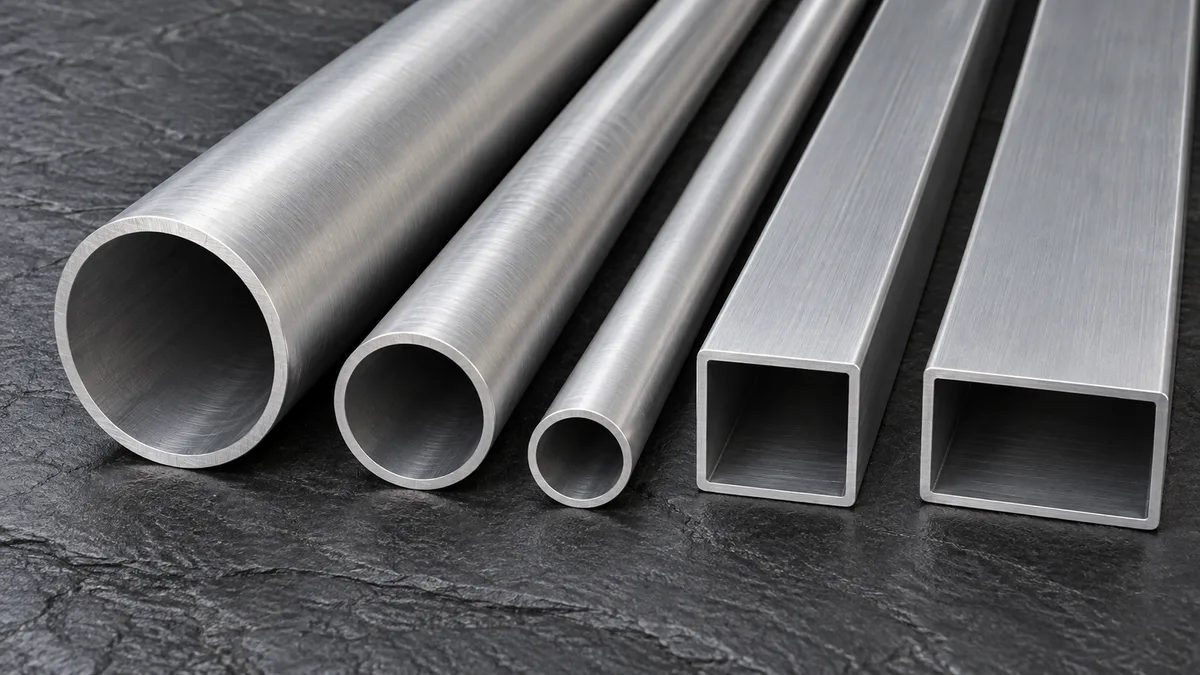
6061 tube is round hollow stock made from the magnesium-silicon alloy 6061 and heat-treated, usually to T6. It offers about twice the strength of 3003 or 6063-T5 tube while remaining easy to weld, bend in softer tempers, machine and anodise.
The same alloy is sold under several product names that buyers sometimes confuse. Extruded tube is pushed through a die and suits most structural work. Drawn seamless tube starts as an extruded hollow and is cold-drawn through a die over a mandrel, giving tighter diameter and wall tolerances, a smoother surface and slightly higher guaranteed strength; it is the route for hydraulic lines, precision sleeves and aircraft tubing. Pipe is tube made to nominal pipe sizes (NPS) and schedules so it fits standard fittings and flanges.
Because 6061 combines strength with good corrosion resistance and weldability, it is the default tube alloy in North America and much of Asia for frames, handrails, scaffolding-type structures, vehicle parts, compressed-air lines and countless machined components. In Europe, 6082 fills the same role; both are covered on this site.
| Element | Min | Max |
|---|---|---|
| Silicon (Si) | 0.40 | 0.80 |
| Iron (Fe) | — | 0.70 |
| Copper (Cu) | 0.15 | 0.40 |
| Manganese (Mn) | — | 0.15 |
| Magnesium (Mg) | 0.80 | 1.20 |
| Chromium (Cr) | 0.04 | 0.35 |
| Zinc (Zn) | — | 0.25 |
| Titanium (Ti) | — | 0.15 |
| Others each / total | — | 0.05 / 0.15 |
| Aluminium | Remainder |
Limits are those registered with the Aluminum Association and used in ASTM and EN 573-3. Magnesium and silicon form the Mg2Si precipitates that give the T6 strength; copper adds strength and chromium controls grain structure.
Drawn tube is guaranteed to higher minimums than extruded tube because cold drawing refines the structure and tightens wall control. Use the minimum for the route and wall range on your order as the design basis.
| Condition | Tensile strength | Yield strength (0.2 %) | Elongation |
|---|---|---|---|
| O, typical | 125 MPa / 18 ksi | 55 MPa / 8 ksi | 25 % |
| T4, typical | 240 MPa / 35 ksi | 145 MPa / 21 ksi | 22 % |
| T6, typical | 310 MPa / 45 ksi | 276 MPa / 40 ksi | 12 – 17 % |
| T6 extruded tube, ASTM B221 minimum | 260 MPa / 38 ksi | 240 MPa / 35 ksi | 8 – 10 % |
| T6 drawn seamless tube, minimum (B210) | 290 MPa / 42 ksi | 241 MPa / 35 ksi | By wall thickness |
| T6 near welds (design value) | 165 MPa / 24 ksi | — | — |
Solution treated and artificially aged. Full strength; the standard condition for structural and machined tube.
Stretched after quenching to relieve stress, so tube stays straight and stable when machined. Common on extruded tube for CNC work.
Naturally aged. Bends more easily; parts can be formed and then aged to T6.
Annealed for flaring, swaging, spinning and tight bends, followed by heat treatment if strength is needed.
| Product | Standard | Notes |
|---|---|---|
| Extruded tube | ASTM B221, EN 755-2 / 755-7 / 755-8 | General structural and engineering tube |
| Drawn seamless tube | ASTM B210, AMS 4080 / AMS 4082 | Tight tolerances, aircraft and precision use |
| Hydraulic tube | AMS 4083 | Drawn seamless T6 for fluid lines |
| Seamless pipe and tube | ASTM B241 / ASME SB-241 | Pressure piping, NPS sizes |
| Structural pipe and tube | ASTM B429 | Buildings, handrails, structures |
| International names | EN AW-6061, 3.3211, UNS A96061, JIS A6061TE / TD, IS 65032 |
Weight in kg/m = π × (OD − wall) × wall × 2.70 / 1000. Section modulus Z is used for bending stress.
| OD × wall (mm) | kg/m | I (cm⁴) | Z (cm³) |
|---|---|---|---|
| 10 × 1 | 0.076 | 0.03 | 0.06 |
| 12 × 1 | 0.093 | 0.05 | 0.09 |
| 16 × 1.5 | 0.184 | 0.18 | 0.23 |
| 20 × 2 | 0.305 | 0.46 | 0.46 |
| 25 × 2 | 0.390 | 0.96 | 0.77 |
| 30 × 3 | 0.687 | 2.35 | 1.56 |
| 40 × 3 | 0.942 | 6.01 | 3.00 |
| 50 × 3 | 1.196 | 12.28 | 4.91 |
| 50 × 5 | 1.909 | 18.11 | 7.25 |
| 60 × 4 | 1.900 | 27.73 | 9.24 |
| 80 × 5 | 3.181 | 83.20 | 20.80 |
| 100 × 5 | 4.029 | 168.81 | 33.76 |
| 120 × 10 | 9.331 | 527.00 | 87.83 |
| 150 × 10 | 11.875 | 1083.06 | 144.41 |
| 200 × 15 | 23.538 | 3754.15 | 375.42 |
Schedule pipe weights (ASTM B241 dimensions):
| NPS | OD (mm) | Sch 40 wall | Sch 40 kg/m | Sch 80 wall | Sch 80 kg/m |
|---|---|---|---|---|---|
| 1/2 | 21.3 | 2.77 | 0.44 | 3.73 | 0.56 |
| 3/4 | 26.7 | 2.87 | 0.58 | 3.91 | 0.76 |
| 1 | 33.4 | 3.38 | 0.86 | 4.55 | 1.11 |
| 1-1/2 | 48.3 | 3.68 | 1.39 | 5.08 | 1.86 |
| 2 | 60.3 | 3.91 | 1.87 | 5.54 | 2.57 |
| 3 | 88.9 | 5.49 | 3.88 | 7.62 | 5.25 |
| 4 | 114.3 | 6.02 | 5.53 | 8.56 | 7.68 |
| 6 | 168.3 | 7.11 | 9.72 | 10.97 | 14.64 |
| 8 | 219.1 | 8.18 | 14.63 | 12.7 | 22.23 |
Extruded tube follows the ANSI H35.2 tables (ASTM orders) or EN 755-7 for seamless and EN 755-8 for porthole tube. Drawn tube is held to the tighter B210 or EN 754-7 tables; typical OD tolerance on small drawn tube is a few hundredths of a millimetre. Straightness, ovality and wall eccentricity matter for precision sleeves and hydraulic fittings, so state limits on the drawing when standard tables are not enough.
T6 tube bends to a centreline radius of roughly 3 – 5 × OD on a mandrel bender, depending on wall. For tighter radii, bend in O or T4 and age afterwards.
TIG or MIG with ER4043 (crack-resistant) or ER5356 (stronger fillets, better anodise match). Expect reduced strength in the heat-affected zone.
Turns and bores well in T6 with sharp carbide tools; T6511 keeps long sleeves straight after boring.
Flaring, beading and swaging are best done in O or T4 temper.
Anodises clear or coloured, hard-anodises for wear, and accepts powder coating.
Isolate from steel or stainless fittings with washers or sealant to avoid galvanic corrosion.
| 6061-T6 | 6063-T6 | 6082-T6 | 7075-T6 | |
|---|---|---|---|---|
| Typical yield | 276 MPa | 214 MPa | 260 – 310 MPa | 505 MPa |
| Weldable | Yes | Yes | Yes | Not recommended |
| Surface finish | Good | Excellent | Good | Fair |
| Drawn seamless availability | Wide | Wide | Moderate | Moderate |
| Typical use | Structural, fluid lines | Architectural, furniture | European structural | Highly stressed parts |
Extruded tube is pushed through a die and suits structural work. Drawn seamless tube is extruded and then cold-drawn over a mandrel, giving tighter tolerances, a smoother surface and a higher minimum tensile strength (290 MPa against 260 MPa in T6).
Use π × (OD − wall) × wall × 2.70 / 1000. A 50 × 3 mm tube weighs about 1.20 kg/m and a 25 × 2 mm tube about 0.39 kg/m.
Yes, on a mandrel bender with a centreline radius of roughly 3 – 5 times the OD. Tight bends risk cracking in T6; bend in O or T4 temper and age to T6 afterwards if needed.
Seamless 6061-T6 pipe to ASTM B241 / ASME SB-241 is used for pressure piping, compressed air and process lines. Porthole (structural) tube should not be used for pressure unless the specification allows it.
EN AW-6061 to EN 755-2. Many European designs specify 6082-T6 tube instead, which has similar or slightly higher strength.
Yes. Metline supplies 6061 tube and pipe worldwide with mill test certificates and export packing.
Tell us the product route, OD, wall, temper, length and destination, and we will quote availability, certification and freight.





