T651
Solution heat-treated, stretched to relieve quench stress and artificially aged. Standard for 6061, 6082, 7075 and 2xxx plate that will be machined.



Aluminium plate is rolled aluminium more than 6 mm thick, supplied in grades from soft commercial-purity 1050 to aerospace 7075 and 7050. Choosing the right plate means matching the alloy and temper to strength, corrosion, welding and machining needs. Metline supplies every common plate grade, cut to size and certified to ASTM, AMS and EN standards, to customers worldwide.
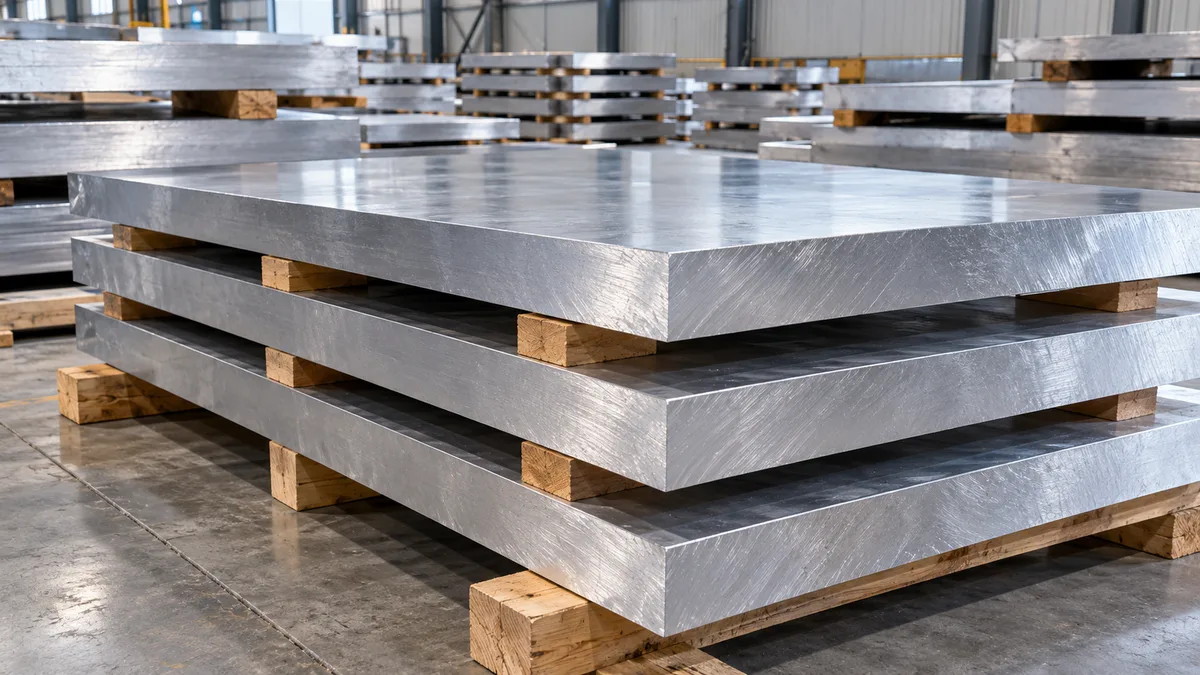
Rolled aluminium is called plate once it is thicker than about 6 mm. ASTM B209 draws the line at 0.250 in (6.35 mm); European practice under EN 485 treats material above 6 mm as plate. Below that it is sheet, and very thin rolled material is foil. The distinction matters because plate is hot rolled, often stress-relieved by stretching, and supplied to thicker-section property limits and tolerances.
Plate is the starting material for parts that are machined, welded into structures or cut into heavy blanks: ship hulls and decks, tank and pressure-vessel shells, machine bases, moulds, aircraft frames and wing ribs, armour, truck and rail bodies, and semiconductor equipment. In each case the alloy is chosen for a different reason, which is why aluminium plate is offered in so many grades.
The single most useful question when choosing plate is "what will happen to it next?" Heavy machining points to a stress-relieved temper such as T651 or a cast tooling plate. Welding into a structure points to 5xxx or 6xxx alloys. Exposure to seawater points to 5083 or 5086 in H116 or H321. High stress and fatigue point to 2xxx or 7xxx aerospace alloys. See our plate vs sheet article for the full definitions.
| Series | Main alloying element | Heat-treatable | Common plate grades | Chosen for |
|---|---|---|---|---|
| 1xxx | None (≥ 99 % Al) | No | 1050, 1060, 1070, 1100 | Conductivity, chemical tanks, formability |
| 2xxx | Copper | Yes | 2024, 2014, 2219, 2124 | High strength and fatigue resistance; aerospace and high-temperature parts |
| 3xxx | Manganese | No | 3003, 3103 | Moderate strength, good corrosion resistance and formability |
| 4xxx | Silicon | Some | 4015, 4047 | Brazing and special thermal applications |
| 5xxx | Magnesium | No | 5083, 5086, 5754, 5454, 5251, 5052 | Weldable, marine-grade corrosion resistance, cryogenic toughness |
| 6xxx | Magnesium + silicon | Yes | 6061, 6082, 6063 | General engineering: strength, machinability, weldability |
| 7xxx | Zinc | Yes | 7075, 7050, 7475, 7020 | Highest strength; aerospace, moulds, defence |
Commercial-purity and 3xxx plate are also commonly ordered in architectural 5005 for anodised panels. For detailed chemistry of each grade, follow the links in the related section; every Metline delivery carries a certificate with the actual analysis of the lot.
Typical values show what the material usually achieves; specified minimums in ASTM B209, B928 and EN 485-2 are what you design to. Minimums for heat-treated plate fall as thickness increases, so always check the band that matches your plate.
| Grade / temper | Tensile strength | Yield strength (0.2 %) | Basis | Density (g/cm³) |
|---|---|---|---|---|
| 3003-H14 | 150 MPa | 145 MPa | Typical | 2.73 |
| 5052-H32 | 228 MPa | 193 MPa | Typical | 2.68 |
| 5754-H111 | 190 MPa | 80 MPa | EN 485-2 minimum | 2.67 |
| 5083-H111 / O | 290 MPa | 145 MPa | Typical | 2.66 |
| 5083-H116 / H321 | 305 MPa | 215 MPa | ASTM B928 minimum | 2.66 |
| 6061-T651 | 310 MPa | 276 MPa | Typical | 2.70 |
| 6082-T651 | about 300 MPa | about 255 MPa | EN 485-2 minimum, mid thickness | 2.70 |
| 2024-T351 | 469 MPa | 324 MPa | Typical | 2.78 |
| 2219-T851 | 455 MPa | 352 MPa | Typical | 2.84 |
| 7075-T651 | 572 MPa | 503 MPa | Typical | 2.81 |
| 7050-T7451 | 524 MPa | 469 MPa | Typical | 2.83 |
Typical values from Aluminum Association and ASM data. The governing values for your order are the minimums of the specification and thickness band, reported on the EN 10204 3.1 certificate.
Solution heat-treated, stretched to relieve quench stress and artificially aged. Standard for 6061, 6082, 7075 and 2xxx plate that will be machined.
Over-aged 7xxx tempers. Slightly lower strength than T651 but far better resistance to stress-corrosion cracking; standard in aircraft structure.
Solution treated, stretched and naturally aged. The usual temper for 2024 plate, giving high fatigue resistance.
Marine tempers for 5083, 5086 and 5456 tested for resistance to exfoliation and intergranular corrosion (ASTM B928). Required by ship classification societies.
Annealed or lightly worked 5xxx and 3xxx plate for forming, welding and general fabrication.
Cast and precision-milled plate (often 5083-based) with very low internal stress and tight flatness; chosen for jigs and machine tables rather than strength.
| System | Standard | Scope |
|---|---|---|
| ASTM / ASME | ASTM B209 (ASME SB-209) | General sheet and plate; properties and tolerances via ANSI H35.2 |
| ASTM marine | ASTM B928 | 5xxx plate for marine service, H116 and H321 corrosion testing |
| European | EN 485-1 to -4, EN 573-3 | Delivery conditions, properties, tolerances and chemistry |
| Aerospace | SAE AMS 4027, 4037, 4045, 4050 and others; AMS-QQ-A-250 | 6061, 2024, 7075 and 7050 plate for aircraft use |
| Ultrasonic inspection | ASTM B594, AMS-STD-2154 | Internal soundness of thick plate |
| Japan / China / India | JIS H4000, GB/T 3880, IS 737 | National sheet and plate standards |
Classification-society approval (DNV, ABS, Lloyd's Register, BV and others) is a separate requirement for ship plate and is certified by the producing mill. State it in your enquiry if your project needs it.
Weight per m² is thickness in mm × density. The table uses 2.70 g/cm³ (6061, 6082); for 5083 multiply by 0.985, for 2024 by 1.03 and for 7075 by 1.04.
| Thickness (mm) | kg per m² | 1250 × 2500 mm (kg) | 1500 × 3000 mm (kg) |
|---|---|---|---|
| 6 | 16.2 | 50.6 | 72.9 |
| 8 | 21.6 | 67.5 | 97.2 |
| 10 | 27.0 | 84.4 | 121.5 |
| 12 | 32.4 | 101.2 | 145.8 |
| 15 | 40.5 | 126.6 | 182.2 |
| 16 | 43.2 | 135.0 | 194.4 |
| 20 | 54.0 | 168.8 | 243.0 |
| 25 | 67.5 | 210.9 | 303.8 |
| 30 | 81.0 | 253.1 | 364.5 |
| 35 | 94.5 | 295.3 | 425.2 |
| 40 | 108.0 | 337.5 | 486.0 |
| 50 | 135.0 | 421.9 | 607.5 |
| 60 | 162.0 | 506.3 | 729.0 |
| 70 | 189.0 | 590.6 | 850.5 |
| 80 | 216.0 | 675.0 | 972.0 |
| 100 | 270.0 | 843.8 | 1215.0 |
| 120 | 324.0 | 1012.5 | 1458.0 |
| 150 | 405.0 | 1265.6 | 1822.5 |
| 200 | 540.0 | 1687.5 | 2430.0 |
Thickness, width, length and flatness tolerances follow ANSI H35.2 for ASTM orders and EN 485-3 (hot-rolled plate) for EN orders. Saw-cut blanks are typically held to about ±0.5 – 1 mm, and precision-milled plate to a few hundredths of a millimetre in thickness, when ordered.
| Application | Usual grades | Why |
|---|---|---|
| Ship hulls and decks | 5083-H116 / H321, 5086, 5456 | Seawater corrosion resistance, weld strength, class approval |
| Storage tanks and pressure vessels | 5083, 5454, 5052, 3003 | Weldability, corrosion resistance, ASME code acceptance |
| LNG and cryogenic tanks | 5083-O | Strength and toughness increase at low temperature |
| Machined parts and fixtures | 6061-T651, 6082-T651, cast tooling plate | Machinability and dimensional stability |
| Moulds and dies | 7075-T651, 6061-T651, 5083 | Strength, hardness, thermal conductivity |
| Aircraft structure | 2024-T351, 7075-T7351, 7050-T7451, 2219 | Strength, fatigue and stress-corrosion resistance |
| Truck, trailer and rail bodies | 5083, 5754, 6082 | Weldable, lightweight, durable |
| Armour | 5083, 7020, 7039 | Ballistic performance with weldability |
| Electrical bus plate | 1050, 1060, 6101 | Electrical conductivity |
Plate starts above about 6 mm. ASTM B209 defines plate as 0.250 in (6.35 mm) and thicker; EN practice treats material over 6 mm as plate. Thinner rolled product is sheet.
5083 in H116 or H321 temper, or 5086, tested to ASTM B928 for resistance to exfoliation and intergranular corrosion. These grades are accepted by classification societies for hulls and decks.
Among common grades, 7075-T651 (typical tensile strength about 572 MPa) and 7050-T7451 (about 524 MPa). 2024-T351 is lower in strength but has excellent fatigue resistance.
They are close substitutes with similar strength, machinability and weldability. 6061 is the standard in the Americas and Asia; 6082 is more common in Europe and slightly stronger in thick sections.
Thickness in mm × 2.70 gives kg per m² for 6061 or 6082. A 1,250 × 2,500 × 10 mm plate weighs about 84 kg; a 1,500 × 3,000 × 20 mm plate about 243 kg.
Yes. Metline supplies aluminium plate in full sizes or cut to your list by saw, waterjet or CNC, with mill test certificates, to customers worldwide.
Send the grade, temper, thickness, size and quantity. We will reply with availability, certification and a delivered price.





