Match filler to furnace
For vacuum brazing use 4004 or 4104 clad. For CAB lines, discuss flux and core options before choosing 6951.



6951 is the heat-treatable core alloy used in brazing sheet when a brazed heat exchanger must be stronger than one built from 3003. Clad with an aluminium-silicon filler layer, usually magnesium-bearing 4004 or 4104 for vacuum brazing, it brazes at about 590 – 605 °C and can then be aged to recover strength. Metline supplies 6951-core clad sheet, coil, strip and bare or clad fin stock to your build-up, worldwide.
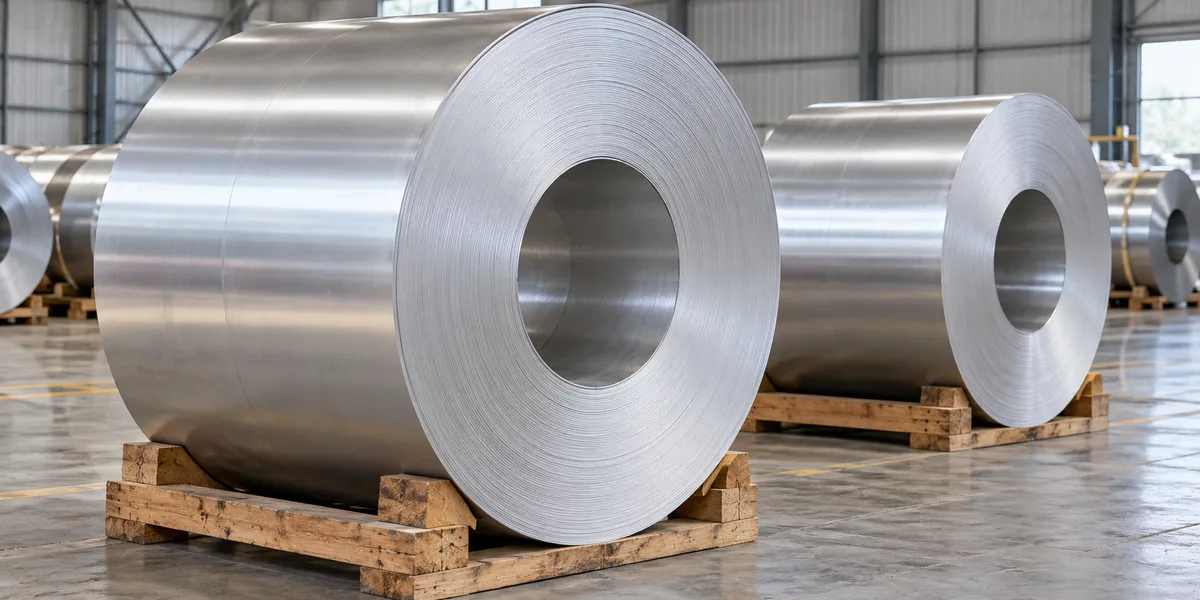
Brazing sheet is a roll-bonded composite: a core alloy that provides strength and a thin cladding of aluminium-silicon filler that melts in the furnace and forms the joints. Most brazing sheet uses a 3003 or modified 3xxx core. 6951 is chosen when the finished exchanger needs more strength or pressure capacity than a non-heat-treatable core can give.
6951 can do this because it is an age-hardening Al-Mg-Si-Cu alloy with low silicon, so its solidus (around 615 °C) stays above the brazing temperature. The brazing cycle itself acts as a solution treatment; if the assembly is cooled quickly and then aged, much of the T6 strength returns. A 3003 core, by contrast, is fully annealed after brazing and cannot be strengthened again.
The magnesium in 6951 (0.4 – 0.8 %) is an advantage in vacuum brazing, where magnesium helps break down the oxide film, and a drawback in flux (CAB) brazing, where magnesium reacts with standard fluoride flux. For that reason 6951-core sheet is mainly a vacuum-brazing product, used in plate-fin exchangers, oil coolers, cold plates and aerospace thermal hardware.
| Build-up | Brazing route | Approx. braze temperature | Typical use | Notes |
|---|---|---|---|---|
| 4004 / 6951 / 4004 | Vacuum | 590 – 605 °C | Plate-fin parting sheets, cold plates, oil coolers | Mg in 4004 supports fluxless brazing |
| 4104 / 6951 / 4104 | Vacuum | 590 – 605 °C | As above, where better wetting is needed | Bismuth addition improves fillet formation |
| 4004 / 6951 (one side) | Vacuum | 590 – 605 °C | Parts brazed on one face only | Bare face can be machined or anodised |
| 4045 or 4343 / 6951 | CAB with special flux, or vacuum with Mg source | 595 – 610 °C | Low-volume or specialist assemblies | Mg in the core limits standard CAB flux; trials recommended |
| 4343 / 6951 / 7072 | Vacuum or modified CAB | 595 – 610 °C | Coolers exposed to corrosive coolant or condensate | 7072 (Al-1Zn) liner corrodes sacrificially to protect the core |
| Bare 6951 fin | Brazed to clad parting sheet | 590 – 605 °C | High-strength fins in plate-fin cores | Fins receive filler from the clad sheet |
Temperatures are typical ranges; the furnace cycle is set by the filler, part mass and fixture design. High-volume CAB radiator and condenser lines normally use low-magnesium 3xxx cores rather than 6951.
| Alloy | Si | Mg | Cu | Zn | Other key limits |
|---|---|---|---|---|---|
| 6951 (core) | 0.20 – 0.50 | 0.40 – 0.80 | 0.15 – 0.40 | ≤ 0.20 | Fe ≤ 0.80; Mn ≤ 0.10 |
| 4004 (clad) | 9.0 – 10.5 | 1.0 – 2.0 | ≤ 0.25 | ≤ 0.20 | Fe ≤ 0.80 |
| 4104 (clad) | 9.0 – 10.5 | 1.0 – 2.0 | ≤ 0.25 | ≤ 0.20 | Bi 0.02 – 0.20 |
| 4045 (clad) | 9.0 – 11.0 | ≤ 0.05 | ≤ 0.30 | ≤ 0.10 | Fe ≤ 0.80 |
| 4343 (clad) | 6.8 – 8.2 | — | ≤ 0.25 | ≤ 0.20 | Fe ≤ 0.80 |
| 7072 (liner) | Si + Fe ≤ 0.7 | ≤ 0.10 | ≤ 0.10 | 0.8 – 1.3 | Sacrificial anode layer |
Summary of Aluminum Association registered limits; certificates report the actual analysis of core and clad.
The mechanical properties of brazing sheet depend on the core, the clad ratio and the condition. Because the clad layer is weak, a thicker clad lowers the overall strength of the composite. The figures below are for the 6951 core alloy itself and show why post-braze ageing matters.
| Condition of 6951 | Typical tensile strength | Typical yield strength | Comment |
|---|---|---|---|
| O (annealed, as supplied for forming) | ≈ 110 MPa | ≈ 40 MPa | Best formability for stamping plates and fins |
| After brazing, slow-cooled | Low; close to annealed | Low | Strength not recovered |
| After brazing, fast-cooled and aged (≈ T6) | Up to ≈ 270 MPa | Up to ≈ 230 MPa | Requires quench from braze temperature and ageing around 160 °C |
| 3003 core after brazing (for comparison) | ≈ 110 MPa | ≈ 40 MPa | Cannot be strengthened by heat treatment |
In practice, vacuum furnaces cool more slowly than a water quench, so post-braze strength is usually below full T6. Gas-fan quenching after the braze and a controlled ageing step bring the assembly closer to it. Ask us for the clad ratio and temper that suit your cycle.
| Form | Typical thickness | Width / length | Use |
|---|---|---|---|
| Clad sheet | ≈ 0.2 – 3.0 mm | Cut sheets to order | Parting sheets, cover plates, cold-plate lids |
| Clad coil | ≈ 0.2 – 3.0 mm | Slit widths, coil to order | Continuous stamping of plates and tubes |
| Strip | ≈ 0.1 – 0.5 mm | Narrow slit widths | Fin forming and precision stamping |
| Fin stock / foil | ≈ 0.08 – 0.15 mm | Narrow coils | Corrugated fins, bare or clad |
For vacuum brazing use 4004 or 4104 clad. For CAB lines, discuss flux and core options before choosing 6951.
Heat-treatable cores can sag more than 3003 at brazing temperature. Support large thin parts and avoid excessive peak temperature.
Long soak times let silicon diffuse into thin cores and fins. Keep time at temperature short and clad ratios appropriate to gauge.
Post-braze strength depends on cooling rate. Gas quenching and a separate ageing step give the best results.
For coolant or condensate exposure, add a 7072 liner or design for a sacrificial fin system.
Seal plates and side bars are often 3003 or 6951 bar; check that all parts survive the same braze cycle.
| Factor | 6951 core | 3003 core |
|---|---|---|
| Heat-treatable | Yes | No |
| Post-braze strength | Higher, if quenched and aged | Annealed level |
| Best brazing route | Vacuum (fluxless) | CAB (flux) and vacuum |
| Sag resistance at braze temperature | Lower | Higher |
| Typical use | Pressure- and fatigue-critical exchangers | High-volume automotive and HVAC exchangers |
| Relative cost | Higher | Lower |
Choose 6951 when strength after brazing is the design driver, typically for higher-pressure or lighter-gauge vacuum-brazed exchangers. Choose 3003 or a long-life 3xxx core for high-volume CAB production where cost and process window matter most.
6951 is heat-treatable, so after brazing it can be quenched and aged to regain strength. 3003 is left in the annealed condition after brazing and cannot be strengthened again.
For vacuum brazing, 4004 or 4104, which contain magnesium to help break the oxide film. 4045 or 4343 can be used in some cases, but the magnesium in 6951 makes standard CAB flux brazing difficult.
Typically about 590 – 605 °C for 4004 / 4104 clad in vacuum. The exact cycle depends on part mass and fixture.
It is possible with special fluxes or careful trials, but it is not the normal route. High-volume CAB lines generally use low-magnesium 3xxx cores.
Commonly 5 – 15 % of total thickness on each side, chosen to suit gauge and joint size.
Yes, bare or clad 6951 fin stock in thin gauges, along with clad sheet and coil, shipped worldwide.
Send your core and clad build-up, gauges, widths and quantities. We will confirm supply and certification.





