Pneumatic and hydraulic cylinders
Honed 6061 or 6063 barrels, often hard anodised, for light and corrosion-resistant actuators.



Large diameter aluminium tube can be made by extrusion, cold drawing, forging and boring, back extrusion or welding, and each route gives a different combination of size, tolerance, surface finish and cost. This guide explains which route suits which requirement, what tolerances are realistic, how precision tube is inspected and how to specify it so that cylinders, rollers, vessels and structural sleeves arrive ready to machine or install.
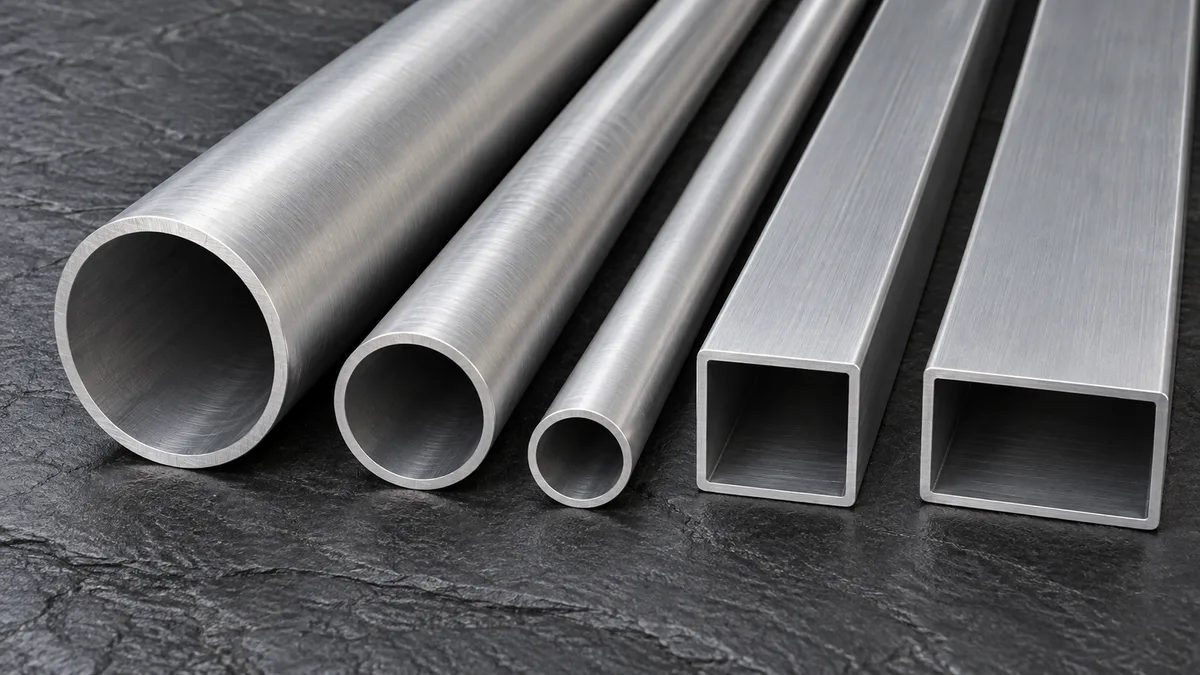
"Large diameter" usually means aluminium tube above roughly 100 – 150 mm outside diameter, where standard extrusion presses run out of capacity and wall-thickness control becomes harder. "High precision" means tolerances on diameter, wall, straightness, ovality and concentricity that are noticeably tighter than the default tables in ASTM B221 or EN 755, often combined with a fine internal or external surface.
Such tubes are used for pneumatic and hydraulic cylinder barrels, printing and film-handling rollers, vacuum and pressure vessels, gas-storage and hydrogen cylinder shells, telescopic masts, optical and instrument housings, and heavy structural sleeves in marine, aerospace and defence equipment. In each case the tube is either a functional surface (a bore that a seal runs on, a roller face that touches film) or a load-bearing shell whose wall must be uniform for predictable stress.
Precision is achieved partly by choosing the right primary process and partly by finishing: cold drawing, turning, boring, honing, roller burnishing and stress relief. Knowing which tolerances come from which step is the key to a sensible specification and a sensible price.
| Route | How it works | Strengths | Limits |
|---|---|---|---|
| Seamless extrusion (piercing / mandrel) | Hollow billet extruded over a mandrel | No seam; suitable for pressure; all alloys including 2xxx and 7xxx | Diameter limited by press and container size |
| Porthole (bridge-die) extrusion | Metal splits around die bridges and rewelds | Economical for 6xxx, good surface | Longitudinal weld seams; not used for high-pressure service in some codes |
| Cold drawing | Extruded tube pulled through a die over a plug or mandrel | Tightest as-produced tolerances and best surface | Diameter and wall range limited by draw bench capacity |
| Forging, back extrusion and boring | Billet pierced, back-extruded or ring-forged, then machined | Very large diameters and thick walls; worked, sound structure | Higher cost; machining sets final tolerance |
| Roll-bent plate or spiral welding | Plate or strip formed and welded longitudinally or helically | Largest diameters, long lengths, thinner walls | Weld seam; tolerances depend on fabrication; mostly 5xxx alloys |
For pressure-bearing and safety-critical tubes, seamless extrusion or forging is normally specified. For large rollers and frames, porthole extrusion or welded tube is often adequate and cheaper. When the bore is a working surface, plan a drawing, honing or boring step regardless of the primary route.
Welded large pipe deserves a separate word. Spiral (helical) welding of 5xxx strip, typically 5052, 5754 or 5083, produces very large diameters and long lengths for ducts, water and process lines and storage structures, and longitudinal welding of roll-bent plate does the same for shorter, thicker shells. The weld and its heat-affected zone set the design strength in non-heat-treatable alloys, so welding procedures, filler choice (ER5356 or ER5183) and radiographic or ultrasonic weld inspection belong in the specification alongside the dimensional tolerances.
| Alloy and temper | Character | Typical large-tube uses |
|---|---|---|
| 6061-T6 / T6511 | Strong, weldable, corrosion resistant, anodises well | Cylinder barrels, rollers, structural sleeves, hydrogen and gas cylinder shells |
| 6063-T5 / T6 | Excellent surface and anodising, moderate strength | Rollers and housings where finish matters more than strength |
| 6005 / 6082-T6 | Slightly stronger 6xxx alternatives | Structural and transport tubes, European specifications |
| 5083-O / H112 | Non-heat-treatable, outstanding seawater and cryogenic performance, weldable | Marine and cryogenic vessels, pressure tubes, welded pipe |
| 5052 / 5754 | Good formability and corrosion resistance | Welded and spiral pipe, thin-wall shells |
| 2024-T3 / T351 / T4 | High strength and fatigue resistance | Aerospace tubes and support members |
| 7075-T6 / T73 | Highest strength | Highly loaded masts, sleeves and defence parts |
Machining stability is often as important as strength for precision work. Stress-relieved tempers (T6511 for extruded tube, T652 for forged tube) move less when the bore is machined. Thin-walled 7075 and 2024 tubes are particularly prone to distortion if residual quench stresses are not relieved.
Standard tolerances come from ASTM B221 / B241 and ANSI H35.2 for extruded tube, ASTM B210 for drawn seamless tube, and EN 755-7, EN 755-8 and EN 754-7 in Europe. Precision tubes are then specified tighter on the drawing. The table shows the general direction; agree exact figures for your size and alloy at quotation.
| Finish condition | Diameter and wall control | Surface | Comment |
|---|---|---|---|
| As-extruded | Standard extrusion tables; wall variation set by mandrel alignment | Mill finish with possible die lines | Lowest cost |
| Cold drawn | Considerably tighter than extruded on diameter and wall | Smooth and bright | Best value where size range allows |
| Turned and bored | Set by machining; very tight concentricity possible | As machined | Used on forged and large extruded tube |
| Honed or roller-burnished bore | Bore held to a few hundredths of a millimetre | Bore Ra in the region of 0.2 – 0.4 µm | For cylinders and seal surfaces |
| Straightened and stress relieved | Straightness improved to tight limits per metre | Unchanged | Often combined with any of the above |
Bore tolerances of ±0.05 mm and surface roughness around Ra 0.4 µm are achievable on precision-machined or honed aluminium tube; they are drawing requirements, not standard mill tolerances.
Weight per metre of a round aluminium tube is π × (OD − wall) × wall × 0.0027 kg, with dimensions in millimetres. The table gives examples for 6061 and similar alloys (density 2.70 g/cm³). Use the tube weight calculator for any other size.
| Outside diameter (mm) | Wall (mm) | Inside diameter (mm) | Weight (kg/m) |
|---|---|---|---|
| 100 | 3 | 94 | 2.5 |
| 150 | 5 | 140 | 6.1 |
| 200 | 10 | 180 | 16.1 |
| 250 | 10 | 230 | 20.4 |
| 300 | 15 | 270 | 36.3 |
| 400 | 20 | 360 | 64.5 |
| 500 | 25 | 450 | 100.7 |
| 600 | 30 | 540 | 145.0 |
| 800 | 40 | 720 | 257.9 |
| 1000 | 50 | 900 | 402.9 |
| Check | Method | Why |
|---|---|---|
| Diameter and ovality | Micrometers, bore gauges, laser or CMM at several positions | Confirms fit with seals, bearings and mating parts |
| Wall and eccentricity | Ultrasonic thickness gauge around the circumference | Uneven wall weakens pressure tubes and unbalances rollers |
| Straightness | Rollers and dial indicator or laser over length | Critical for long cylinders and rollers |
| Surface roughness | Profilometer readings on functional faces | Seal life and coating quality |
| Internal soundness | Ultrasonic or eddy-current testing | Required for pressure, aerospace and forged tubes |
| Mechanical and chemical | Tensile tests and spectrometer analysis | Confirms alloy and temper; reported on the 3.1 certificate |
| Pressure test | Hydrostatic test where specified | Proves pressure-retaining tubes |
Inspection results are summarised on an EN 10204 3.1 certificate, with dimensional reports for precision items. Third-party inspection can be arranged when the project requires it. Measure precision tubes at a stable temperature: aluminium expands about 0.023 mm per metre per °C, so a 500 mm bore grows by roughly 0.01 mm for every degree, which is a significant share of a tight tolerance.
Honed 6061 or 6063 barrels, often hard anodised, for light and corrosion-resistant actuators.
Printing, film, textile and conveyor rollers where straightness, balance and surface finish control product quality.
Seamless or forged 6061 shells for gas and hydrogen cylinders, 5083 for cryogenic and marine vessels.
Large thin-wall 2024 and 6061 tubes, 7075 sleeves and forged cylindrical parts made to drawing.
5083 and 6061 tubes for masts, davits, rails and welded structures.
Chamber bodies, beam tubes and instrument housings needing clean bores and stable dimensions.
Extruded seamless tube is limited by press size, typically to several hundred millimetres. Larger diameters, beyond one metre, are made by forging and boring, back extrusion or by rolling and welding plate. Tell us the size and we will advise the route.
Seamless tube is extruded over a mandrel from a hollow or pierced billet and has no weld lines. Porthole tube is extruded through a bridge die and contains longitudinal seams where the metal rewelds. Both are strong, but pressure codes often require seamless tube.
As-extruded tolerances follow ASTM B221 or EN 755. Cold drawing tightens them considerably, and turning, boring or honing can hold a bore to a few hundredths of a millimetre with roughness around Ra 0.4 µm. Specify tight tolerances only on functional surfaces.
6061-T6 and 6063-T6 are the most common, often hard anodised after honing. 7075 is used when wall thickness must be minimised under high pressure, and 5083 for marine or cryogenic service.
Weight in kg per metre equals π × (OD − wall) × wall × 0.0027 with dimensions in millimetres. A 300 × 15 mm tube weighs about 36.3 kg/m.
Yes. Metline supplies forged and seamless 6061 tube blanks to drawing with mechanical test results and EN 10204 3.1 certificates; the cylinder maker completes forming, testing and approval.
Send the drawing, alloy and tolerance requirements. We will recommend the manufacturing route and reply with inspection and delivery details.





