7075-T6511
Solution treated, quenched, stretched about 1 – 3 % with minor straightening, then aged to peak strength. Standard for machined bar and profiles where loads are not sustained across the grain in a corrosive setting.



7075 is one of the strongest commercial aluminium alloys, with a typical yield strength above 500 MPa in the T6 temper, close to many structural steels at a third of the weight. Metline supplies 7075 extruded bar, rod and profiles in T6511 for maximum strength and T73511 for stress-corrosion resistance, certified to ASTM, AMS and EN standards and shipped worldwide.
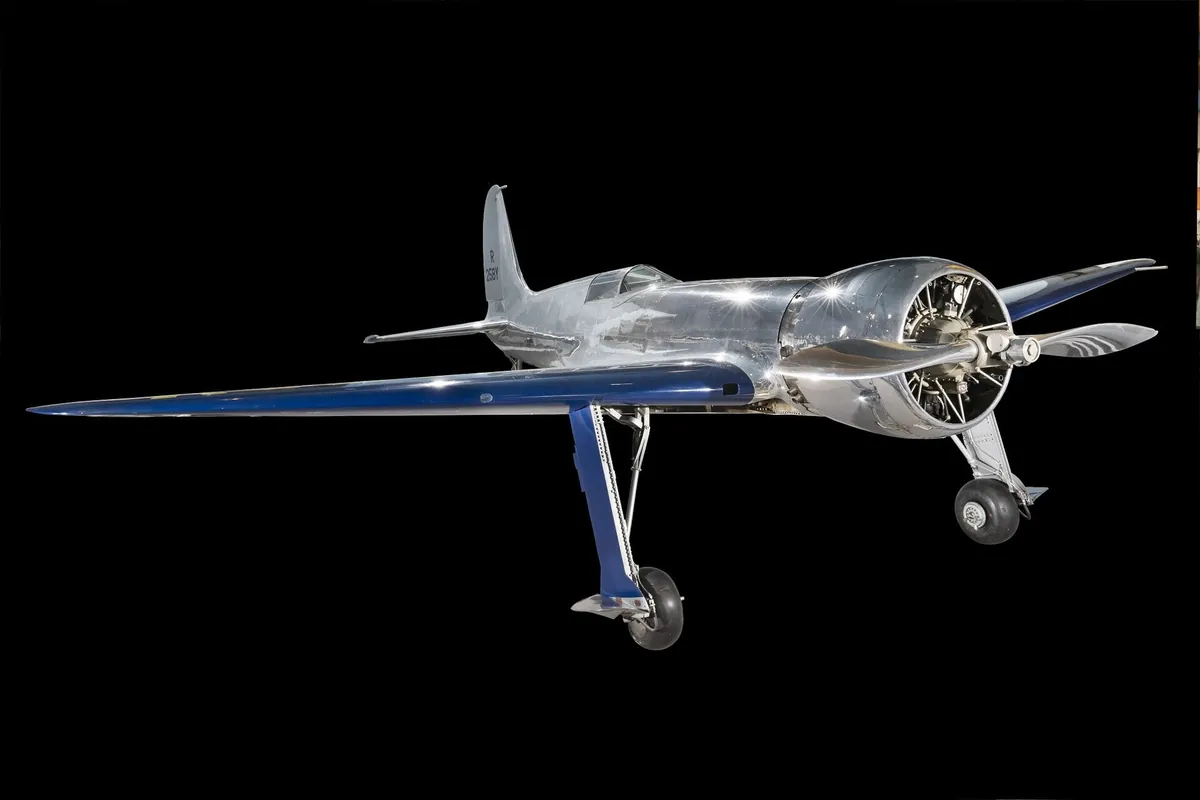
7075 is an aluminium-zinc-magnesium-copper alloy introduced in the 1940s for aircraft structures. Zinc and magnesium form very fine precipitates during ageing that give it roughly twice the strength of 6061, while copper adds strength and chromium controls grain structure.
That strength makes 7075 hard to extrude. The billet resists deformation, so presses run slowly, dies wear faster and profiles are kept to simpler shapes with thicker walls than 6xxx alloys allow. Porthole dies, which split and re-weld the metal around a mandrel, are generally avoided for 7075 because the weld seams cannot match the parent metal in strength. Hollow 7075 sections are usually made as seamless tube from pierced billet, or the design is changed to an open section.
Most 7075 extrusions are therefore bar, rod, flat bar and relatively compact profiles such as angles, tees, Z sections and stringers. They are machined into high-load parts: aircraft fittings, landing gear components, gun and optics mounts, bicycle parts, climbing hardware, moulds and racing components.
| Element | Min | Max |
|---|---|---|
| Silicon (Si) | — | 0.40 |
| Iron (Fe) | — | 0.50 |
| Copper (Cu) | 1.2 | 2.0 |
| Manganese (Mn) | — | 0.30 |
| Magnesium (Mg) | 2.1 | 2.9 |
| Chromium (Cr) | 0.18 | 0.28 |
| Zinc (Zn) | 5.1 | 6.1 |
| Titanium (Ti) | — | 0.20 |
| Others, each / total | — | 0.05 / 0.15 |
| Aluminium (Al) | Remainder |
Aluminum Association registered limits; EN AW-7075 (AlZn5.5MgCu) follows the same ranges. Aerospace orders may call for tighter limits per the AMS specification.
| Temper | Tensile strength | Yield strength (0.2 %) | Elongation | Basis |
|---|---|---|---|---|
| O (annealed) | ≤ 275 MPa | ≤ 165 MPa | 10 % min | Specified maximum strength |
| T6 / T6511, typical | about 570 MPa (83 ksi) | about 505 MPa (73 ksi) | about 11 % | Typical |
| T6 / T6511, thin sections (min.) | about 540 MPa (78 ksi) | about 480 MPa (70 ksi) | 7 % | Specified, rising slightly for medium thicknesses |
| T73 / T73511, typical | about 505 MPa (73 ksi) | about 435 MPa (63 ksi) | about 13 % | Typical |
Minimum values depend on the thickness band and the governing specification (ASTM B221, AMS or EN 755-2); the certificate states the actual values for each lot.
The two main extrusion tempers trade strength against corrosion behaviour. Peak-aged T6 gives the highest strength but is susceptible to stress-corrosion cracking (SCC) and exfoliation when stressed in the short-transverse direction in a corrosive environment. The over-aged T73 condition gives up roughly 10 – 15 % of strength in return for very high SCC resistance.
Solution treated, quenched, stretched about 1 – 3 % with minor straightening, then aged to peak strength. Standard for machined bar and profiles where loads are not sustained across the grain in a corrosive setting.
Same route but over-aged. Chosen for aircraft fittings, parts under sustained tensile stress and anything exposed to moisture or salt. Electrical conductivity is used as an acceptance check for the correct over-ageing.
An intermediate over-aged temper with better exfoliation resistance than T6 and higher strength than T73, used on some aerospace parts.
Annealed for forming, followed by solution treatment and ageing. Rare in extrusions outside aerospace.
If you are unsure, start from the environment. Dry, indoor, machined parts with mainly longitudinal loads can use T6511. Outdoor, marine or sustained-load parts should use T73511, or a modern alternative such as 7050-T7451 or T76511.
| System | Designation | Extrusion standards |
|---|---|---|
| ASTM / Aluminum Association | 7075 | ASTM B221 (extruded bar, rod, profiles and tube), ASTM B241 (seamless tube) |
| SAE aerospace | 7075-T6 / T6510 / T6511 | AMS 4154; further AMS specifications cover the T73 tempers |
| Federal / military | 7075 | AMS-QQ-A-200/11 (extrusions) |
| UNS | A97075 | — |
| European | EN AW-7075 (AlZn5.5MgCu) | EN 755-2, EN 755-9; EN 2000-series aerospace standards |
| Japan | A7075S | JIS H4100 |
| Germany (Werkstoff) | 3.4365 | — |
Size limits depend on the press and the section; send the drawing for confirmation.
Weight is easy to estimate: 7075 weighs about 2.81 kg per metre for every 1,000 mm² of cross-section. A 50 mm round bar (1,963 mm²) weighs about 5.5 kg/m, and a 25 × 100 mm flat bar about 7.0 kg/m. The bar weight calculator handles any size.
Excellent in T6 and T73: short chips, fine finish and stable dimensions in stretched tempers. Use carbide or PCD tools at high speeds.
Not recommended for structural joints: fusion welding causes hot cracking and severe strength loss. Join with fasteners, adhesives or friction stir welding where qualified.
Poor at room temperature in T6. Form in O or freshly quenched W condition, then age.
Anodises well, including hard anodising; the film has a slightly grey-yellow tone compared with 6xxx alloys.
Lower general corrosion resistance than 6xxx alloys. Anodise, apply conversion coating and primer, or use T73 tempers in exposed service.
Strength falls with prolonged exposure above about 120 °C because the alloy over-ages.
| Property | 6061-T6 | 2024-T3511 | 7075-T6511 | 7050-T7451 / T76511 |
|---|---|---|---|---|
| Typical yield strength | about 275 MPa | about 360 MPa | about 505 MPa | about 470 – 500 MPa |
| Fatigue performance | Good | Very good | Good | Very good |
| SCC resistance | High | Moderate | Low in T6, high in T73 | High |
| Weldability | Good | Poor | Poor | Poor |
| Machinability | Very good | Good | Excellent | Excellent |
| Relative cost | Low | Medium | Medium–high | High |
7075 is not a drop-in substitute for 2024: 2024 is preferred where fatigue and damage tolerance dominate, 7075 where static strength does. See 2024 vs 7075 and 7075 vs 7050.
Only to a limited degree. 7075 extrudes slowly and is normally made as bar, rod and compact open profiles. Hollow sections from porthole dies are avoided because the internal weld seams are weak; seamless tube is used instead.
T6511 is peak-aged for maximum strength. T73511 is over-aged, giving about 10 – 15 % lower strength but far better resistance to stress-corrosion cracking. Use T73511 for parts under sustained stress in humid or salty environments.
Arc welding is not recommended: the alloy is prone to hot cracking and the joint loses much of its strength. Use mechanical fastening or bonding, or a qualified friction stir welding process.
Typical 7075-T6 yield strength (about 505 MPa) exceeds that of mild structural steels such as S275 or A36, at about one-third of the density. It is less stiff, so parts are often made deeper to control deflection.
Metline supplies 7075 to ASTM, AMS and EN specifications with EN 10204 3.1 certificates. Specific testing such as ultrasonic inspection can be arranged on request.
Send the size, temper, specification and quantity. We will reply with availability, certification and a delivered price.





