Slitting
Master coils are slit into narrow strips with clean, burr-controlled edges and wound onto the core size your line uses.



Aluminium coil is rolled sheet or strip wound on itself, the form in which most flat aluminium leaves the mill and the starting stock for roll forming, stamping, cladding, cans, fins and slit strip. Common grades are 1050, 1100, 3003, 3105, 5052, 5754, 6061 and 8011, in O, H1x and H2x tempers. Metline supplies mill-finish, coated and slit coil to ASTM B209 and EN 485 for customers worldwide.
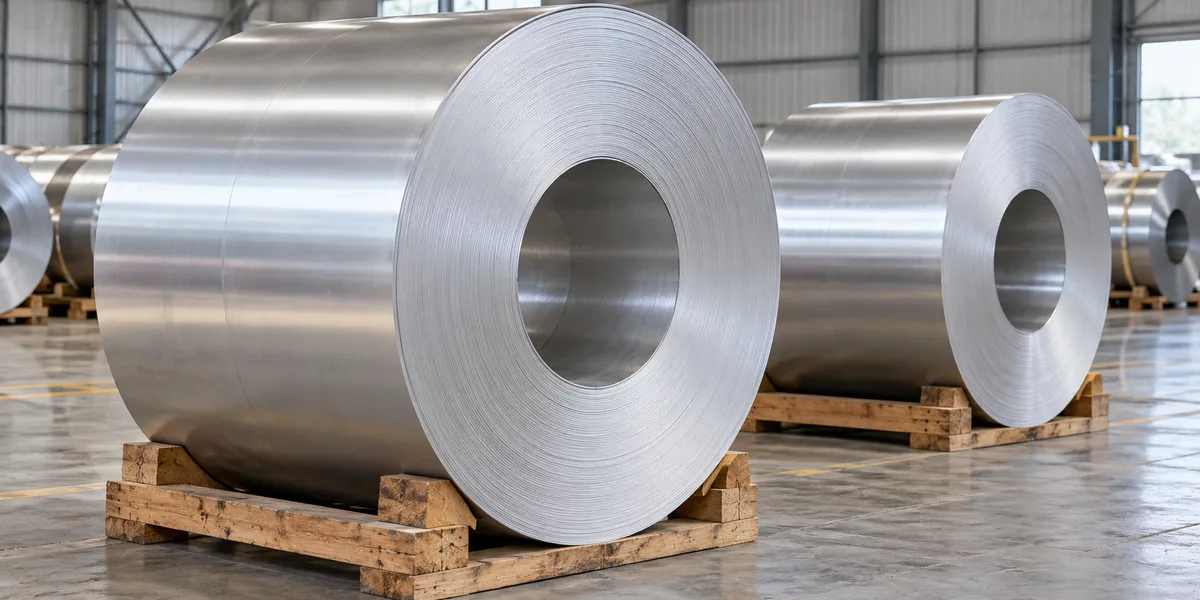
A rolling mill produces aluminium as a long continuous strip. Winding that strip into a coil is the cheapest way to store, ship and feed it, which is why manufacturers who process large volumes of sheet buy coil and cut, slit or form it on their own lines.
Coil starts either as a direct-chill (DC) cast slab that is hot rolled and then cold rolled, or as continuously cast (CC) strip that goes straight to cold rolling. DC material has a finer, more uniform structure and is preferred for deep drawing, anodising and critical surfaces; CC material is economical for general-purpose sheet, foil stock and fin stock. Cold rolling sets the final gauge and the strain-hardened temper; an anneal produces soft O temper or a partially annealed H2x temper.
The word coil is used for any wound flat product from a few hundred millimetres to around two metres wide. Narrow coils produced by slitting a wide master coil are often called strip. Very thin gauges below about 0.2 mm overlap with foil.
| Alloy | Typical tempers | Character | Typical uses |
|---|---|---|---|
| 1050 / 1060 / 1070 | O, H12, H14, H18, H24 | Very pure, highly conductive and formable | Reflectors, transformer strip, insulation jacketing, chemical equipment |
| 1100 | O, H14, H16, H18 | Commercially pure, easy to form | Fin stock, cookware, nameplates |
| 3003 / 3105 | O, H14, H16, H24, H26 | Stronger than 1xxx, good corrosion resistance | Roofing, cladding, gutters, painted coil, heat exchangers |
| 3004 | H19, H34 | Higher-strength Al-Mn-Mg | Can bodies, roofing |
| 5052 / 5754 | O, H22, H32, H34 | Strong, excellent seawater resistance | Truck bodies, tanks, marine panels, automotive inners |
| 5083 | O, H111, H116 | Highest-strength non-heat-treatable | Tanker and marine applications |
| 6061 | O, T4, T6 | Heat-treatable | Formed and aged components |
| 8011 | O, H14, H18, H24 | Al-Fe-Si | Bottle closures, fin stock, foil stock |
In H temper codes the first digit tells you how the strength was reached (1 = strain-hardened only, 2 = strain-hardened and partly annealed, 3 = stabilised) and the second digit how hard it is (2 = quarter hard, 4 = half hard, 6 = three-quarter hard, 8 = full hard). An H24 coil has roughly the strength of H14 but better elongation, so it is chosen when parts are formed after cutting.
| Alloy and temper | Tensile strength | Yield strength | Elongation |
|---|---|---|---|
| 1050-H14 | 105 – 145 MPa | ≥ 85 MPa | 2 – 6 % |
| 1100-H14 | 125 MPa (typ.) | 115 MPa (typ.) | 9 % |
| 3003-H14 | 150 MPa (typ.) | 145 MPa (typ.) | 8 % |
| 3105-H24 | 150 – 200 MPa | ≥ 120 MPa | 3 – 5 % |
| 5052-H32 | 230 MPa (typ.) | 195 MPa (typ.) | 12 % |
| 5754-H22 | 220 – 270 MPa | ≥ 130 MPa | 7 – 10 % |
| 6061-T6 | 310 MPa (typ.) | 276 MPa (typ.) | 12 % |
Ranges are EN 485-2 limits for mid-range thicknesses; "typ." marks typical values from Aluminum Association data. Limits vary by thickness band. Elongation is lower in thin gauges.
Tell us the maximum outside diameter and weight your uncoiler can take, so the coil can be wound to suit.
Coil weight follows from the volume of an annulus: weight (kg) = π/4 × (OD² − ID²) × width × density, with dimensions in metres and density 2,710 kg/m³. The table shows the result for a 1000 mm wide coil on a 508 mm core.
| Outside diameter (mm) | Weight of 1000 mm wide coil (kg) | Weight per 100 mm of width (kg) |
|---|---|---|
| 800 | 813 | 81 |
| 1000 | 1579 | 158 |
| 1200 | 2516 | 252 |
| 1400 | 3622 | 362 |
| 1600 | 4900 | 490 |
| 1800 | 6347 | 635 |
To find the length of strip in a coil, divide the weight by (thickness × width × density). A 1,000 kg coil of 1.0 mm × 1000 mm strip holds about 369 metres. The coil weight calculator does both calculations.
| Purpose | ASTM / North America | EN / international |
|---|---|---|
| Properties and general requirements | ASTM B209 / B209M | EN 485-1, EN 485-2 |
| Dimensional tolerances | ANSI H35.2 | EN 485-4 (cold-rolled); EN 485-3 (hot-rolled) |
| Chemical composition | Aluminum Association registration | EN 573-3 |
| Pre-painted coil | ASTM / AAMA performance specs | EN 1396 |
| Japan / China / India | JIS H4000 | GB/T 3880; IS 737 |
Cold-rolled coil under EN 485-4 has thickness tolerances that tighten with gauge; for example, coil around 1 mm thick and up to 1250 mm wide is typically held to a few hundredths of a millimetre. Where strip feeds a progressive die or roll former, also specify flatness, edge camber and crossbow, since these cause more line stoppages than thickness variation.
Master coils are slit into narrow strips with clean, burr-controlled edges and wound onto the core size your line uses.
Coil is levelled and sheared into flat sheets; levelling improves flatness and relieves coil set.
Polyester (PE) and PVDF coatings are applied on continuous coil-coating lines for cladding, roofing and ceilings.
Stucco and diamond patterns add stiffness and hide scratches on insulation jacketing and panels.
PE or PVC film protects the surface during forming and handling.
Coil can be supplied fully soft (O) or partially annealed (H2x) to match the forming operation.
Both are wound flat products. "Coil" usually means a full-width master coil from the mill, while "strip" means a narrower coil slit from it. Standards such as EN 485 treat them together.
Weight = π/4 × (OD² − ID²) × width × 2,710 kg/m³, with all dimensions in metres. A 1000 mm wide coil wound from 508 mm to 1200 mm OD weighs about 2,515 kg.
3003 and 3105 in H14, H16, H24 or H26 temper are the usual choices, often pre-painted with PE or PVDF. In coastal areas 5052 or 5754 offers better corrosion resistance.
505 mm or 508 mm is most common for wide coil. Slit strip is also wound on 150, 200, 300 or 400 mm cores, and 610 mm is used on some lines.
H14 is cold rolled to half-hard. H24 is rolled harder and then partially annealed back to half-hard, giving similar strength with better ductility for bending.
Yes. Coil can be slit to the widths you need, wound on your core size and packed to your coil weight limit, with a mill certificate for every shipment.
Send the grade, temper, gauge, width, core and coil weight. We will reply with availability, certification and a delivered price.





