Standard AND shapes
Angles, tees, zees, channels, H-sections and bulb shapes published in the AND10133 – AND10141 series. Widely used for repairs, light aircraft and secondary structure.



Aircraft extrusions are aluminium shapes, bars and tubes pressed through a die and then heat treated and stretched to aerospace specifications. They form the stringers, longerons, frames, spar caps, seat tracks and floor beams of almost every metal airframe. Metline supplies 2024, 7075, 7050, 7150, 6061 and other aerospace alloys as standard AND shapes, shapes to customer drawings, seat-track sections, drawn tube and bar, certified to AMS and ASTM, to customers worldwide.
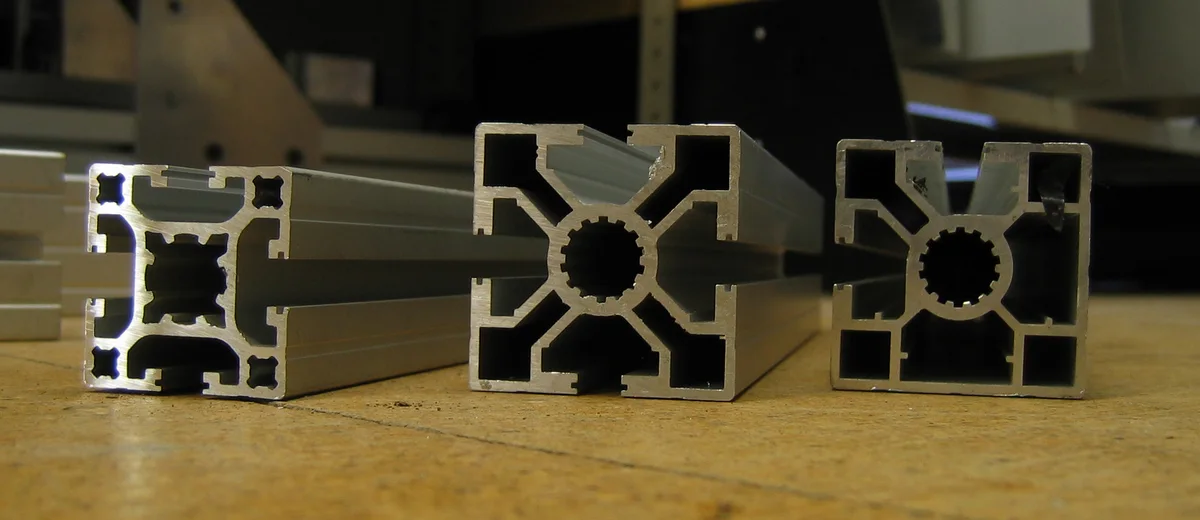
An aircraft extrusion is an aluminium section with a constant cross-section, made by forcing a heated billet through a steel die. For aerospace use it is then solution heat treated, quenched, stretched to remove residual stress and straighten it, and aged. The suffix "511" in tempers such as 2024-T3511 or 7075-T6511 records that stretching step and minor straightening.
Extrusions carry load along their length, which is exactly what stringers, longerons, frames, spar caps and floor beams need. Because the die can put material precisely where the bending or buckling load demands it, an extruded stringer with a bulb or flange is lighter than one machined from plate or roll-formed from sheet for the same job.
The aerospace extrusion market divides into three groups: standard shapes published as AND (Army-Navy) or similar drawings, which anyone can supply; proprietary airframe-maker shapes, which can only be produced against drawings the customer is authorised to use; and custom shapes designed for a specific programme. Metline supplies all three, provided the drawing rights are clear.
Angles, tees, zees, channels, H-sections and bulb shapes published in the AND10133 – AND10141 series. Widely used for repairs, light aircraft and secondary structure.
Stringers, longerons, frames, chords and floor beams to the airframe maker's or customer's drawing, produced where the customer holds the right to use the drawing.
High-strength 7xxx tracks with the standard 1-inch slot pitch, supplied as extrusion or machined to finished track.
Round, square and rectangular tube; drawn 2024-T3 and 6061-T6 tube to AMS-WW-T-700, extruded tube to AMS-QQ-A-200.
Round, square, flat and hexagon bar in 2024, 7075, 7050 and 6061 for machined fittings.
Small, thin-walled profiles for interiors, avionics racks and ducting, with tight cross-section tolerances.
| AND number | Shape | Typical use |
|---|---|---|
| AND10133 | Equal-leg angle | Stiffeners, clips, edge members |
| AND10134 | Unequal-leg angle | Frame attachments, doublers |
| AND10135 | Bulb angle | Stringers needing extra buckling resistance |
| AND10136 | Tee | Rib caps, splice members |
| AND10137 | Channel | Frames, floor members |
| AND10138 / 10139 | Equal / unequal-leg zee | Fuselage stringers and frames |
| AND10140 | H-beam | Floor beams, keel members |
| AND10141 | Bulb tee | Wing stringers |
Many aircraft programmes buy tube and bar from the same source as their shapes, so they can be certified and shipped together. Drawn tube is cold drawn over a mandrel after extrusion, giving tighter wall tolerance and a smoother finish than extruded tube; it is the normal choice for hydraulic, fuel and control-rod tubing. Extruded tube is used for larger sizes and heavier walls.
| Product | Common alloy-temper | Typical specification | Typical use |
|---|---|---|---|
| Drawn seamless tube | 2024-T3, 6061-T6 | AMS-WW-T-700/3, AMS-WW-T-700/6 | Hydraulic and fuel lines, control rods, struts |
| Drawn tube, high strength | 7075-T6 | AMS-WW-T-700/7 | Highly loaded struts and push rods |
| Extruded tube | 2024-T3511, 7075-T6511 | AMS-QQ-A-200/3, /11 | Larger structural tubes and sleeves |
| Extruded or cold-finished bar | 2024-T351, 7075-T651, 7050-T7451 | AMS-QQ-A-200, AMS 4123 | Machined fittings, bushings and pins |
| Alloy | Typical tempers | Strengths | Typical parts |
|---|---|---|---|
| 2024 | T3511, T42, T8511 | Good fatigue and damage tolerance | Fuselage stringers, lower-wing stringers, frames |
| 2014 | T6511 | High strength, good machinability | Heavy fittings and chords |
| 2219 | T3511, T8511 | Weldable, good at cryogenic and moderate temperatures | Launch-vehicle and space structures |
| 7075 | T6511, T73511, T76511 | High static strength; T73 for SCC resistance | Upper-wing stringers, spar caps, seat tracks, floor beams |
| 7050 | T74511, T76511 | High strength with good toughness and SCC resistance | Wing stringers, spar chords, frames |
| 7150 | T77511 | Higher compressive strength | Upper-wing stringers and floor beams on large transports |
| 7175 / 7149 | T73511 | High strength in thick sections, good toughness | Heavy chords and landing-gear support members |
| 6061 | T6511 | Weldable, corrosion resistant, economical | Light aircraft, struts, ground equipment, interiors |
| 6063 | T5, T6 | Excellent surface finish | Interior trim, ducts, non-structural profiles |
Older 7178 extrusions appear on legacy drawings; they are seldom specified for new parts because of low toughness. Where a drawing calls for an obsolete alloy, a design authority must approve any substitution.
Temper designations on aerospace drawings carry a lot of information. The first digits after the T describe the heat treatment; the trailing "510" or "511" describes stress relief by stretching. Choosing the wrong one is a common cause of distortion, stress-corrosion cracking or rejected parts.
Solution treated, stretched, naturally aged. Good fatigue and fracture toughness; the default for 2024 stringers and frames.
Solution treated and naturally aged by the user rather than the mill, typically after forming. Slightly lower guaranteed properties than T3511.
Solution treated, stretched and artificially aged. Higher yield and better stress-corrosion resistance than T3511, but lower toughness.
Solution treated, stretched and aged to peak strength. For 7075, use only where stress-corrosion is not a concern.
Over-aged for stress-corrosion (T73) or exfoliation (T76) resistance. T73 gives up roughly 10 – 15 % strength compared with T6.
Modern over-aged tempers balancing strength, toughness and corrosion resistance; T77 uses a three-step ageing process to keep most of the T6 strength.
T3510 and T6510 are the same as T3511 and T6511 except that no straightening is allowed after stretching. They are specified when residual stress must be kept to an absolute minimum, at the cost of looser straightness tolerances.
AMS-QQ-A-200 and its slash sheets replaced the old federal QQ-A-200 documents and remain the general specification for aerospace extrusions. Alloy-specific AMS numbers add tighter requirements. ASTM B221 covers commercial extrusions in the same alloys.
| Alloy | General specification | Representative AMS numbers | ASTM |
|---|---|---|---|
| 2014 | AMS-QQ-A-200/2 | AMS 4153 | B221 |
| 2024 | AMS-QQ-A-200/3 | AMS 4152, AMS 4164, AMS 4165 | B221 |
| 2219 | — | AMS 4162, AMS 4163 | B221 |
| 6061 | AMS-QQ-A-200/8 | AMS 4150, AMS 4160, AMS 4161, AMS 4172, AMS 4173 | B221 |
| 6063 | AMS-QQ-A-200/9 | — | B221 |
| 7050 | — | AMS 4340, AMS 4341, AMS 4342 | — |
| 7075 | AMS-QQ-A-200/11, /15 | AMS 4154, AMS 4166 – AMS 4169 | B221 |
| 7150 | — | AMS 4345 | — |
| 7175 | — | AMS 4344 | — |
Airframe makers also publish their own material specifications. Quote the exact document and revision from your drawing; Metline certifies to the specification stated on the order.
These are specified minimums as published in AMS-QQ-A-200 and ASTM B221 for the most common thickness bands. Minimums vary with section thickness, so the certificate states the band that applies to your shape.
| Alloy-temper | Tensile strength, min | Yield strength, min | Elongation, min |
|---|---|---|---|
| 6061-T6511 | 262 MPa (38 ksi) | 241 MPa (35 ksi) | 8 – 10 % |
| 2024-T3511 | 393 – 483 MPa (57 – 70 ksi) by thickness | 290 – 359 MPa (42 – 52 ksi) | 8 – 12 % |
| 2024-T8511 | ~455 MPa (66 ksi) | ~400 MPa (58 ksi) | ~5 % |
| 7075-T6511 | 538 – 558 MPa (78 – 81 ksi) by thickness | 483 – 496 MPa (70 – 72 ksi) | 7 % |
| 7075-T73511 | ~469 – 483 MPa (68 – 70 ksi) | ~400 – 421 MPa (58 – 61 ksi) | 7 – 8 % |
Values summarised for comparison; the governing table in the specification is authoritative. Several elongation and yield values on an earlier version of this page contained typing errors and have been corrected.
Unless a drawing gives tighter limits, aerospace extrusions follow the standard tolerance tables of ANSI H35.2 (referenced by ASTM B221 and AMS-QQ-A-200). Tolerances depend on the dimension, on whether it is a metal or a space dimension, and on the circumscribing-circle size. Hard 2xxx and 7xxx alloys carry slightly wider tolerances than 6xxx alloys. The table shows indicative metal-dimension tolerances for 2xxx and 7xxx shapes.
| Specified dimension (in) | Tolerance (± in) | Specified dimension (mm) | Tolerance (± mm) |
|---|---|---|---|
| up to 0.124 | 0.006 | up to 3.15 | 0.15 |
| 0.125 – 0.249 | 0.007 | 3.18 – 6.32 | 0.18 |
| 0.250 – 0.499 | 0.008 | 6.35 – 12.67 | 0.20 |
| 0.500 – 0.749 | 0.009 | 12.70 – 19.02 | 0.23 |
| 0.750 – 0.999 | 0.010 | 19.05 – 25.37 | 0.25 |
| 1.000 – 1.499 | 0.012 | 25.40 – 38.07 | 0.30 |
| 1.500 – 1.999 | 0.014 | 38.10 – 50.77 | 0.36 |
| 2.000 – 3.999 | 0.024 | 50.80 – 101.57 | 0.61 |
| 4.000 – 5.999 | 0.034 | 101.60 – 152.37 | 0.86 |
Straightness, twist, flatness, angularity and corner radii have their own tolerance tables. For shapes that will be machined, ask for a machining allowance rather than tightening the as-extruded tolerance.
Saw cutting to length, with squareness and burr-free ends; standard lengths of 10, 12, 20 and 24 ft or metric equivalents.
Seat-track slots, lightening holes, joggles and end fittings machined to drawing on request.
Re-solution treatment and ageing of formed parts per AMS 2770 can be arranged through approved processors.
Stretch forming of frames and stringers is usually done in W or T3/T4 condition before final ageing.
Chromic, sulphuric or boric-sulphuric anodising, or conversion coating, through qualified processors.
Dimensional checks against drawing, conductivity and hardness for 7xxx tempers, ultrasonic inspection where specified.
A typical example: a narrow-body fuselage uses 2024-T3511 or 7075-T73511 zee and hat stringers riveted to the skin at roughly 150 – 250 mm spacing, crossed by formed or extruded frames. Upper-wing stringers on large transports use stronger 7150 or 7055 tempers because the upper skin is loaded mainly in compression.
| Factor | Extruded shape | Machined from plate | Roll-formed sheet |
|---|---|---|---|
| Cross-section freedom | High: bulbs, varying thickness, closed shapes | Very high | Limited to constant thickness |
| Material utilisation | Good | Poor for long thin parts | Excellent |
| Tooling cost | Moderate die cost | None | Roll set cost |
| Length | Long lengths, limited by press and stretcher | Limited by plate length | Continuous |
| Typical aerospace use | Stringers, chords, floor beams, seat tracks | Integral panels, short fittings | Light frames and stringers on smaller aircraft |
Extrusions are usually the lowest-weight answer for long, constant-section load paths. Machining from plate makes sense for short parts or where the section must change along the length; roll-forming suits thin, constant-thickness sections in 2024 or 7075 sheet, often produced in O or W condition and heat treated afterwards.
Aerospace extrusions are long, heat-treated parts with tight straightness tolerances, so packing must stop bending, chafing and moisture. Each length is identified with alloy, temper, specification and lot number so that traceability is kept through to the end user.
The extrusion was stress-relieved by stretching after quenching and may have received minor straightening afterwards. It reduces distortion during machining.
Yes, where the customer holds the right to use the drawing and supplies it with the order, or for parts already approved under the customer's programme.
2024-T3511 has better fatigue and damage tolerance and suits tension-loaded areas such as the lower wing and fuselage. 7075, 7050 and 7150 give higher strength for compression-loaded areas such as the upper wing.
Common aerospace lengths are 10, 12, 20 and 24 ft, with metric or cut-to-length options on request.
Yes, for repairs, light aircraft, ground equipment and secondary structure. Many newer programmes use drawing-specific shapes instead.
For parts machined to drawing, first article inspection to AS9102 can be arranged on request, together with EN 10204 3.1 material certificates.
Send AND numbers or drawings, alloy, temper and specification. We will reply with availability and certification details.





