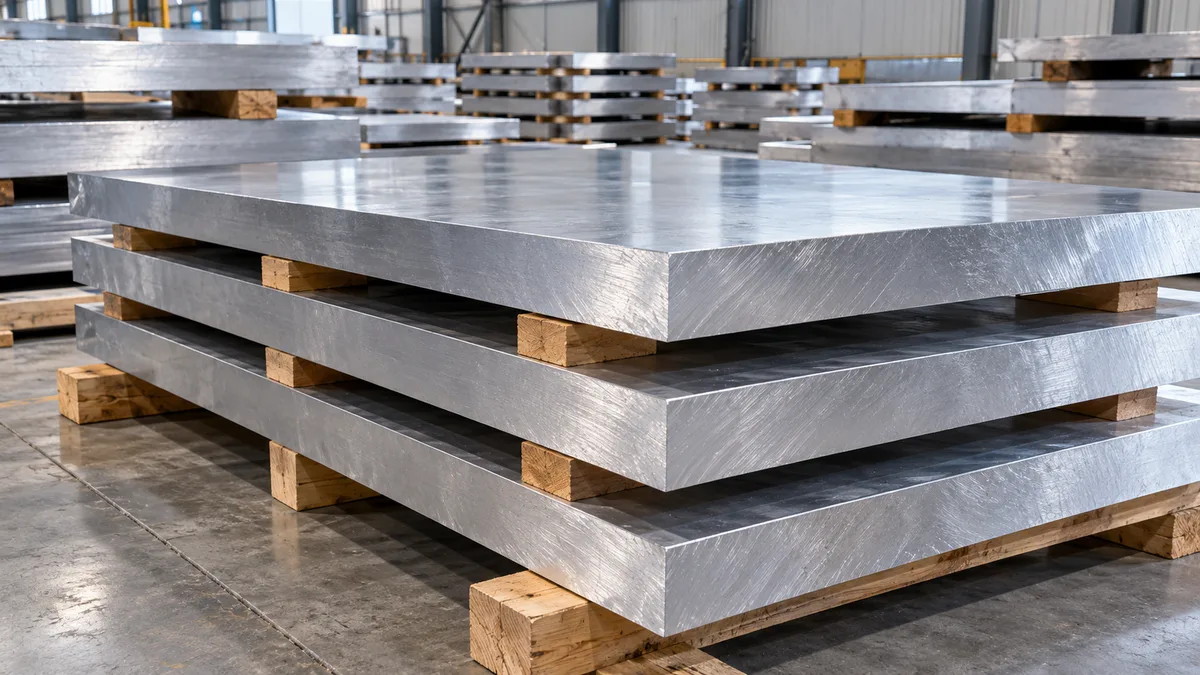
Large Aluminium Products: Plate, Bar, Tube, Extrusions and Forgings Beyond Standard Sizes
Large aluminium products are mill products made beyond the size limits of ordinary stock: plate wider than 2.5 m or thicker than about 150 mm, bar and billet several hundred millimetres in diameter, seamless tube approaching a metre across, very wide extrusions and heavy forged rings. They allow one-piece machined structures, fewer welds and shorter fabrication routes on major projects. This guide explains each product family, its realistic size envelope, the alloys used and how to specify and ship oversize aluminium.
"Large" is relative to what ordinary rolling mills, extrusion presses and forges produce. Standard sheet and plate stops at about 2,000 – 2,500 mm wide; most extrusions fit inside a 300 mm circle; most round bar stops at about 300 – 500 mm diameter.
Beyond those limits, only a limited number of plants worldwide have the hot-rolling width, stretcher capacity, press force or forging equipment to make the product, and every order needs engineering attention: the casting must be sound through its full thickness, heat treatment must reach the centre, residual stress must be controlled, and the finished piece must be handled and shipped safely.
Buyers turn to oversize aluminium for three reasons. First, integration: a part machined from one plate or forging has no welds, no bolted joints and no assembly tolerance stack-up. Second, weight: aluminium is about one third the density of steel, so even a massive aluminium structure is far easier to lift, ship and install. Third, process savings: material delivered close to the final shape cuts welding, inspection and rough-machining time.
Size ranges
Size envelope by product form
The table shows the size classes that exist in the global market for each form. The largest sizes are made by few producers and in limited alloys, so treat the upper values as the edge of feasibility rather than stock items; we confirm what can be supplied for your alloy, temper and certification on each enquiry.
Product form
Standard range
Large / oversize range
Common alloys
Plate (stretched T651 / T7451)
Up to 2,500 mm wide, 6 – 150 mm
Widths of 3,000 – 4,000 mm; stretched plate up to about 200 – 250 mm thick
2024, 5083, 6061, 6082, 7050, 7075, 7085
Thick plate and blocks (as-rolled, forged or cast)
Up to about 150 – 200 mm
250 – 600 mm thick blocks and sawn blanks
5083, 6061, 6082, 7050, 7075
Round bar and billet
Ø 6 – 300 mm extruded bar
Ø 400 – 1,000 mm and above (forged bar, cast or homogenised billet)
2014, 2024, 2219, 5083, 6061, 7050, 7075
Seamless round tube
OD up to about 300 – 500 mm
OD 500 – 1,300 mm class, heavy walls
5083, 6061, 6063, 6082, 7075
Square and rectangular tube
Up to about 200 × 200 mm
300 × 300 up to about 1,200 × 1,200 mm
6061, 6063, 6082, 2024, 7075
Extrusions
CCD up to about 300 mm
Panels up to about 750 mm wide; lengths to about 25 m
6005A, 6061, 6063, 6082, 7005
Forgings and rolled rings
Rings up to about 1 m
Open-die discs and rolled rings of several metres in diameter
2014, 2219, 6061, 7050, 7075
Busbar
Extruded or rolled flats to about 300 mm wide
Plate-cut bars about 100 mm thick, 500 – 600 mm wide, 8 – 10 m long
1050A, 1060, 1070, 1350, 6101
Plate
Ultra-wide and ultra-thick aluminium plate
Ultra-wide plate comes from hot-rolling mills with wide work rolls and stretchers long and strong enough to stretch the whole plate after quenching. Plates of 3 – 4 m width are used for aircraft wing skins, ship and LNG tank panels, rail car floors and semiconductor equipment frames, where a single wide plate removes a longitudinal weld. Hot-rolled coil and plate are also produced in widths of about 2,600 mm for large panels and tanks.
Ultra-thick plate raises a different challenge: the centre of a thick plate cools more slowly when quenched, so heat-treatable alloys lose some strength at mid-thickness. This is why alloys with low quench sensitivity are chosen for thick sections. 7050-T7451 and 7085 are the aerospace choices for very thick plate, while 7075-T651 is usually limited to more moderate thicknesses. For general engineering, 6061-T651 and 6082-T651 thick plate are standard, and cast plate or 5083 is preferred when flatness and stability matter more than strength.
Need
Recommended choice
Why
Large aerospace frames and bulkheads
7050-T7451 thick plate
Low quench sensitivity, good through-thickness properties and stress-corrosion resistance
Machine bases and large fixtures
6061-T651 or 6082-T651 plate
Stretched to relieve stress, machines without distortion, good value
Vacuum chambers and semiconductor frames
6061-T651, 5083-O/H112 plate or forged blocks
Clean machining, vacuum compatibility, weldable
Large moulds for plastics and composites
7075-T651, 6061-T651, or high-strength mould alloys
Hardness and polishability with fast heat removal
Very flat tooling and inspection plates
Cast and precision-milled tooling plate
Minimal residual stress, stable after machining
Stretching to relieve quench stress is possible only up to the stretcher limit, typically around 200 – 250 mm. Thicker blocks are supplied as-rolled, forged or cast, and may be stress relieved by compression or by careful rough machining and ageing.
Long products
Large-diameter bar, tube and square tube
Large-diameter bar and billet
Above about 300 mm, bar is usually forged from cast ingot or supplied as homogenised cast billet. Forging closes porosity and refines grain, so forged bar is preferred for highly stressed parts. Diameters of 600 – 700 mm are common in heavy machining; larger sizes are possible. See large-diameter aluminium bar.
Large seamless tube
Made by piercing and extruding a large billet on a heavy press (including vertical presses), by forging and boring, or by machining from solid. Used for pressure vessel shells, nuclear and petrochemical piping and large cylinders. See large-diameter tube and pipe.
Spiral and seam-welded pipe
For very large diameters with thin walls, aluminium strip or plate is roll-formed and welded. Suitable for ducting, low-pressure pipelines and structural columns. See spiral-welded aluminium pipe.
Extra-large square and rectangular tube
Square sections up to about 1,200 × 1,200 mm are made by extruding a heavy round tube and forming it to square, with walls of several centimetres. See extra-large square tube.
High-precision large tube
Large tubes can be turned and bored to close tolerances and fine surface finishes for cylinders and rollers. See high-precision large tube.
Machined blanks
Any of these can be supplied rough-turned, bored or cut to length so that you receive a blank ready for finish machining.
Shaped products
Large extrusions, forgings and rings
Large extrusions extend the extrusion process to wide hollow panels, heavy beams and long profiles. Rail car body panels, interlocking trailer floors, EV battery tray members and bridge decks are typical. The design rules and size limits are covered in our large aluminium extrusions guide.
Large forgings are made by open-die forging, ring rolling or closed-die forging on heavy presses. Forging aligns grain flow with the shape of the part and closes internal porosity, giving the best fatigue and fracture properties of any product form. Large forged rings are used for rocket and launch-vehicle structures, bearing housings, slewing rings, flanges and pressure vessel connections; open-die discs and blocks serve as blanks for heavy machined parts. See large size forged products and rolled ring forgings.
Starting form
Best for
Trade-off
Thick plate
Prismatic parts, frames and bases
Lowest cost per kg; properties vary through thickness
Forged block or disc
Highly stressed, thick parts
Better properties in all directions; higher cost
Rolled ring
Large circular parts, flanges and rings
Little machining waste; needs ring-rolling capacity
Large extrusion
Long parts with constant section
Die cost; limited by press size
Seamless tube
Cylinders and shells
Wall thickness and diameter limits of the process
Handling
How heavy are large aluminium products?
Weight drives lifting, packing and freight decisions, so check it early. Aluminium alloys have a density of about 2.70 – 2.80 g/cm³; the examples below use 2.70 g/cm³ (multiply by 1.03 for 7xxx alloys, which are slightly denser).
Example piece
Volume (m³)
Approximate weight (kg)
Stretched plate 4000 × 10000 × 100 mm
4.00
10,800
Thick block 600 × 1500 × 3000 mm
2.70
7,290
Round bar Ø700 × 3000 mm
1.15
3,117
Seamless tube OD 1000 × ID 800 × 6000 mm
1.70
4,580
Square tube 1000 × 1000 × 50 wall × 6000 mm
1.14
3,078
Plate-cut busbar 120 × 600 × 10000 mm
0.72
1,944
Pieces above about 5 – 10 tonnes or longer than 12 m usually need flat-rack containers or break-bulk shipment, and the lifting points and support spacing should be agreed before production. Use our plate weight calculator for other sizes.
Quality
Inspection and testing of large products
Large sections are more likely to hide internal defects than thin products, so inspection matters more. A sensible specification covers:
Ultrasonic testing to ASTM B594 or AMS-STD-2154 for aerospace and critical parts, with the acceptance class stated on the order
Mechanical testing at specified locations, including through-thickness (short-transverse) tests for thick plate and forgings
Conductivity and hardness checks to confirm heat treatment, especially for 7xxx alloys
Dimensional inspection of flatness, straightness, ovality and wall thickness, using the tolerances in ASTM B209, EN 485, EN 755 or the drawing
Residual stress control by stretching, compression or stress-relief ageing, which reduces distortion during heavy machining
Documentation: EN 10204 3.1 mill test certificate with heat number traceability; third-party inspection on request
Ordering
How to specify and ship oversize aluminium
Start from the finished partSend the part drawing, not only the blank size. We can then suggest whether plate, forging, bar or tube gives the lowest total cost after machining.
State alloy, temper and standardFor example 7050-T7451 to AMS 4050, or 6061-T651 to ASTM B209, and any ultrasonic class or property direction requirements.
Agree machining allowanceLarge blanks are often supplied with a few millimetres of machining stock per face, or rough machined to save freight weight.
Plan handlingConfirm crane capacity at your site, maximum piece weight and length, and preferred lifting method.
Packing and shipmentHeavy pieces are strapped to timber skids or steel frames, wrapped against moisture and shipped in containers, on flat racks or break-bulk on EXW, FOB, CIF or DAP terms.
ASTM B209 – Aluminum and Aluminum-Alloy Sheet and Plate
ASTM B247 – Aluminum and Aluminum-Alloy Die Forgings, Hand Forgings, and Rolled Ring Forgings
ASTM B594 – Ultrasonic Inspection of Aluminum-Alloy Wrought Products
SAE AMS-STD-2154 – Inspection, Ultrasonic, Wrought Metals, Process for
EN 485-2 and EN 755-2 – Mechanical properties of rolled and extruded aluminium products
ASM International – ASM Handbook, Volume 2: Properties and Selection of Nonferrous Alloys
FAQ
Large aluminium (aluminum) products: FAQ
What is the widest aluminium plate available?
A few mills produce stretched heat-treated plate around 3,500 – 4,000 mm wide, mainly for aerospace and shipbuilding. Most general-purpose plate is 1,250 – 2,500 mm wide. Tell us the width you need and we confirm feasibility for the alloy and temper.
How thick can aluminium plate be?
Stretched plate is generally available up to about 200 – 250 mm. Thicker blocks of 300 – 600 mm are supplied as-rolled, forged or cast. For very thick heat-treated sections, choose alloys with low quench sensitivity such as 7050.
Is a forged block better than thick plate?
Forged blocks have more uniform properties in all directions and fewer internal defects, which matters for highly stressed parts. Thick plate is cheaper and is fine for frames, bases and moderately loaded components.
Can large aluminum products be supplied machined?
Yes. Oversize pieces can be sawn, rough-turned, bored or milled to drawing so that they arrive close to final shape, which also reduces freight weight.
How are oversize aluminium pieces shipped?
Heavy or long pieces are fixed to skids or frames, wrapped against moisture and shipped in containers, on flat racks or as break-bulk cargo, with lifting points agreed in advance.
Which certificates come with large aluminium products?
Every shipment carries an EN 10204 3.1 mill test certificate with chemistry and mechanical results. Ultrasonic test reports and third-party inspection can be arranged when specified.
Have a project that needs oversize aluminium?
Send the part drawing or blank size, alloy, quantity and destination. We will recommend the starting form and quote delivered.