Forming
Order annealed (М) sheet for deep bends and stamping. Inside bend radii of about 1 × thickness are usually achievable in М temper; hard tempers need larger radii and bending across the rolling direction.



1105 is a Russian wrought aluminium alloy of the aluminium-copper-magnesium family, listed in GOST 4784 with unusually wide composition limits: 2.0–5.0 % copper, 0.4–2.0 % magnesium and up to 3 % silicon. It is supplied as ingot, sheet and strip for general engineering parts of moderate strength. This guide explains what the grade really is, how to read its temper codes and how to choose a substitute outside the GOST system.
Russian wrought aluminium grades carry a four-digit number in which the first digit "1" means aluminium and the second digit identifies the alloy system. Grades beginning 11 belong to the Al-Cu-Mg group that also contains Д1 (1110) and Д16 (1160). 1105 sits in that group, but unlike the classic duralumins it has no letter name and a composition window that is several times wider.
That wide window is the most important fact about the alloy. Copper may lie anywhere between 2.0 and 5.0 %, magnesium between 0.4 and 2.0 % and manganese between 0.3 and 1.0 %, while silicon is allowed up to 3.0 %, iron up to 1.5 % and zinc up to 1.0 %. Two lots that both comply with the standard can therefore behave quite differently. A lot near the top of the copper and magnesium ranges responds to heat treatment like a light duralumin; a lot near the bottom behaves more like a lean, work-hardened alloy.
The permissive limits make 1105 a practical outlet for mixed or recycled charge, and the grade also appears in GOST 1131, the standard for wrought-alloy pigs that are remelted to make rolling ingots or used to adjust the composition of other melts. For the buyer, this means the grade name alone does not define the material: the actual analysis on the mill certificate does.
The grade is defined by the general grade standard and then by product standards for each form. Quote both on purchase orders so that composition, tolerances and testing follow the right document.
| Standard | Scope | What it controls for 1105 |
|---|---|---|
| GOST 4784-2019 (previously GOST 4784-97) | Wrought aluminium and aluminium alloys: grades | Chemical composition limits and the digital / letter designation |
| GOST 1131-76 | Wrought aluminium alloys in pigs | Pig (ingot) supply for remelting and charge make-up |
| GOST 21631-76 | Aluminium and alloy sheet | Sheet sizes, tempers, cladding codes, tolerances and mechanical testing |
| GOST 13726-97 | Aluminium and alloy strip | Strip supplied in coil |
| GOST 21488-97 | Pressed (extruded) bars | Round and shaped bar, where available |
GOST 4784-2019 replaced the 1997 edition in Russia; many export documents and older drawings still cite GOST 4784-97. The composition of 1105 is the same in both for practical purposes, but confirm the edition your customer requires.
Limits below follow the Al-Cu-Mg table of GOST 4784-97. Single values are maximums.
| Element | Limit (%) | Effect |
|---|---|---|
| Copper (Cu) | 2.0 – 5.0 | Main strengthening element; enables age hardening at higher levels |
| Magnesium (Mg) | 0.4 – 2.0 | Works with copper to form strengthening phases |
| Manganese (Mn) | 0.3 – 1.0 | Raises strength, controls grain structure |
| Silicon (Si) | ≤ 3.0 | High allowance; increases fluidity and hardness, lowers ductility |
| Iron (Fe) | ≤ 1.5 | Impurity; forms brittle intermetallics at high levels |
| Zinc (Zn) | ≤ 1.0 | Impurity |
| Nickel (Ni) | ≤ 0.2 | Impurity |
| Ti + Cr + Zr | ≤ 0.2 | Grain refiners (sum limited for extruded and forged products) |
| Others, each / total | ≤ 0.05 / ≤ 0.2 | |
| Aluminium (Al) | Remainder | Roughly 86 – 97 % depending on the lot |
GOST lists a nominal density of 2.80 g/cm³ for 1105, higher than pure aluminium (2.70) because of the copper. Use 2.80 for weight estimates: a 1500 × 3000 × 2 mm sheet weighs about 25.2 kg.
Russian sheet designations combine the alloy number, a cladding letter and a temper letter. This is a frequent source of confusion: in "1105АМ" the letter А is not part of the temper but means normal cladding, and М means annealed. The table summarises the codes used in GOST 21631 and related sheet standards.
| Code | Meaning | Notes |
|---|---|---|
| А | Normal cladding | Thin layer of purer aluminium on both faces for corrosion protection |
| У | Thickened cladding | Heavier clad layer for more aggressive environments |
| Б | Technological cladding | Thin layer applied mainly to aid rolling, not for service protection |
| (no letter) | Unclad | Bare alloy on both faces |
| М | Annealed (soft) | Maximum formability for bending, drawing and stamping |
| Н2 | Semi-hard (half work-hardened) | Balance of stiffness and formability |
| Н | Work-hardened (hard) | Highest strength from cold rolling alone |
| Т | Quenched and naturally aged | Heat-treated condition, where the lot chemistry supports it |
| Т1 | Quenched and artificially aged | Higher strength, lower elongation |
So 1105АМ is normally clad, annealed sheet, 1105АН2 is clad semi-hard sheet, and 1105Н would be bare hard sheet. The exact list of codes a mill can supply for 1105 depends on its product standard or technical conditions (ТУ), so confirm the code on the quotation.
Because the composition range is so wide, there is no single "typical" property set for 1105, and published tables that quote one should be treated with caution. Guaranteed values come from the product standard or ТУ for the specific form and temper, and the actual values come from the lot certificate. Some general rules still help with design:
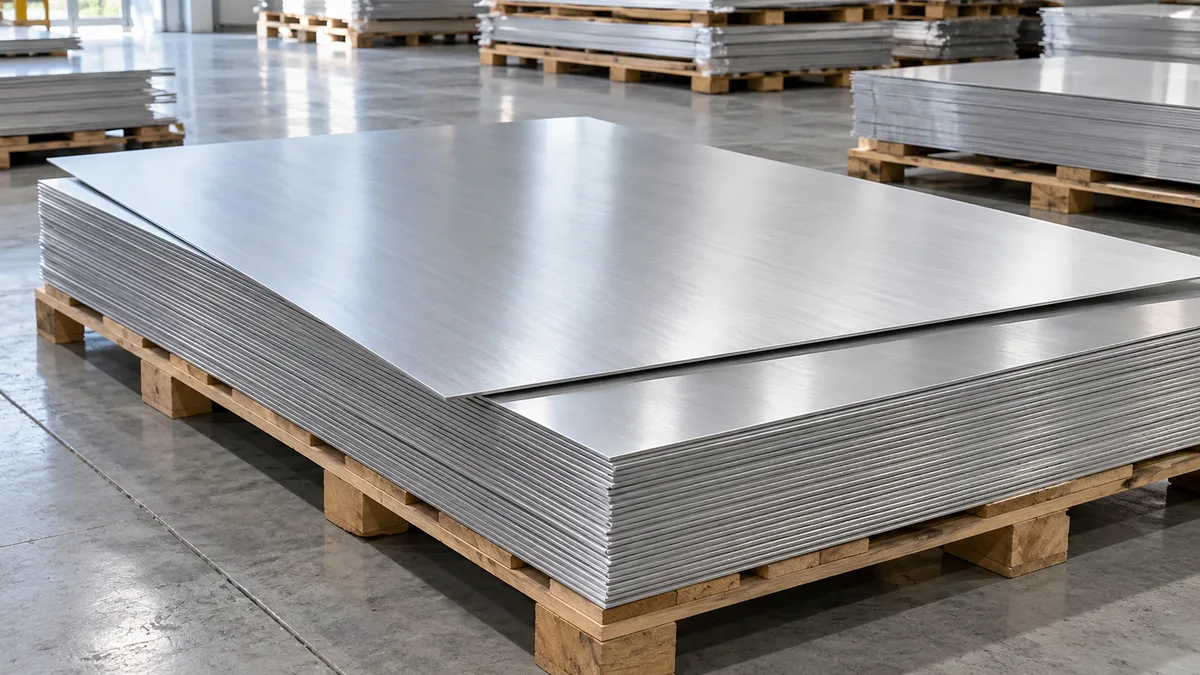
Sizes depend on the producing mill and its ТУ. Popular sheet formats include 1.0 × 1500 × 3000 mm, 2.0 × 1500 × 4000 mm and 3.0 × 1500 × 3000 mm.
If you are replacing 1105 in an existing product, send the original drawing or certificate. It is often faster and cheaper to supply a widely stocked international alloy with equal or better properties than to source the GOST grade itself.
Order annealed (М) sheet for deep bends and stamping. Inside bend radii of about 1 × thickness are usually achievable in М temper; hard tempers need larger radii and bending across the rolling direction.
Copper improves chip breaking compared with pure aluminium, so 1105 machines cleanly with sharp carbide or HSS tools and coolant. Annealed material can be gummy.
Copper-bearing alloys are prone to hot cracking in fusion welds. Use 4043-type filler, control heat input and clean off oxide and oil. Qualify the procedure with a crack test before production. Resistance spot welding of thin sheet is common.
Annealing relieves work hardening and restores ductility between forming stages. Whether quenching and ageing give a useful strength gain depends on the copper and magnesium level of the lot.
Use clad sheet, chromate-free conversion coating, primer or paint for outdoor or humid service. Avoid contact with copper and carbon steel without insulation.
Possible, but copper gives a duller, less uniform film than 5xxx or 6xxx alloys. Not a first choice for decorative anodised parts.
Avoid 1105 for primary aircraft structure, pressure equipment, marine immersion and electrical conductors. Those duties have dedicated alloys with tighter composition control.
1105 has no one-for-one ASTM, EN, ISO or JIS equivalent. Choose a replacement by matching the function of the part rather than the chemistry:
| If the part needs… | Consider | Why |
|---|---|---|
| Formability and moderate strength | 3003 / 3004 (АМц type) or 5052 (АМг2.5 type) | Better corrosion resistance and tighter composition control |
| More strength, still weldable | 5083 / 5754 (АМг5 / АМг3 types) or 6061 / 6082 | Higher, predictable strength with good weldability |
| Duralumin-type heat-treated strength | 2017A (Д1) or 2024 (Д16) | True Al-Cu-Mg aerospace alloys with defined properties |
| Good machinability | 2011 or 6061-T6 bar | Free-machining or general-purpose machining grades |
Send the original specification and target standard and we will compare candidates on composition, guaranteed properties, temper and certification so that the substitution can be approved.
An aluminium-copper-magnesium wrought alloy in the Russian GOST 4784 system, with 2.0–5.0 % Cu, 0.4–2.0 % Mg and 0.3–1.0 % Mn and wide limits on silicon, iron and zinc. It is not a pure aluminium grade despite the leading "1", which in GOST numbering simply means aluminium-based.
Alloy 1105, normally clad (А), in the annealed temper (М). The cladding letter comes before the temper letter in Russian sheet codes.
No. The Russian digital number is unrelated to Aluminum Association numbers. AA 1100 is 99 % pure aluminium, while GOST 1105 contains several per cent of copper and magnesium.
Yes, but copper raises the risk of hot cracking. Use a silicon-bearing filler such as 4043, control heat input and qualify the procedure. For welded structures, a 5xxx or 6xxx alloy is usually the better choice.
It depends on the duty: 3003 or 5052 for formed sheet, 5083 or 6061 for stronger welded parts, and 2017A or 2024 where duralumin-type strength is needed. Compare guaranteed properties before approving the change.
Yes. We supply GOST grades or approved substitutes with mill test certificates showing the actual chemical analysis and mechanical results, packed for export and shipped worldwide.
Send the GOST designation, form, size, quantity and destination. We will reply with availability, certification and a proposed substitute if it helps.





