H116
Strain hardened under special process control and tested for exfoliation and intergranular corrosion per ASTM B928. The correct temper for hull and deck plating in seawater.



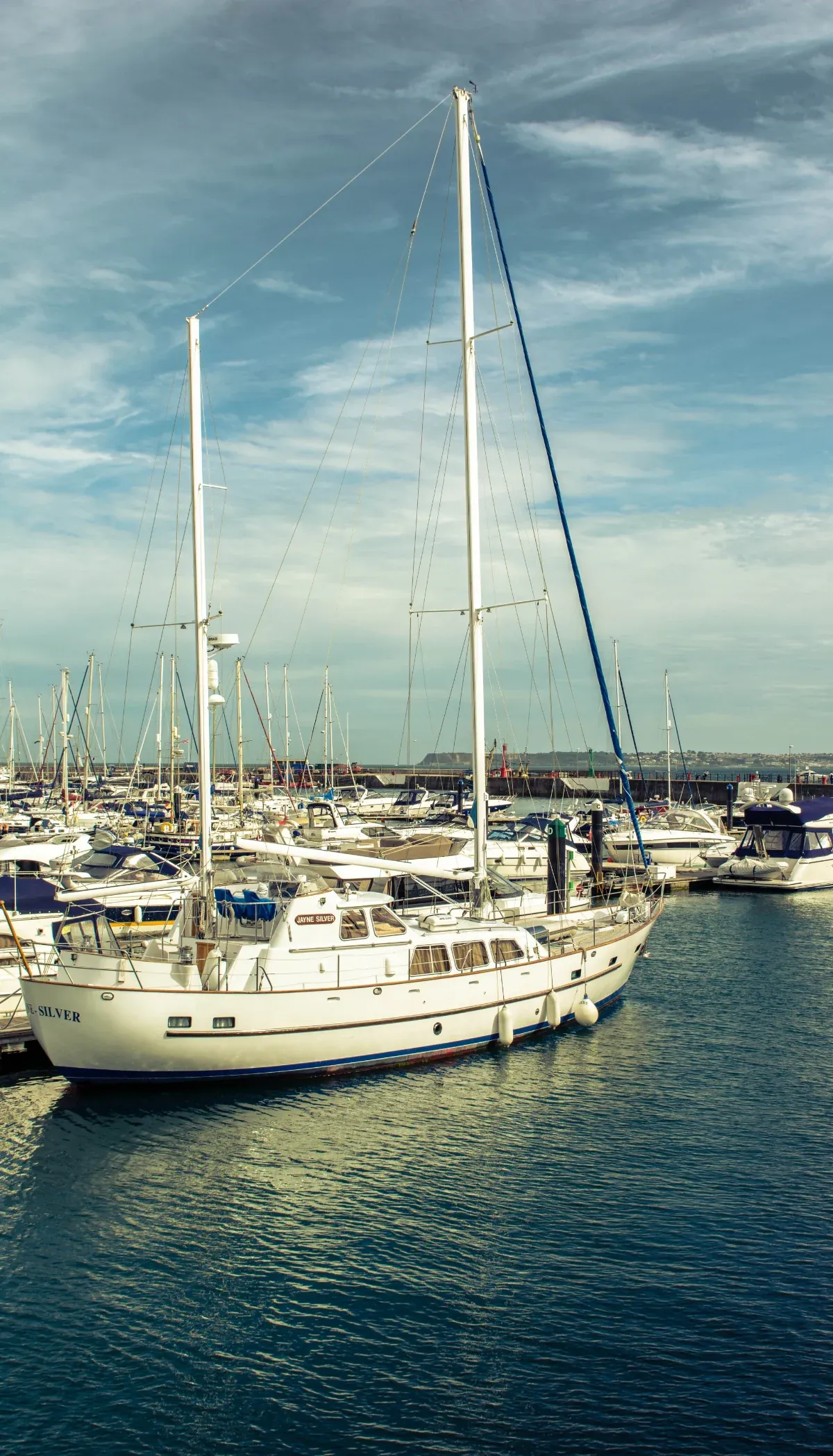
5086 is a marine-grade Al-Mg alloy with about 4 % magnesium: slightly less strong than 5083 but easier to form, with the same excellent resistance to seawater and good welded strength. It is a favourite for boat hulls, workboats and tanks, especially in North America. Metline supplies 5086 sheet, plate and tread plate in O, H32, H34, H112 and H116 to ASTM B928, ASTM B209 and EN 485, worldwide.
5086 sits between 5052 and 5083 in the 5xxx family. With 3.5 – 4.5 % magnesium, 0.2 – 0.7 % manganese and a small chromium addition, it is non-heat-treatable and gains its strength from solid solution and cold work.
The practical difference from 5083 is formability. Lower manganese and slightly lower magnesium make 5086 a little softer, so it bends more readily and is easier to roll into curved hull panels, while its seawater resistance is essentially the same. Many North American boatbuilders and workboat yards standardise on 5086-H116 for hull bottoms and sides for exactly that reason, with 5083 used where higher strength is needed.
Like 5083, 5086 welds well with ER5356 or ER5183 filler, retains good strength in the welded condition and performs well at low temperatures. It shares the same limitation: sustained service above about 65 °C can sensitise the alloy, so it is not used for hot tanks or near engines without careful assessment.
Limits are the Aluminum Association values used in ASTM B209, ASTM B928 and EN 573-3 (EN AW-5086).
| Element | Minimum | Maximum | Role |
|---|---|---|---|
| Silicon (Si) | — | 0.40 | Impurity |
| Iron (Fe) | — | 0.50 | Impurity |
| Copper (Cu) | — | 0.10 | Kept low for corrosion resistance |
| Manganese (Mn) | 0.20 | 0.7 | Strength and grain control |
| Magnesium (Mg) | 3.5 | 4.5 | Main strengthening element |
| Chromium (Cr) | 0.05 | 0.25 | Stress-corrosion resistance |
| Zinc (Zn) | — | 0.25 | |
| Titanium (Ti) | — | 0.15 | Grain refiner |
| Others, each / total | — | 0.05 / 0.15 | |
| Aluminium (Al) | Remainder | About 93 – 96 % |
Typical values (handbook data) show normal performance; specified minimums from ASTM B209 and B928 are the design basis. Minimums vary with thickness band.
| Temper | Typical tensile | Typical yield (0.2 %) | Typical elongation | Specified minimum (tensile / yield) |
|---|---|---|---|---|
| O | 262 MPa (38 ksi) | 117 MPa (17 ksi) | 22 % | 240 – 305 MPa / 95 MPa |
| H32 | 290 MPa (42 ksi) | 207 MPa (30 ksi) | 12 % | 275 MPa / 195 MPa |
| H34 | 324 MPa (47 ksi) | 255 MPa (37 ksi) | 10 % | 300 MPa / 235 MPa |
| H116 | 290 MPa (42 ksi) | 207 MPa (30 ksi) | 12 % | 275 MPa / 195 MPa (B928) |
| H112 plate | about 270 MPa | about 130 MPa | 14 % | 240 – 250 MPa / 105 – 125 MPa by thickness |
Minimums summarised from ASTM B209 and B928 for medium gauges; thin sheet and very thick plate have their own bands. Typical values are not design allowables.
Strain hardened under special process control and tested for exfoliation and intergranular corrosion per ASTM B928. The correct temper for hull and deck plating in seawater.
Quarter-hard and stabilised. Same strength level as H116 but without the marine corrosion test; widely used for tanks, trailers and general fabrication.
Half-hard and stabilised. Higher strength for flat panels and tread plate; slightly less formable.
Annealed for heavy forming, spinning and deep drawing.
As-rolled plate, used for thick sections, machined parts and flanges.
5086 diamond, five-bar and similar patterned plate in H32/H34 gives slip-resistant decks with marine corrosion resistance.
| System | Designation | Product standard |
|---|---|---|
| Aluminum Association / ASTM | 5086 | ASTM B928 (marine), ASTM B209 (general) |
| US federal (historical) | 5086 | QQ-A-250/7, now superseded by ASTM B209 / B928 |
| UNS | A95086 | — |
| European (EN) | EN AW-5086 / AlMg4 | EN 485-2, EN 573-3, EN 13195 |
| German Werkstoff | 3.3545 | DIN EN 485 |
| ISO | AlMg4 | ISO 6361 |
| Japan (JIS) | A5086P | JIS H4000 |
| China (GB) | 5086 | GB/T 3880, GB/T 3190 |
Older drawings may still cite QQ-A-250/7; most buyers now accept ASTM B209 or B928 material in its place. For classed vessels, name the classification society (DNV, ABS, LR, BV and others) so certification can be confirmed before order.
Common imperial plate sizes and their approximate weights (0.096 lb/in³):
| Thickness (in) | Fraction | Size (in) | Approx. weight (lb) |
|---|---|---|---|
| 0.125 | 1/8 | 48 × 144 | 83 |
| 0.188 | 3/16 | 60 × 144 | 156 |
| 0.250 | 1/4 | 48 × 96 | 111 |
| 0.250 | 1/4 | 60 × 240 | 346 |
| 0.250 | 1/4 | 96 × 240 | 553 |
| 0.312 | 5/16 | 60 × 240 | 432 |
| 0.375 | 3/8 | 60 × 240 | 518 |
| 0.375 | 3/8 | 96 × 240 | 829 |
| 0.500 | 1/2 | 48 × 144 | 332 |
| 0.500 | 1/2 | 60 × 240 | 691 |
| 0.750 | 3/4 | 60 × 240 | 1037 |
| 1.000 | 1 | 48 × 144 | 664 |
Metric weights: 2.66 kg per m² per millimetre of thickness.
| Thickness (mm) | kg per m² | 1250 × 2500 mm (kg) | 1500 × 3000 mm (kg) | 2000 × 6000 mm (kg) |
|---|---|---|---|---|
| 2 | 5.32 | 16.6 | 23.9 | 63.8 |
| 3 | 7.98 | 24.9 | 35.9 | 95.8 |
| 4 | 10.64 | 33.2 | 47.9 | 127.7 |
| 5 | 13.30 | 41.6 | 59.9 | 159.6 |
| 6 | 15.96 | 49.9 | 71.8 | 191.5 |
| 8 | 21.28 | 66.5 | 95.8 | 255.4 |
| 10 | 26.60 | 83.1 | 119.7 | 319.2 |
| 12 | 31.92 | 99.8 | 143.6 | 383.0 |
| 16 | 42.56 | 133.0 | 191.5 | 510.7 |
| 20 | 53.20 | 166.2 | 239.4 | 638.4 |
| 25 | 66.50 | 207.8 | 299.2 | 798.0 |
MIG and TIG weld readily. ER5356 is the most common filler; ER5183 gives slightly higher weld strength. Welded strength is close to the O-temper level.
Bends more easily than 5083. In H116/H32, inside radii of about 1 – 2 × thickness are typical for plate up to 6 mm.
Fair; soft and gummy in O. Use sharp, polished tools with high rake and coolant.
Blast or etch, prime and coat. Use aluminium-compatible antifouling below the waterline.
Isolate from stainless steel, copper and bronze fittings with insulating washers and sealants.
Avoid sustained service above 65 °C; tough and strong at cryogenic temperatures.
| Property | 5086-H116 | 5083-H116 | 5052-H32 |
|---|---|---|---|
| Magnesium | 3.5 – 4.5 % | 4.0 – 4.9 % | 2.2 – 2.8 % |
| Min. tensile / yield | 275 / 195 MPa | 305 / 215 MPa | 215 / 160 MPa |
| Formability | Very good | Good | Very good |
| Seawater resistance | Excellent | Excellent | Very good |
| Marine corrosion-tested temper | Yes (H116) | Yes (H116, H321) | No |
| Above 65 °C | No | No | Yes |
Pick 5086 for formed hull panels and smaller craft where its extra formability helps; pick 5083 for large welded structures needing the highest standard strength. 5052 suits tanks and light boats where cost and formability come first.
Both are excellent. 5083 is about 10 % stronger (minimum yield 215 against 195 MPa in H116), while 5086 forms more easily. Many smaller craft use 5086; larger welded hulls more often use 5083. The design rules you build to decide the final choice.
A strain-hardened temper produced under special control and tested for exfoliation and intergranular corrosion under ASTM B928. It is the temper to specify for plating in contact with seawater.
Yes. It welds readily by MIG and TIG with ER5356 or ER5183 filler and keeps good strength in the welded zone, close to the annealed level.
Not for sustained service above about 65 °C, because it can become sensitised. 5454 or 5052 is preferred for hot service.
A 48 × 96 × 0.25 in plate weighs about 111 lb (50 kg); a 60 × 240 in plate of the same thickness about 346 lb.
The federal specification was cancelled in favour of ASTM B209 for general sheet and plate, with ASTM B928 covering marine tempers such as H116.
Send the temper, thickness, sizes, quantity and destination. We will confirm availability, certification and a delivered price.





