Extruded (DR) high-fin tube
Fins are rolled out of a thick aluminium sleeve over a base tube, giving a very tight bond and excellent corrosion protection of the base tube.



Aluminium heat exchanger tube carries the refrigerant, coolant or oil while fins carry the heat to air. The right choice depends on the exchanger design: round drawn or inner-grooved tube for fin-and-tube coils, multi-port microchannel tube for parallel-flow condensers, HF-welded clad flat tube for brazed radiators and charge-air coolers, and finned tube for air-cooled process exchangers. Metline supplies all of these in 1xxx, 3xxx and 6xxx alloys, with braze cladding, zinc or flux coatings where the process needs them.
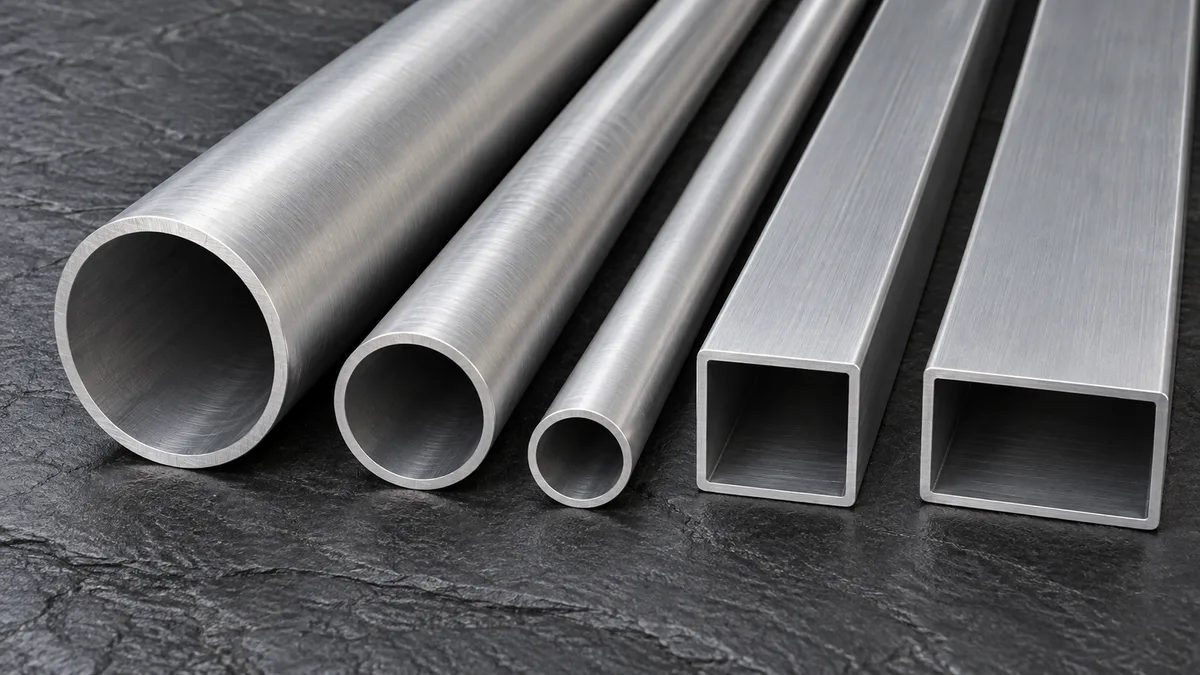
For decades copper tube with aluminium fins was the default for air conditioning and refrigeration coils. Since the 2000s, all-aluminium designs have taken over automotive radiators, condensers and evaporators almost completely, and they are now common in residential and commercial HVAC, data-centre cooling and battery thermal management.
The reasons are practical. An all-aluminium coil weighs much less than a copper-tube coil of the same duty, the metal costs less per unit of heat transferred, and a single-metal design eliminates galvanic corrosion between tube and fin. Aluminium also extrudes into shapes copper cannot easily match, such as the multi-port flat tubes of a microchannel condenser, which pack more surface into less volume and need less refrigerant charge.
Aluminium is less conductive than copper, but in an air-side heat exchanger the dominant thermal resistance is on the air side, not in the tube wall. A thin aluminium wall adds very little resistance, so the conductivity difference matters far less than its weight and geometry advantages.
Values from ASM handbook data; conductivity falls slightly as cold work and alloy content rise.
| Tube type | How it is made | Typical alloys | Typical exchangers |
|---|---|---|---|
| Precision drawn round tube | Extruded then cold drawn to tight OD and wall | 1070, 3003, 3103, 5052, 6063, 6061 | Fin-and-tube coils, evaporators, capillary and refrigerant lines |
| Inner-grooved round tube | Drawn with internal helical or straight grooves | 1050, 1070, 1100, 3003 | Room AC and heat-pump coils replacing copper tube |
| Microchannel (multi-port) tube | Extruded flat with 2 – 35 internal ports | 1100, 1197, 3102, modified 3003 | Parallel-flow condensers, evaporators, gas coolers |
| HF-welded flat or oval tube | Roll-formed from clad strip and high-frequency welded | 3003 core clad with 4343 or 4045, often 7072 inner layer | Radiators, heater cores, charge-air coolers, oil coolers |
| Folded (B-type) tube | Folded from clad strip into a B-section, brazed in the core | Clad 3xxx brazing strip | Radiators and heater cores |
| Seamless extruded tube | Extruded from hollow billet, optionally drawn | 3003, 5052, 6061, 6063 | Shell-and-tube exchangers, headers, manifolds |
| Finned tube | Aluminium fins extruded, embedded or wound on a base tube | 1050, 1060, 1100, 6063 fins | Air-cooled process coolers, economisers |
Choosing between them usually follows from the exchanger concept. A fin-and-tube coil that is expanded mechanically into collared fins needs round tube. A brazed parallel-flow core needs flat tube, either extruded microchannel or welded clad tube. An air-cooled process exchanger handling hot fluids at higher pressure typically uses finned tube.
Drawn round tube is the workhorse of fin-and-tube coils. The tube is extruded, then drawn through dies over a mandrel to produce a bright surface, close OD and wall tolerances and the temper required for bending into hairpins and expanding into the fin collars.
Inner-grooved tube adds fine internal ridges that break up the refrigerant boundary layer and increase internal surface area, improving evaporation and condensation coefficients. Aluminium grooved tube is the direct replacement for copper grooved tube in room air conditioners and heat pumps, and it uses the same coil-making equipment with adjusted expansion settings.
| Parameter | Typical range for aluminium inner-grooved tube |
|---|---|
| Outside diameter | 5 – 16 mm (common sizes 5, 7, 7.94, 9.52, 12.7 mm) |
| Bottom wall thickness | About 0.2 – 0.4 mm on small tube; heavier on larger sizes |
| Groove (tooth) height | About 0.10 – 0.30 mm |
| Number of teeth | About 40 – 75 |
| Helix angle | 0 – 25° (straight or helical) |
| Alloys | 1050, 1070, 1100, 3003 |
Aluminium grooved tube is softer than copper, so expansion bullets, hairpin bending and brazing of return bends must be set up for aluminium. Wall thickness is usually slightly heavier than the copper tube it replaces to keep burst and handling margins.
Microchannel tube is a flat extrusion with a row of small parallel ports. Brazed between louvred fins and into header pipes, it forms the parallel-flow cores used in nearly all automotive condensers and a growing share of HVAC condensers, evaporators and CO2 gas coolers.
Zinc applied to the outside of the tube diffuses into the surface during brazing and creates a sacrificial layer. If corrosion starts, it spreads sideways through that layer instead of pitting through the thin wall. Pre-flux and silicon-flux coatings put the brazing flux, and in the Si-flux case the filler metal, directly on the tube so the fins can be bare, simplifying the brazing line.
Radiators, heater cores, charge-air coolers and many oil coolers use flat or oval tube roll-formed from clad brazing strip and welded by high-frequency induction. Production is fast, wall thickness can be very thin, and the cladding provides the brazing filler for the tube-to-fin and tube-to-header joints.
| Layer | Typical alloy | Function |
|---|---|---|
| Outer clad layer | 4343 or 4045 (Al-Si) | Melts during brazing to form tube-to-fin and tube-to-header joints |
| Core | 3003 or long-life modified 3xxx | Strength and pressure containment after brazing |
| Inner layer (optional) | 7072 (Al-Zn) | Sacrificial protection against coolant-side corrosion |
Clad ratio is typically around 10 % of thickness per side for the braze layer. The 4343 filler melts at about 577 – 613 °C and 4045 at about 577 – 591 °C, below the core alloy, which is why controlled-atmosphere brazing (CAB) runs close to 600 °C. Welded tube is also supplied in round, D-shaped and multi-cavity forms for EV battery cooling and solar thermal collectors. See our guide to HF-welded aluminium pipe for size ranges.
Finned tube multiplies the outside surface of a tube many times, which is essential when the outside fluid is air. Aluminium is the standard fin material because it is light, conductive and easy to form.
Fins are rolled out of a thick aluminium sleeve over a base tube, giving a very tight bond and excellent corrosion protection of the base tube.
An aluminium fin strip is wound into a helical groove cut in the base tube and peened in. Good for higher fin temperatures.
An L-foot fin strip is tension-wound onto the tube; overlapped and knurled versions improve bond and protection.
Fins formed from the tube wall itself, used in condensers and where the outside film coefficient is moderate.
Round tubes expanded into stacks of punched aluminium fin plates, the standard HVAC coil construction.
Fin material is supplied as coil in 1100, 3003, 8011 or 8006, bare, hydrophilic or epoxy-coated. See fin stock.
Common finned-tube parameters are fin pitch from about 1.5 mm (closer pitch adds surface but raises air-side pressure drop and fouling), fin height up to about 16 mm and average fin thickness around 0.4 mm on base tubes up to about 50 mm OD. Base tubes for process service are often carbon or stainless steel; Metline supplies the aluminium fin material and aluminium finned tube, while non-aluminium base tubes are specified and supplied by the exchanger builder.
| Alloy | Strength | Conductivity | Brazeability | Best fit |
|---|---|---|---|---|
| 1050 / 1060 / 1070 | Low | Highest | Good | Grooved and drawn tube, fins, low-pressure circuits |
| 1100 | Low | High | Good | Microchannel tube, general drawn tube |
| 3102 | Low–medium | High | Very good | Microchannel tube with improved corrosion behaviour |
| 3003 / 3103 | Medium | Good | Very good | Drawn tube, welded tube cores, headers |
| Modified 3xxx (long-life) | Medium–high after braze | Good | Very good | Thin-wall welded radiator and condenser tube |
| 5052 / 5454 | Medium–high | Lower | Poor for flux brazing (Mg) | Mechanically assembled exchangers, pressure tube |
| 6063 / 6061 | High (heat-treatable) | Good | Limited; vacuum brazing preferred | Headers, manifolds, structural or high-pressure tube |
Magnesium above roughly 0.3 – 0.5 % interferes with fluoride (NOCOLOK-type) flux in CAB brazing, which is why 5xxx and most 6xxx alloys are kept out of flux-brazed cores or brazed in vacuum. For refrigerant pressures in CO2 systems, wall thickness and alloy strength need checking against burst requirements of the relevant pressure-equipment code.
| Standard | Scope |
|---|---|
| ASTM B234 / B234M | Drawn seamless aluminium tube for condensers, evaporators and heat exchangers (alloys including 1060, 3003, 5052, 5454, 6061 and 7072-clad tube) |
| ASTM B210 / B210M | Drawn seamless aluminium tube, straight lengths and coils |
| ASTM B241 / B241M | Seamless pipe and seamless extruded tube |
| ASTM B221 | Extruded bars, rods, wire, profiles and tubes |
| EN 754 / EN 755 | Cold-drawn and extruded aluminium tube, European specifications |
| EN 1592 | HF-welded aluminium tube |
For most air-side exchangers, yes. Copper conducts heat better, but the tube wall is a small part of the total thermal resistance. All-aluminium coils are lighter, cost less, avoid galvanic corrosion between tube and fin and allow microchannel designs with lower refrigerant charge.
Mostly 1100, 3102 and modified 3003-type alloys in H112 temper. They extrude into thin multi-port sections, braze well in CAB furnaces and, with a zinc coating, resist pitting corrosion.
Microchannel tube is extruded with internal ports and has no braze cladding, so the filler comes from clad fins or a Si-flux coating. HF-welded tube is roll-formed from clad strip, which supplies the braze filler, and usually has a single or simple multi-cavity section.
7072 contains about 1 % zinc, making it electrochemically more active than the 3003 core. It corrodes preferentially and sideways, protecting the core from pitting through the wall. It is used as an inner liner on coolant tubes and as cladding on Alclad 3003.
With difficulty in flux CAB brazing, because its magnesium content interferes with the flux. 6061 and 6063 parts are normally vacuum brazed, mechanically joined or welded. For flux-brazed cores, use 1xxx, 3xxx or modified 3xxx alloys.
Typical tests are dimensional checks, eddy-current or pressure leak testing, flare or expansion tests, tensile tests and, for coated tube, coating weight checks. Results are reported on an EN 10204 3.1 mill certificate.
Send the tube type, size or profile drawing, alloy, coating and quantity. We review the design requirements and reply with a delivered price.





