Mill finish sheet
The rolled surface as delivered, usually with PVC film on one side for decorative work. The base for most fabrication.



A 4x8 aluminium sheet measures 4 × 8 feet, which is 48 × 96 inches or 1219 × 2438 mm, and is the standard panel size for fabrication, signage, vehicle bodies and cladding. A 1/8 inch (3.2 mm) 4x8 sheet in 6061 weighs about 56 lb (25.5 kg); in 5052 it is slightly lighter. This guide gives weights for every common thickness, explains how to pick the alloy and temper, and lists what to state when you order.
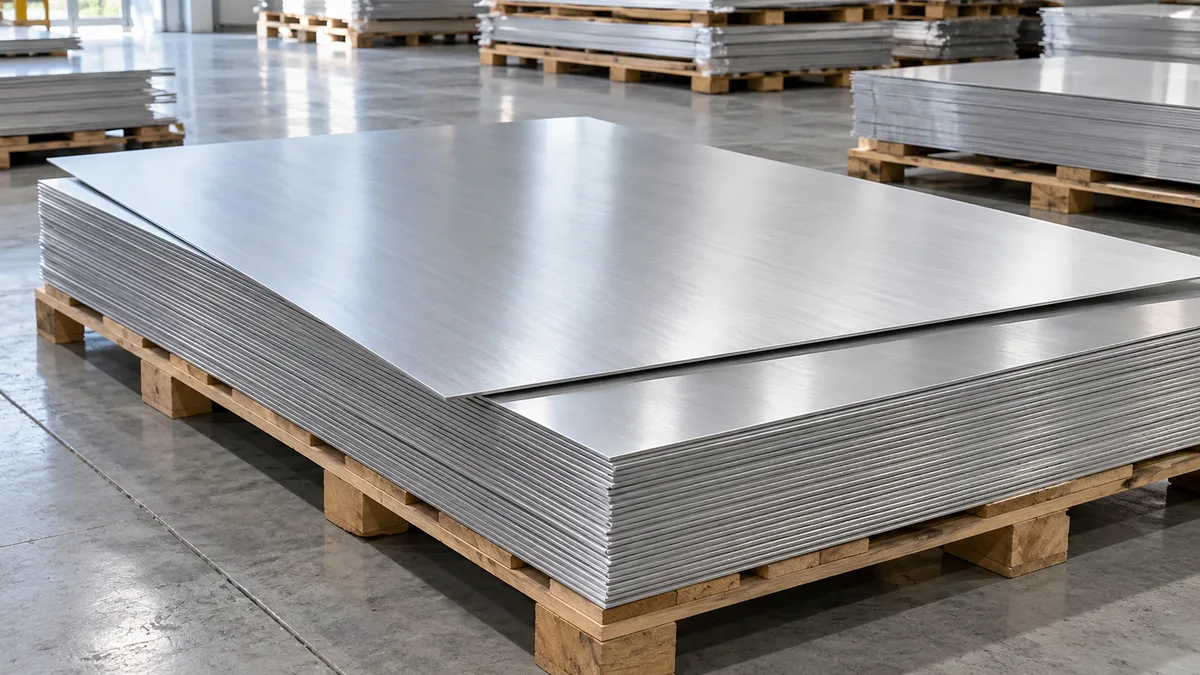
The 4x8 format comes from North American building practice, where plywood, drywall and metal panels are made to fit framing at 16 or 24 inch centres. Aluminium mills and service centres roll and shear to the same 48 × 96 inch size so that sheets drop straight into fabrication jigs, CNC routers and vehicle body designs built around it.
| Unit | Nominal size | Area |
|---|---|---|
| Feet | 4 ft × 8 ft | 32 ft² |
| Inches | 48 in × 96 in | 4,608 in² |
| Millimetres (exact) | 1219.2 × 2438.4 mm | 2.973 m² |
| Metric near-equivalent | 1220 × 2440 mm | 2.977 m² |
| Common metric alternative | 1250 × 2500 mm | 3.125 m² |
Outside North America many mills cut to 1220 × 2440 mm, which is within a millimetre of true 4x8, or to the European standard 1250 × 2500 mm, which is about 5 % larger. If your drawing, router bed or shipping crate is designed tightly around 48 × 96 inches, say so on the order: a 1250 × 2500 sheet will not fit a 4x8 rack, and nesting programs built for one size waste material on the other.
Larger formats follow the same logic: 4x10 (48 × 120 in), 4x12 (48 × 144 in), 5x10 (60 × 120 in) and 5x12 (60 × 144 in). They reduce seams on trailer sides and facades, but they are heavier to handle and cost more to ship in containers.
Weight is area × thickness × density. A 4x8 sheet is 4,608 in², so in 6061 (0.0975 lb/in³) each 0.001 in of thickness adds 0.449 lb. Alloys differ slightly: 5052 is about 1 % lighter than 6061 and 3003 about 1 % heavier. The table uses nominal thickness; real sheets fall within the thickness tolerance of ASTM B209, so treat figures as estimates for handling and freight.
| Thickness (in) | Thickness (mm) | 6061 (lb) | 6061 (kg) | 5052 (lb) | 3003 (lb) |
|---|---|---|---|---|---|
| 0.020 | 0.51 | 9.0 | 4.1 | 8.9 | 9.1 |
| 0.025 | 0.64 | 11.2 | 5.1 | 11.2 | 11.4 |
| 0.032 | 0.81 | 14.4 | 6.5 | 14.3 | 14.5 |
| 0.040 | 1.02 | 18.0 | 8.2 | 17.8 | 18.2 |
| 0.050 | 1.27 | 22.5 | 10.2 | 22.3 | 22.7 |
| 0.063 (1/16) | 1.60 | 28.3 | 12.8 | 28.1 | 28.6 |
| 0.080 | 2.03 | 35.9 | 16.3 | 35.7 | 36.3 |
| 0.090 | 2.29 | 40.4 | 18.3 | 40.1 | 40.9 |
| 0.100 | 2.54 | 44.9 | 20.4 | 44.6 | 45.4 |
| 0.125 (1/8) | 3.17 | 56.2 | 25.5 | 55.8 | 56.8 |
| 0.160 | 4.06 | 71.9 | 32.6 | 71.4 | 72.7 |
| 0.190 (3/16) | 4.83 | 85.4 | 38.7 | 84.8 | 86.3 |
| 0.250 (1/4) | 6.35 | 112.3 | 50.9 | 111.5 | 113.6 |
| 0.375 (3/8) | 9.52 | 168.5 | 76.4 | 167.3 | 170.4 |
| 0.500 (1/2) | 12.70 | 224.6 | 101.9 | 223.0 | 227.2 |
| 0.750 (3/4) | 19.05 | 337.0 | 152.8 | 334.5 | 340.8 |
| 1.000 | 25.40 | 449.3 | 203.8 | 446.1 | 454.3 |
For metric sheets of 1220 × 2440 mm the arithmetic is simpler: weight in kg = 2.977 × thickness in mm × density in g/cm³.
| Thickness (mm) | 1220 × 2440 in 6061 (kg) | 1220 × 2440 in 5052 (kg) |
|---|---|---|
| 0.5 | 4.0 | 4.0 |
| 0.8 | 6.4 | 6.4 |
| 1 | 8.0 | 8.0 |
| 1.2 | 9.6 | 9.6 |
| 1.5 | 12.1 | 12.0 |
| 2 | 16.1 | 16.0 |
| 2.5 | 20.1 | 19.9 |
| 3 | 24.1 | 23.9 |
| 4 | 32.1 | 31.9 |
| 5 | 40.2 | 39.9 |
| 6 | 48.2 | 47.9 |
| 8 | 64.3 | 63.8 |
| 10 | 80.4 | 79.8 |
| 12 | 96.4 | 95.7 |
For any other size use the plate and sheet weight calculator.
In the US, aluminium sheet is often called out by gauge. Aluminium uses the Brown & Sharpe (American Wire Gauge) series, not the Manufacturers' Standard Gauge used for steel, so a 16 gauge aluminium sheet is thinner than 16 gauge steel. Avoid confusion by ordering in decimal inches or millimetres.
| Gauge | Inches | mm | 6061 4x8 sheet (lb) | 6061 4x8 sheet (kg) |
|---|---|---|---|---|
| 24 | 0.0201 | 0.51 | 9.0 | 4.1 |
| 22 | 0.0253 | 0.64 | 11.4 | 5.2 |
| 20 | 0.0320 | 0.81 | 14.4 | 6.5 |
| 18 | 0.0403 | 1.02 | 18.1 | 8.2 |
| 16 | 0.0508 | 1.29 | 22.8 | 10.4 |
| 14 | 0.0641 | 1.63 | 28.8 | 13.1 |
| 12 | 0.0808 | 2.05 | 36.3 | 16.5 |
| 11 | 0.0907 | 2.30 | 40.7 | 18.5 |
| 10 | 0.1019 | 2.59 | 45.8 | 20.8 |
| 8 | 0.1285 | 3.26 | 57.7 | 26.2 |
Any wrought alloy can be cut to 4x8, but a handful cover almost all orders. Choose the alloy for what the part must do: bend, weld, resist the weather, carry load or take a decorative finish.
| Grade and temper | Typical tensile strength | Strengths | Typical 4x8 uses |
|---|---|---|---|
| 1100-H14 | 125 MPa (18 ksi) typical | Highest formability, excellent corrosion resistance, high conductivity | Reflectors, nameplates, chemical equipment liners, spinning |
| 3003-H14 | 150 MPa (22 ksi) typical | Easy to bend and weld, low cost | Ductwork, trailer liners, general fabrication, tread plate |
| 5052-H32 | 228 MPa (33 ksi) typical | Good strength without heat treatment, very good marine corrosion resistance, bends well | Boat parts, truck bodies, enclosures, fuel tanks, signs |
| 5005-H34 | 160 MPa (23 ksi) typical | Even colour after anodising | Architectural panels, anodised facades, trim |
| 6061-T6 | 310 MPa (45 ksi) typical | Heat-treated strength, machinable, weldable | Machine guards, structural panels, base plates, frames |
| 7075-T6 | 572 MPa (83 ksi) typical | Very high strength, poor weldability | Aerospace parts, tooling, high-stress components |
| 5083-H116 / H321 | 305 MPa (44 ksi) min (H116) | Marine-rated strength and corrosion resistance | Hulls, decks, marine superstructure |
The rolled surface as delivered, usually with PVC film on one side for decorative work. The base for most fabrication.
Raised diamond or five-bar pattern for steps, truck beds, ramps and toolboxes, usually 3003-H22, 5052 or 6061. See diamond plate.
Polyester or PVDF-coated coil cut to 4x8 for signage, cladding and truck bodies. Specify colour code and coating system.
Clear or coloured anodised panels for architecture and appliances. See anodised sheet.
Round, square or slotted holes for screens, acoustic panels and ventilation. See perforated sheet.
Two thin skins bonded to a core give a stiff, light 4x8 panel. See the 4x8 honeycomb panel guide.
Under ASTM B209 and the ANSI H35.2 dimensional standard, flat-rolled aluminium 0.006 to 0.249 in thick is sheet, and 0.250 in (6.35 mm) and over is plate. European practice under EN 485 uses 6 mm as the usual dividing line. The distinction is not just vocabulary: plate has its own tolerance tables, is often produced on different lines and is available in stress-relieved tempers such as 6061-T651.
A 4x8 sheet at 1/4 inch in 6061 weighs about 112 lb (51 kg), which is about the limit of comfortable two-person handling. Above that thickness, plate is often bought in larger formats and saw-cut to finished blanks rather than ordered as 4x8 sheets. Our 1/4 inch plate guide covers that thickness in detail.
Price depends mainly on the aluminium market on the order date, the alloy and temper, the thickness (very thin sheet costs more per kilogram), the finish and the freight route. We quote each enquiry against current market conditions.
It depends on thickness and alloy. In 6061, a 0.040 in sheet weighs about 18 lb (8.2 kg), 1/8 in about 56 lb (25.5 kg) and 1/4 in about 112 lb (51 kg). 5052 is about 1 % lighter.
Almost. True 4x8 is 1219.2 × 2438.4 mm, so 1220 × 2440 is less than 2 mm larger and is accepted as 4x8 in most markets. 1250 × 2500 mm is a different, larger European size.
5052-H32 is the usual choice: stronger than 3003 yet still bendable to about 1 × thickness. 3003-H14 is cheaper and bends even more easily. Avoid 6061-T6 for tight bends.
Aluminium uses the Brown & Sharpe series, so 16 gauge is 0.0508 in (1.29 mm). A 4x8 sheet of it in 6061 weighs about 22.8 lb (10.3 kg).
Yes. Sheets can be sheared, sawn, routed or waterjet cut to blanks before shipping, which saves freight on offcuts and handling at your end.
Yes. Metline supplies sheet worldwide from Mumbai, packed on seaworthy pallets or in wooden cases, with mill test certificates.
Send the alloy, temper, thickness, finish and quantity. We reply with availability, certification and a delivered price.





