Macro-etch
Sections from first articles and periodic samples check grain flow and the depth of any peripheral coarse grain.



6082-T6 is the standard European alloy for forged aluminium suspension parts. It is a little stronger than 6061, its manganese content helps control grain structure during forging and heat treatment, and it resists road-salt corrosion without coatings. Control arms, steering knuckles, wheel carriers, links and forged wheels are typical parts. Metline supplies 6082 die and open-die forgings, forging stock and rolled rings, heat-treated and tested, to automotive customers worldwide.
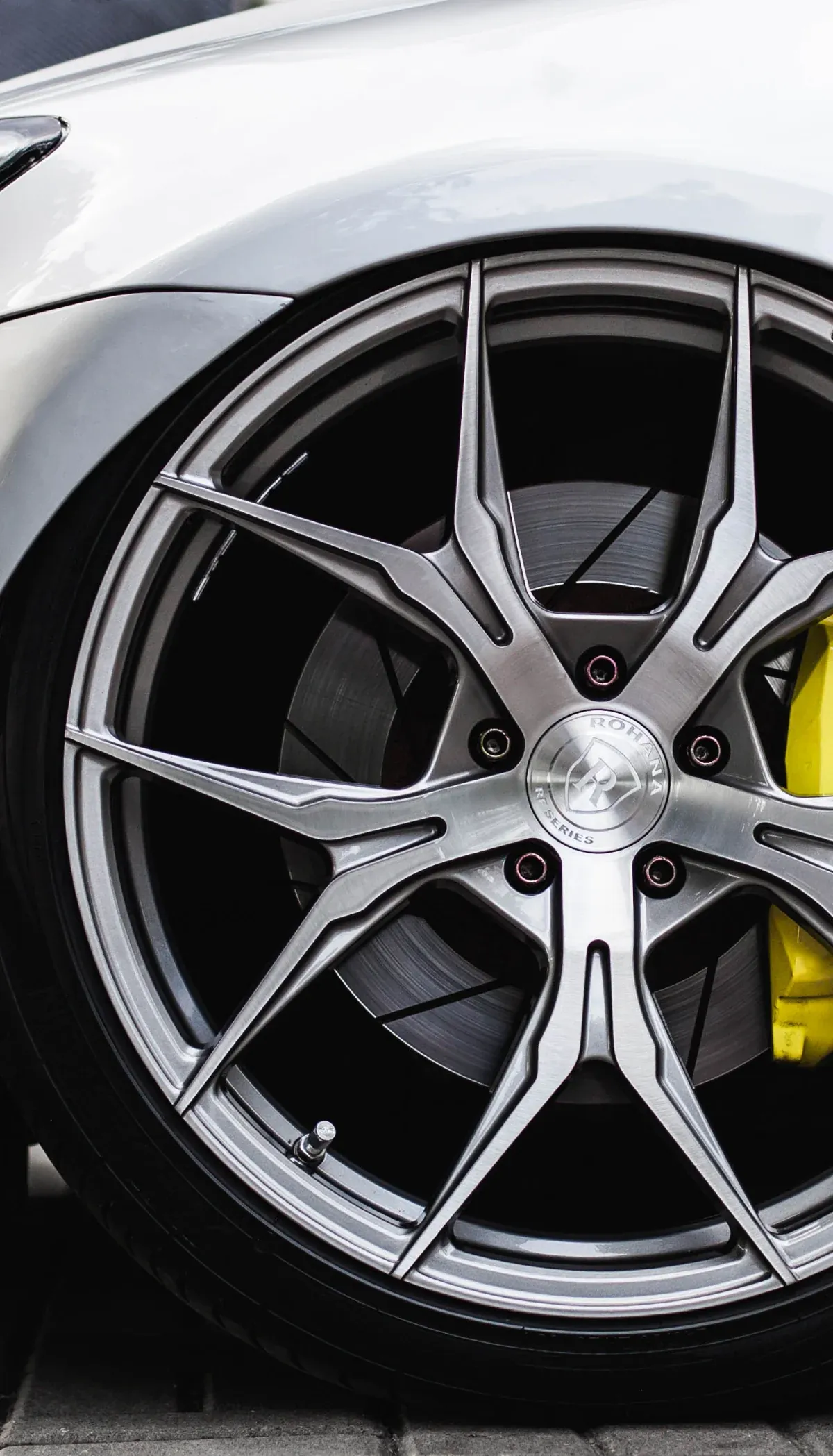
Suspension parts carry millions of load cycles over the life of a vehicle and must also survive kerb strikes and pothole impacts without fracture. Forging gives them continuous grain flow and a sound, porosity-free structure; 6082 gives them strength, toughness and corrosion resistance. Replacing a steel control arm with a forged 6082 arm commonly saves 40 – 50 % of the part's mass, which reduces unsprung weight and improves ride and handling.
6082 differs from 6061 mainly in its manganese content (0.40 – 1.0 %) and lower copper. Manganese forms fine dispersoid particles that resist recrystallisation, so a well-processed 6082 forging keeps a fibrous, unrecrystallised grain structure with good fatigue and stress-corrosion behaviour. The low copper level helps general corrosion resistance in salted winter roads.
The main metallurgical risk with 6082 forgings is peripheral coarse grain: a layer of abnormally large grains that can form near the surface during solution treatment if forging temperature, strain or stock condition are wrong. Coarse grain lowers strength and fatigue life, so process windows and macro-etch checks are part of every serious automotive forging plan.
Registered limits per EN 573-3 and the Aluminum Association. Forging producers often work to narrower internal bands for Mg, Si, Mn and Cr to stabilise strength and grain structure.
| Element | Minimum | Maximum | Role |
|---|---|---|---|
| Silicon (Si) | 0.7 | 1.3 | Forms Mg2Si; excess Si adds strength |
| Iron (Fe) | — | 0.50 | Impurity |
| Copper (Cu) | — | 0.10 | Kept low for corrosion resistance |
| Manganese (Mn) | 0.40 | 1.0 | Controls grain structure and recrystallisation; raises toughness |
| Magnesium (Mg) | 0.6 | 1.2 | Main strengthening element |
| Chromium (Cr) | — | 0.25 | Grain structure control |
| Zinc (Zn) | — | 0.20 | Impurity |
| Titanium (Ti) | — | 0.10 | Grain refiner |
| Others, each / total | — | 0.05 / 0.15 | |
| Aluminium (Al) | Remainder |
EN 586-2 sets minimum properties for 6082 forgings by thickness and test direction. Automotive drawings usually specify their own, higher minimums, measured on specimens cut from defined locations in the part. The values below show typical ranges and commonly seen drawing requirements.
| Condition | Tensile strength | Yield strength (0.2 %) | Elongation | Hardness |
|---|---|---|---|---|
| Typical production, along grain flow | about 330 – 360 MPa | about 300 – 330 MPa | about 10 – 14 % | about 100 – 110 HB |
| Common OEM drawing minimum, along grain flow (≤ 100 mm) | ≥ 340 MPa | ≥ 300 MPa | ≥ 10 % | ≥ 90 HB |
| Common OEM drawing minimum, across grain flow | ≥ 290 MPa | ≥ 250 MPa | ≥ 5 % | ≥ 90 HB |
| Forged wheel, typical requirement | ≥ 295 MPa | ≥ 265 MPa | ≥ 7 % | ≥ 90 HB |
Check EN 586-2 and your drawing for the exact minimums that apply to your thickness and specimen direction. The mill certificate reports results for each heat-treatment batch.
| Type | Typical automotive use | Notes |
|---|---|---|
| Closed-die forgings | Control arms, knuckles, wheel carriers, links, brackets | Near-net shape; drawing-specific tooling |
| Open-die forgings and blocks | Prototypes, motorsport, low-volume parts | Machined to shape; no dedicated tooling |
| Forged wheels and wheel blanks | Passenger car, SUV and commercial-vehicle wheels | Often forged then flow-formed |
| Rolled rings | Flanges, bearing housings, wheel rim blanks | Circumferential grain flow |
| Forging stock | Bar for customer forging lines | Cast or extruded, with grain-size and cleanliness checks |
Sections from first articles and periodic samples check grain flow and the depth of any peripheral coarse grain.
Fracture or macro tests detect oxide films and inclusions; drawings may limit their total and single-point area.
Tensile specimens from defined part locations and hardness on every part or by sampling.
Volumetric and surface inspection for safety-critical parts, to the acceptance class on the drawing.
Fatigue and misuse-load tests on finished arms and knuckles are normally run by the part maker or OEM.
Cast lot, forging batch and heat-treatment load are recorded on the EN 10204 3.1 certificate.
Connecting rods, crankcases and cylinder heads are not 6082 forgings: engine blocks and heads are cast, and highly loaded engine parts use steel or specialised alloys. Brake drums and discs need wear-resistant cast iron or composites.
| Property | 6082-T6 forging | 6061-T6 forging | High-strength 6xxx forging (e.g. 6110A) | A356-T6 casting |
|---|---|---|---|---|
| Typical tensile strength | about 330 – 360 MPa | about 310 MPa | about 380 – 420 MPa | about 260 – 280 MPa |
| Typical yield strength | about 300 – 330 MPa | about 275 MPa | about 350 – 380 MPa | about 190 – 210 MPa |
| Fatigue performance | High | High | High | Moderate |
| Main market | Europe, global | Americas, Asia | Weight-optimised premium parts | Cast knuckles and wheels |
Where an OEM wants to take more weight out of a suspension arm, higher-strength 6xxx forging alloys with additions of copper and other elements are used. For most programmes, 6082-T6 remains the balance point between strength, process robustness and cost.
6082 is slightly stronger, its manganese content helps keep a fine, unrecrystallised grain structure, and it is the established alloy in European OEM specifications. 6061 performs well too and is more common in North American and Asian supply chains.
Typical values along the grain flow are about 330 – 360 MPa tensile and 300 – 330 MPa yield with 10 – 14 % elongation. Drawings commonly require at least 340 MPa and 300 MPa in that direction.
A surface layer of abnormally large grains that can form during solution treatment if forging conditions are not controlled. It lowers strength and fatigue life, so its depth is checked by macro-etching and limited on the drawing.
EN 586 covers technical delivery conditions (part 1), mechanical properties (part 2) and tolerances (part 3). Automotive drawings add OEM-specific requirements.
Many suspension forgings are used bare or shot-peened, because 6082 resists corrosion well. Coatings are added where parts touch steel or for appearance.
Yes. We supply 6082 forgings and forging stock worldwide with EN 10204 3.1 certificates and export packing on EXW, FOB, CIF or DAP terms.
Send the drawing, volume and test requirements. Our team will reply with feasibility, certification and delivered terms.





