Machining
Thick walls allow mounting faces, rail seats and tapped holes to be machined directly. Rough machine, rest the part, then finish to control movement from residual stress.



Extra-large aluminium square and rectangular tube covers box sections far beyond normal extrusion sizes: from about 300 × 300 mm up to around 1,200 × 1,200 mm, with walls from 6 mm to over 100 mm and lengths of 4 – 12 m. These one-piece seamless sections replace welded box beams in gantries, columns, machine frames and vacuum enclosures. This guide covers how they are made, alloys, section properties and how to specify them.
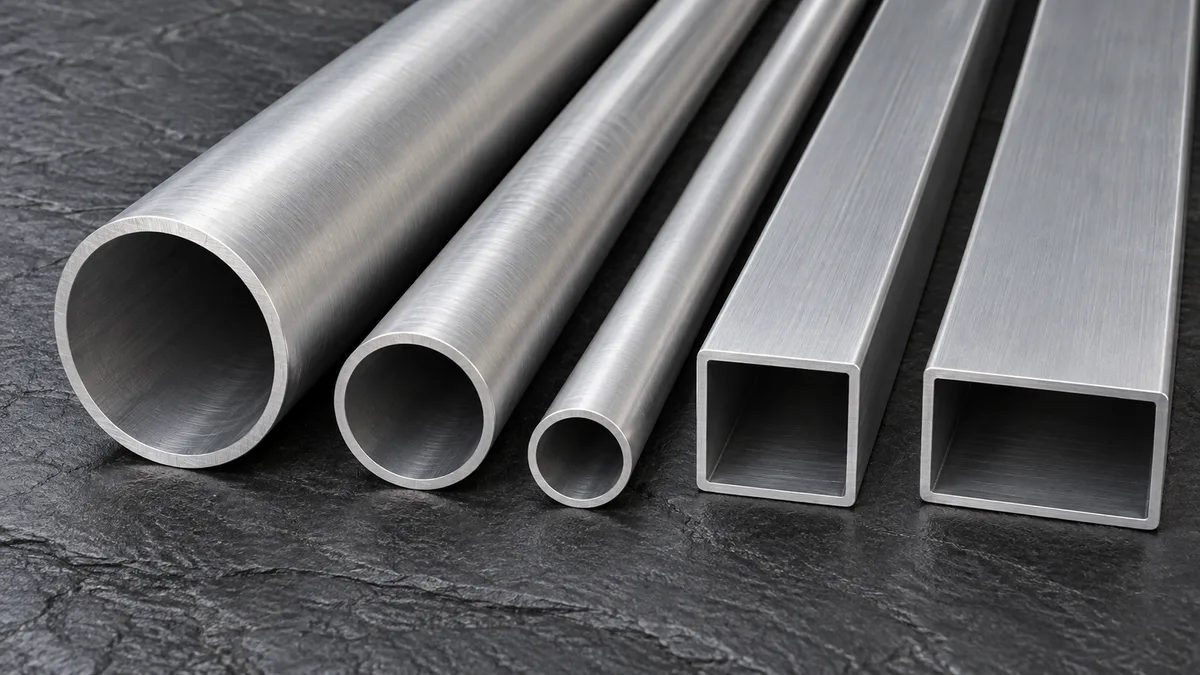
Aluminium square tube (also called box section or square hollow section) is normally extruded directly through a hollow die. Because press force and die size limit the circumscribing circle, the common commercial range stops at about 200 × 200 mm, or 8 × 8 in.
Above that, a different approach is needed. The largest square and rectangular tubes are produced by the few plants with very large vertical or horizontal extrusion presses: a heavy round tube is extruded from a pierced billet and then formed to a square or rectangular shape in a series of roll or die passes, before heat treatment and straightening. The result is a seamless box section with uniform wall thickness and no longitudinal weld.
The alternative for large boxes has traditionally been to weld four plates or two channels together. That works, but every weld seam reduces strength in heat-treated alloys, introduces distortion and needs inspection. A seamless section avoids those issues and gives consistent properties around the whole perimeter.
The largest sizes and thickest walls are not available in every alloy. Confirm the combination of size, wall, alloy and temper on enquiry.
| Alloy | Typical temper | Typical tensile / yield (MPa) | Character | Typical uses |
|---|---|---|---|---|
| 6061 | T6 | 310 / 276 | Balanced strength, weldability and corrosion resistance; the default structural choice | Gantries, columns, machine frames |
| 6082 | T6 | About 310 – 340 / 260 – 300 | Slightly stronger than 6061 in thick walls; common in Europe | Cranes, offshore and transport structures |
| 6063 | T5 / T6 | 186 / 145 (T5); 241 / 214 (T6) | Lower strength, excellent surface and anodising | Architectural columns, enclosures |
| 6060 | T5 / T6 | Lower than 6063 | Easy extrusion, good finish | Lightly loaded frames and housings |
| 2024 | T3 / T4 type | 470 / 325 (T351 typical) | High strength and fatigue resistance; needs corrosion protection; poor weldability | Aerospace ground equipment, high-load beams |
| 7075 | T6 / T73 | 572 / 503 (T6) | Very high strength; not normally fusion welded | High-stress frames, defence and tooling |
Typical values for standard sections from ASM / Aluminum Association data, for comparison only. Heavy walls test lower at the centre; design to the minimums on the mill certificate for the actual size.
For most structural uses, 6061-T6 or 6082-T6 is the right starting point. Choose 6063 when appearance and anodising matter more than strength, and 2024 or 7075 only when strength or stiffness-to-weight justifies the higher cost and the joining limitations.
The table gives calculated values for sharp-cornered sections using a density of 2.70 g/cm³. Real tubes have corner radii, which slightly reduce area and second moment of area; use the values for preliminary sizing and confirm with the supplied profile drawing.
| Size B × H × t (mm) | Area (cm²) | Weight (kg/m) | Ix (cm⁴) | Wx (cm³) |
|---|---|---|---|---|
| 300 × 300 × 10 | 116 | 31.3 | 16,279 | 1,085 |
| 300 × 300 × 20 | 224 | 60.5 | 29,419 | 1,961 |
| 400 × 400 × 20 | 304 | 82.1 | 73,365 | 3,668 |
| 500 × 500 × 25 | 475 | 128.2 | 179,115 | 7,165 |
| 600 × 600 × 30 | 684 | 184.7 | 371,412 | 12,380 |
| 800 × 800 × 40 | 1,216 | 328.3 | 1,173,845 | 29,346 |
| 1000 × 1000 × 50 | 1,900 | 513.0 | 2,865,833 | 57,317 |
| 1200 × 1200 × 60 | 2,736 | 738.7 | 5,942,592 | 99,043 |
| 400 × 300 × 15 | 201 | 54.3 | 29,311 | 1,954 |
| 600 × 400 × 25 | 475 | 128.2 | 123,490 | 6,174 |
| 1000 × 800 × 40 | 1,376 | 371.5 | 1,405,099 | 35,127 |
| 1200 × 1000 × 60 | 2,496 | 673.9 | 3,866,752 | 77,335 |
Aluminium has about one third of the elastic modulus of steel (about 69 GPa against 200 GPa), so an aluminium box must be deeper or thicker than a steel one for the same deflection. The large sizes in this range exist precisely because they let designers recover stiffness through section depth while keeping weight down: a 1,000 × 1,000 × 50 mm aluminium section weighs about 513 kg/m, roughly a third of a steel box of the same dimensions.
Large box sections are usually finish-machined on their mounting faces, so the most important properties are straightness, twist, squareness of corners and wall-thickness uniformity. Agree these before order, together with how they will be measured.
| Characteristic | What to specify | Notes |
|---|---|---|
| Outside dimensions | Nominal size and tolerance | Large sections carry wider standard tolerances than small tubes; tighter values by machining |
| Wall thickness | Minimum wall or nominal ± tolerance | Specify minimum wall where it controls strength or machining depth |
| Straightness | mm per metre and over full length | Measured unrestrained on a flat bed |
| Twist and squareness | Degrees or mm over length | Important for gantry beams and guide-rail mounting |
| Corner radius | Outside and inside radius | Affects fit of mating parts and section properties |
| Internal soundness | Ultrasonic testing standard and class | Recommended for thick walls and critical structures |
| Mechanical properties | Alloy, temper, standard, test direction | Reported on EN 10204 3.1 certificate |
Thick walls allow mounting faces, rail seats and tapped holes to be machined directly. Rough machine, rest the part, then finish to control movement from residual stress.
6061 and 6082 weld with ER4043 or ER5356; expect reduced strength in the heat-affected zone. 2024 and 7075 are not normally fusion welded; use bolted or bonded joints.
Flanges, end plates and nodes can be machined from thick plate and bolted or welded to the tube ends.
Anodising, powder coating or painting. Very large sections may need large-tank anodising or are coated instead.
6xxx alloys perform well outdoors; isolate from steel fasteners with sleeves and washers to avoid galvanic corrosion.
Lift with spreader beams and soft slings; long thin-walled sections can be dented by point loads.
| Option | Strengths | Limitations | Choose it when |
|---|---|---|---|
| Seamless extra-large square tube | Uniform properties, no weld seam, good straightness | Limited producers; size and alloy combinations must be confirmed | The box carries high loads or will be precision machined |
| Box welded from four plates | Any size; plate is widely available | Weld heat-affected zones, distortion, inspection cost | Sizes exceed the seamless range or loads are moderate |
| Two extruded channels, friction stir welded | Lower distortion than fusion welding, good joint strength | Needs suitable channel profiles and FSW capacity | Long, medium-size boxes in 6xxx alloys |
| Machined from solid block or forging | Any internal shape, highest integrity | Heavy material waste and cost | Short, very thick-walled or complex parts |
| Steel box section | High stiffness, low material cost | About three times the weight, corrosion protection, magnetic | Weight and corrosion are not concerns |
Ordering steps are straightforward. Send the outside dimensions, wall thickness, length, alloy and temper with the governing standard, the quantity, and any machining, straightness or ultrasonic requirements. We confirm the feasible size and alloy combination, then supply the tubes cut to length, inspected and certified to EN 10204 3.1, packed with end caps and timber supports, and shipped on EXW, FOB, CIF or DAP terms. For standard sizes below 300 × 300 mm, use the square tube weight calculator and our regular square tube range instead.
Seamless square sections up to about 1,200 × 1,200 mm (48 × 48 in) and rectangular sections up to about 1,000 × 1,200 mm are produced by a small number of plants with very large presses. Standard extruded square tube normally stops at about 200 × 200 mm.
A thick round tube is extruded from a pierced billet on a very large press and then formed into a square or rectangle in successive passes, followed by heat treatment and straightening.
About 185 kg per metre for a sharp-cornered section at 2.70 g/cm³; corner radii reduce this slightly.
For heat-treated alloys, yes in most cases: there is no heat-affected zone along the length, properties are uniform and distortion is lower. Welded boxes remain an option for sizes or alloys outside the seamless range.
6061-T6 or 6082-T6 for most machines, chosen for strength, stability during machining and weldability. Use stress-relieved material and finish-machine mounting faces after rough machining.
Yes. Tubes can be supplied cut to length and, on request, machined on ends or mounting faces, with EN 10204 3.1 certificates and export packing.
Send size, wall, length, alloy and quantity. We confirm what can be produced and quote delivered to your site.





