H131
Strain hardened by a controlled, heavy reduction for armour. Highest yield strength of the 5083 tempers and the standard choice for ballistic plate.



5083, 5456 and 5059 are the weldable aluminium-magnesium armour alloys of MIL-DTL-46027, supplied as plate from 0.250 to 3.000 in thick. Strengthened by cold work to the hard H131 temper, they give dependable fragment protection, excellent corrosion resistance and easy welding, which is why most aluminium-hulled armoured vehicles are built from them. Metline supplies all three in standard and cut sizes, with mill and test certificates, worldwide.
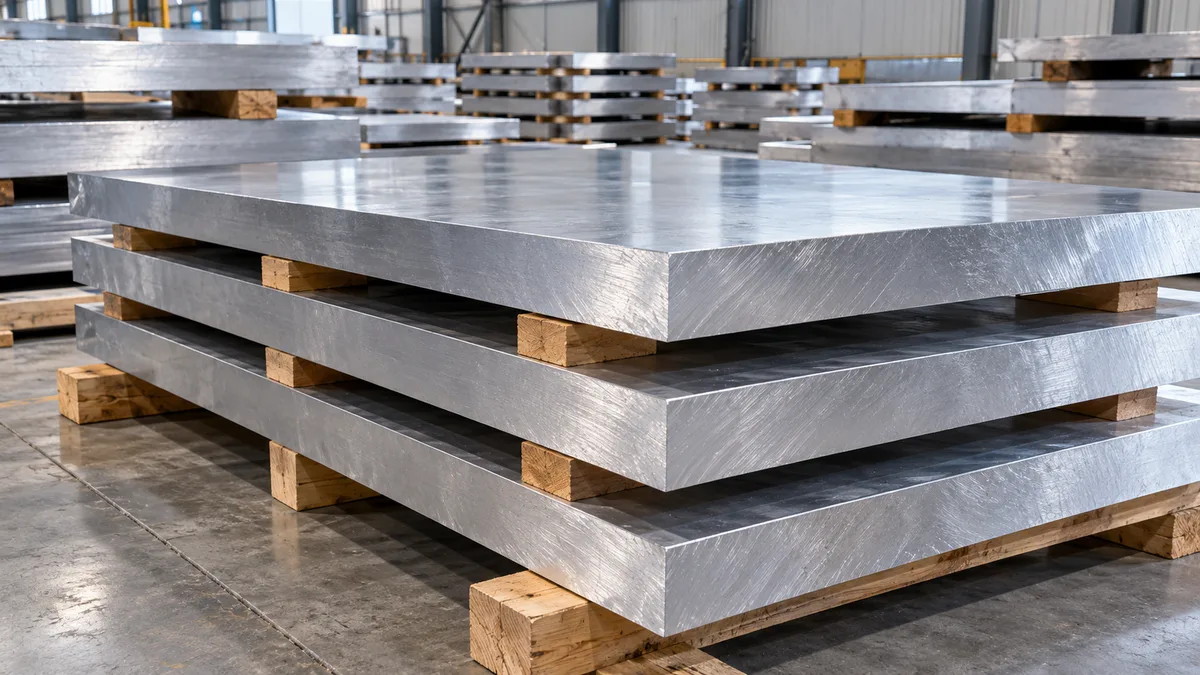
5083 armour plate has protected light armoured vehicles since the 1960s. It is the baseline against which other aluminium armour is judged: not the strongest, but the easiest to weld into a large hull that stays sound for decades in wet, salty conditions.
The 5xxx alloys get their strength from magnesium held in solid solution and from cold work; they are not heat treated. That brings two big advantages for armour. First, welding does not wipe out a precipitation-hardened structure, so welded joints keep a high share of the parent strength and need no post-weld heat treatment. Second, there are no zinc- or copper-rich precipitates to drive stress-corrosion cracking, so the plate tolerates residual weld stresses and marine environments well.
MIL-DTL-46027 covers 5083, 5456 and 5059 wrought armour plate for welded and unwelded use, in nominal thicknesses from 0.250 to 3.000 in. The hard H131 temper is the main armour temper: a heavy, controlled amount of cold work raises yield strength well above the marine H116 temper, at some cost in formability. 5059, the newest of the three, contains more magnesium plus zinc and zirconium, and gives notably higher strength and ballistic resistance than 5083 at similar weldability.
MIL-DTL-46027 assigns each alloy a class. The limits below are the registered compositions; single values are maximums.
| Element | 5083 (Class 1) | 5456 (Class 2) | 5059 (Class 3) |
|---|---|---|---|
| Silicon (Si) | 0.40 | 0.25 | 0.45 |
| Iron (Fe) | 0.40 | 0.40 | 0.50 |
| Copper (Cu) | 0.10 | 0.10 | 0.25 |
| Manganese (Mn) | 0.40 – 1.0 | 0.50 – 1.0 | 0.6 – 1.2 |
| Magnesium (Mg) | 4.0 – 4.9 | 4.7 – 5.5 | 5.0 – 6.0 |
| Chromium (Cr) | 0.05 – 0.25 | 0.05 – 0.20 | 0.25 |
| Zinc (Zn) | 0.25 | 0.25 | 0.40 – 0.9 |
| Zirconium (Zr) | — | — | 0.05 – 0.25 |
| Titanium (Ti) | 0.15 | 0.20 | 0.20 |
| Others, each / total | 0.05 / 0.15 | 0.05 / 0.15 | 0.05 / 0.15 |
| Aluminium | Remainder | Remainder | Remainder |
Minimums for armour plate depend on alloy, temper and thickness band. The H131 values come from the armour specification; the H116 values are the ASTM B928 marine minimums, shown for comparison because some programmes use H116 or H321 plate for non-ballistic structure.
| Alloy and temper | Thickness (in) | Tensile, min (ksi) | Yield 0.2 %, min (ksi) | Elongation, min |
|---|---|---|---|---|
| 5083-H131 | 0.250 – 0.499 | 45 | 35 | 8 % |
| 5083-H131 | 0.500 – 2.000 | 45 | 37 | 8 % |
| 5083-H131 | 2.001 – 3.000 | 44 | 35 | 9 % |
| 5059-H131 | 0.250 – 0.499 | 57 | 44 | 8 % |
| 5059-H131 | 0.500 – 2.000 | 57 | 43 | 7 % |
| 5059-H131 | 2.001 – 3.000 | 50 | 42 | 8 % |
| 5083-H116 / H321 (ASTM B928) | up to 1.500 | 44 | 31 | 10 – 12 % |
| 5083-H116 / H321 (ASTM B928) | 1.501 – 3.000 | 41 | 29 | 12 % |
1 ksi = 6.895 MPa: 45 ksi ≈ 310 MPa, 57 ksi ≈ 393 MPa. Confirm values against the specification revision and the 5456 table on your order; the mill certificate reports actual results.
Strain hardened by a controlled, heavy reduction for armour. Highest yield strength of the 5083 tempers and the standard choice for ballistic plate.
A strain-hardened armour temper with lower strength and higher elongation than H131; used where more formability or toughness is wanted.
Marine temper with controlled microstructure for resistance to exfoliation and intergranular corrosion, tested to ASTM G66 and G67. Used for non-ballistic hull and deck structure.
Strain hardened and thermally stabilised; similar strength to H116 and also tested for corrosion resistance under ASTM B928.
Do not substitute H116 or H321 plate for H131 in ballistic areas: the lower yield strength gives noticeably lower V50 values. Conversely, H131 plate has less elongation, so tight bends are better made in H116 or designed out.
5083 weighs 2.66 kg per m² for every millimetre of thickness. Weights for a 72 × 144 in (1829 × 3658 mm) plate are shown below; use the plate weight calculator for other sizes.
| Thickness (in) | Thickness (mm) | kg per m² | 72 × 144 in plate (kg) |
|---|---|---|---|
| 0.250 | 6.35 | 16.9 | 113 |
| 0.375 | 9.53 | 25.3 | 170 |
| 0.500 | 12.7 | 33.8 | 226 |
| 0.750 | 19.05 | 50.7 | 339 |
| 1.000 | 25.4 | 67.6 | 452 |
| 1.250 | 31.75 | 84.5 | 565 |
| 1.500 | 38.1 | 101.3 | 678 |
| 2.000 | 50.8 | 135.1 | 904 |
| 2.500 | 63.5 | 168.9 | 1130 |
| 3.000 | 76.2 | 202.7 | 1356 |
Each lot of armour plate is accepted on V50 ballistic limit tests carried out to MIL-STD-662, using a projectile and obliquity set by the nominal thickness. The specification tabulates a minimum V50 for every thickness step, rising steeply as the plate gets thicker.
| Approximate thickness range | Test projectile | Obliquity |
|---|---|---|
| About 0.45 – 0.72 in | .30 calibre AP M2 | 30° |
| About 0.72 – 1.00 in | .50 calibre fragment-simulating projectile | 0° |
| About 1.00 – 1.40 in | 20 mm fragment-simulating projectile, and .30 calibre AP M2 | 0° |
| Thicker plate | Heavier AP and fragment threats as tabulated | 0° |
Bands are indicative and differ slightly by alloy class. The governing limits are those in the specification revision on the order.
Vehicle-level protection is usually defined by NATO STANAG 4569 (AEP-55) levels, which set the threats a complete vehicle must stop. The plate specification ensures each lot of material performs consistently; the vehicle designer then chooses thickness, obliquity and any add-on armour to reach the required STANAG level.
MIG welding with 5183 or 5556 filler is standard; 5356 is used for lower-strength joints. Welds in H131 plate lose part of the cold-work strength in the heat-affected zone, so weld locations are kept away from the most exposed areas where possible.
Plasma, waterjet and saw cutting all work. Waterjet avoids heat-affected edges; plasma-cut edges are usually dressed before welding.
H131 plate has limited ductility: use generous bend radii and test bends on offcuts first. Avoid heating to aid forming, which softens the plate.
Avoid long exposure between about 65 °C and 200 °C, which can sensitise high-magnesium alloys to intergranular corrosion.
H131 is a heavily strain-hardened armour temper with a minimum yield of about 35 – 37 ksi, chosen for ballistic performance. H116 is a marine temper with lower strength (about 29 – 31 ksi yield) but guaranteed resistance to exfoliation and intergranular corrosion.
5059 has higher magnesium plus zinc and zirconium, giving H131 minimum tensile strengths around 57 ksi against 45 ksi for 5083, and better ballistic resistance at similar weldability. It usually costs more and is less widely stocked.
Yes. 5xxx alloys are not heat treatable, so welds are made with 5183 or 5556 filler and used as welded. The heat-affected zone of H131 plate softens somewhat, which is allowed for in the design.
MIL-DTL-46027 covers weldable 5083, 5456 and 5059 armour plate from 0.250 to 3.000 in. Non-ballistic marine plate is ordered to ASTM B928 or EN 485.
5083 weighs 2.66 kg per m² per millimetre of thickness. A 1 in (25.4 mm) plate of 72 × 144 in weighs about 452 kg.
Common sheets are 72 × 144 in for H131 and 48 × 144 in for H32 and H116, in thicknesses from 0.250 in up. Cut-to-size panels and metric sizes are available on request.
Send alloy, temper, thickness, size and quantity. We will reply with availability, test scope and a delivered price.





