T351
Solution treated, stretched 1.5 – 3 %, naturally aged. The standard temper for machining block: high toughness and fatigue strength, stable in machining.



2024 aluminium block is cut from thick 2024-T351 plate or forged block and machined into parts that must carry high, repeated loads: aircraft fittings, actuator housings, racing components and high-strength fixtures. It combines about 470 MPa typical tensile strength with excellent fatigue resistance and good machinability. Metline supplies 2024 block cut to size in T351 and other tempers, certified to ASTM, AMS and EN, worldwide.
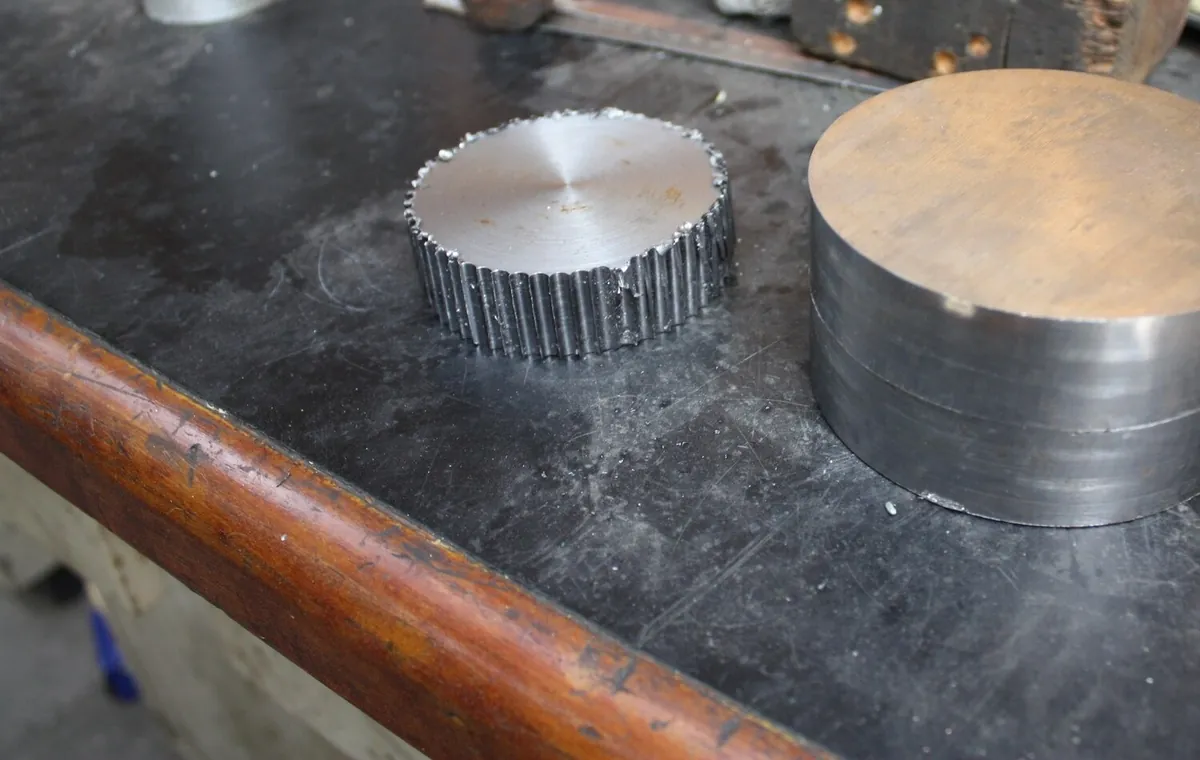
"Block" is a buyer’s term rather than a separate product standard. In practice, 2024 block is either thick rolled plate (to ASTM B209 or AMS specifications) saw-cut into rectangular pieces, or an open-die forged block for sizes beyond the plate range. Either way, the material is 2024: the original high-strength aluminium-copper-magnesium aircraft alloy.
2024 is chosen when fatigue strength and damage tolerance matter more than peak static strength. It is weaker than 7075 but resists crack growth better, which is why it remains standard for tension-loaded aircraft structure and many machined fittings. In the T351 temper the plate is solution treated, stretched to relieve quench stress and naturally aged, so blocks stay stable when large amounts of material are removed.
Its weak points are corrosion resistance and weldability. The high copper content makes bare 2024 susceptible to pitting and intergranular attack, so finished parts are normally anodised, conversion coated and painted. Arc welding is not recommended.
| Element | Minimum | Maximum | Role |
|---|---|---|---|
| Copper (Cu) | 3.8 | 4.9 | Main strengthening element (Al2CuMg precipitates) |
| Magnesium (Mg) | 1.2 | 1.8 | Accelerates natural ageing and raises strength |
| Manganese (Mn) | 0.30 | 0.9 | Grain control, toughness |
| Silicon (Si) | — | 0.50 | Impurity |
| Iron (Fe) | — | 0.50 | Impurity |
| Chromium (Cr) | — | 0.10 | |
| Zinc (Zn) | — | 0.25 | |
| Titanium (Ti) | — | 0.15 | Grain refiner |
| Others, each / total | — | 0.05 / 0.15 | |
| Aluminium (Al) | Remainder | About 90.7 – 94.7 % |
Registered Aluminum Association limits; EN AW-2024 under EN 573-3 is the same alloy.
Typical values describe thin and moderate sections. In thick plate, specified minimums fall as thickness increases because the centre cools more slowly during quenching; the ASTM B209 and AMS tables give the limits by thickness band, and the certificate shows the tested values.
| Temper | Tensile strength | Yield strength (0.2 %) | Elongation | Hardness |
|---|---|---|---|---|
| O (annealed) | 186 MPa / 27 ksi | 76 MPa / 11 ksi | 20 % | 47 HB |
| T351, typical | 470 MPa / 68 ksi | 325 MPa / 47 ksi | ≈ 19 % | 120 HB |
| T851, typical | ≈ 480 MPa / 70 ksi | ≈ 450 MPa / 65 ksi | ≈ 6 % | ≈ 128 HB |
Solution treated, stretched 1.5 – 3 %, naturally aged. The standard temper for machining block: high toughness and fatigue strength, stable in machining.
T351 material artificially aged. Higher yield strength and better resistance to intergranular and stress corrosion, with lower elongation and toughness. Useful for parts in warm service.
Forged blocks are stress-relieved by compression (T352) rather than stretching, for sizes beyond the plate range.
Annealed. Bought only when the part will be formed or heat-treated after machining.
| System | Designation / specification |
|---|---|
| ASTM | ASTM B209 (sheet and plate); ASTM B247 (forgings) |
| SAE AMS | AMS 4037 (T3 / T351 sheet and plate); AMS-QQ-A-250/4 |
| UNS | A92024 |
| European (EN) | EN AW-2024 / AlCu4Mg1; EN 485-2 plate; Werkstoff 3.1355 |
| Japan (JIS) | A2024 (JIS H4000) |
| China (GB) | 2024; 2A12 is the closest traditional Chinese grade |
2024 weighs 2.78 kg per litre (2.78 g/cm³), so a block weight in kg is thickness × width × length in mm × 2.78 ÷ 1,000,000.
| Block size (mm) | Weight (kg) |
|---|---|
| 50 × 100 × 200 | 2.78 |
| 50 × 300 × 300 | 12.51 |
| 75 × 200 × 400 | 16.68 |
| 100 × 200 × 300 | 16.68 |
| 100 × 300 × 500 | 41.70 |
| 150 × 300 × 600 | 75.06 |
| 200 × 400 × 600 | 133.44 |
| 250 × 500 × 1000 | 347.50 |
| 300 × 600 × 1200 | 600.48 |
Machines very well in T351: chips break cleanly and surfaces are bright. Use sharp carbide, high speeds and coolant. Balance material removal from both sides of thick blocks to limit distortion.
Not suited to arc welding. Assemble with rivets or bolts; friction stir welding is used in some aerospace structures.
Anodise (sulphuric or chromic), apply conversion coating and prime. Isolate from carbon fibre and stainless steel to avoid galvanic attack.
Keeps strength better than 7075 up to about 120 – 150 °C; T851 is preferred for sustained warm service.
| Property | 2024-T351 | 7075-T651 | 6061-T651 |
|---|---|---|---|
| Typical tensile strength | 470 MPa | 572 MPa | 310 MPa |
| Typical yield strength | 325 MPa | 503 MPa | 276 MPa |
| Fatigue / crack growth | Best of the three | Good | Fair |
| Corrosion resistance | Fair | Fair | Very good |
| Weldability | Poor | Poor | Good |
| Relative cost | High | High | Low |
Pick 2024 for fatigue-driven parts, 7075 for maximum static strength and stiffness of small parts, and 6061 for general machined components where cost, corrosion and weldability matter more. See the 2024 vs 7075 comparison for a deeper look.
Usually none in material terms: block is thick plate cut into rectangular pieces. For sizes beyond the plate range, forged block is used and is stress-relieved by compression (T352) instead of stretching.
Typical values are about 470 MPa tensile and 325 MPa yield. Specified minimums fall with thickness, so check the band that matches your block on the certificate.
7075 is stronger and harder, but 2024 has better fatigue and crack-growth resistance. Choose by the load case: static strength favours 7075, cyclic tension favours 2024.
Yes. Bare 2024 is prone to pitting and intergranular corrosion. Anodise or conversion coat and paint finished parts.
Multiply thickness × width × length in mm by 2.78 and divide by 1,000,000 to get kg. A 100 × 200 × 300 mm block weighs about 16.7 kg.
Yes. Blocks are saw-cut to size with a clean-up allowance, or milled to tighter tolerances on request, and shipped worldwide.
Send the block sizes, temper, quantity and specification. We will reply with availability and a delivered price.






