T6
Solution heat-treated and artificially aged, without stress relief. Standard for cold-finished rod and for bar that will not be heavily machined.



6061 aluminium bar is the default choice for machined and structural parts: strong in T6, easy to machine, weldable and corrosion resistant. Metline supplies 6061 round, square, hex, flat and rectangular bar in T6, T651, T6511, T4 and O, both extruded and cold-finished, certified to ASTM, AMS and EN standards and shipped worldwide.
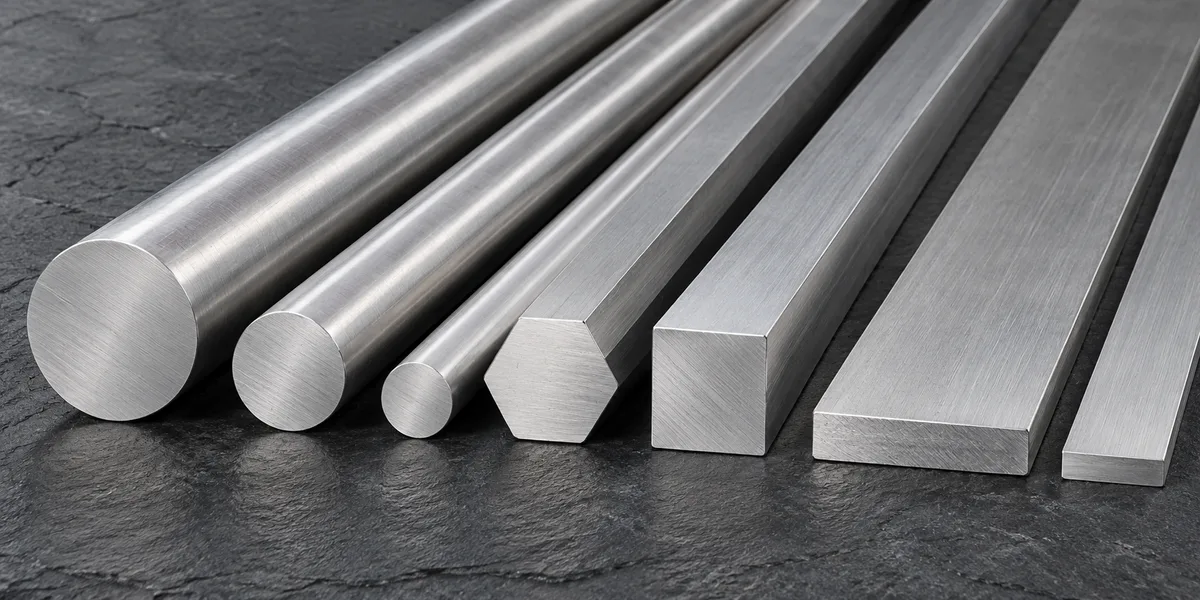
6061 is a heat-treatable aluminium-magnesium-silicon alloy with small additions of copper and chromium. In the T6 condition it reaches a typical yield strength of about 276 MPa, roughly twice that of annealed 5083, while still machining cleanly, welding with standard procedures and resisting atmospheric corrosion well. That balance is why 6061 bar is stocked by almost every metals distributor in the world.
"Bar" covers several solid shapes: round rod, square, hexagon, flat and rectangular bar. Each comes from one of two production routes. Extruded bar is pushed hot through a die and then heat-treated; it is economical and available in large sizes. Cold-finished bar is extruded and then drawn through a second die; it has tighter tolerances, sharper corners on square and hex, a brighter surface and slightly higher guaranteed strength.
The right choice depends on what you will do with the bar. For heavy machining, order a stress-relieved temper (T651 or T6511) so parts stay straight. For screw-machine work on small diameters, cold-finished T6 with its close tolerance saves a turning pass. For welded frames and fabrications, extruded T6 is usually the most economical.
Limits follow the Aluminum Association registration, used in ASTM B211, B221 and EN 573-3. The actual analysis of each lot is on the mill certificate.
| Element | Minimum | Maximum |
|---|---|---|
| Magnesium (Mg) | 0.80 | 1.20 |
| Silicon (Si) | 0.40 | 0.80 |
| Copper (Cu) | 0.15 | 0.40 |
| Chromium (Cr) | 0.04 | 0.35 |
| Iron (Fe) | — | 0.70 |
| Manganese (Mn) | — | 0.15 |
| Zinc (Zn) | — | 0.25 |
| Titanium (Ti) | — | 0.15 |
| Others, each / total | — | 0.05 / 0.15 |
| Aluminium (Al) | Remainder |
Cold-finished bar carries higher guaranteed tensile strength than extruded bar in the same temper, because the drawing step adds a little strain hardening and the specifications reflect that. Values below are specified minimums unless marked typical.
| Product, temper and standard | Tensile min. | Yield min. | Elongation min. |
|---|---|---|---|
| Cold-finished T6 / T651, ASTM B211 | 290 MPa / 42 ksi | 240 MPa / 35 ksi | 10 % |
| Extruded T6 / T6511, ASTM B221 | 260 MPa / 38 ksi | 240 MPa / 35 ksi | 8 – 10 % |
| Extruded T6, EN 755-2 (bar ≤ 200 mm) | 260 MPa | 240 MPa | 8 % |
| Drawn T6, EN 754-2 (bar ≤ 80 mm) | 290 MPa | 240 MPa | 10 % |
| Cold-finished T4, ASTM B211 | 207 MPa / 30 ksi | 110 MPa / 16 ksi | 18 % |
| O (annealed), maximum | ≤ 152 MPa / 22 ksi | — | 16 – 18 % |
| T6, typical | 310 MPa / 45 ksi | 276 MPa / 40 ksi | 12 – 17 % |
Elongation and sometimes strength minimums vary with size band. Check the mill certificate for the limits that apply to your diameter or thickness.
Solution heat-treated and artificially aged, without stress relief. Standard for cold-finished rod and for bar that will not be heavily machined.
T6 plus stretching (1 – 3 %) to relieve quench stresses; applies to rolled or cold-finished bar. Stays straight when machined.
The extruded-bar version of T651: stretched and then lightly straightened. The usual temper for extruded bar that will be machined.
Stretched, with no further straightening. Less common; tolerance on straightness is set by stretching alone.
Solution treated and naturally aged. Softer and more formable; can be aged to T6 after forming.
Fully annealed for forming, swaging and upsetting. Re-heat-treat to T6 after forming for strength.
| Shape | Typical size range | Common uses | Detail page |
|---|---|---|---|
| Round bar / rod | about 3 – 300 mm (1/8 – 12 in) | Shafts, pins, turned parts, bushings | 6061 round bar |
| Square bar | about 6 – 150 mm (1/4 – 6 in) | Milled blocks, brackets, keys, fixtures | 6061 square bar |
| Hex bar | about 6 – 100 mm A/F (1/4 – 4 in) | Nuts, fittings, standoffs, couplings | 6061 hex bar |
| Flat and rectangular bar | thickness about 3 – 100 mm, width to about 300 mm | Frames, base plates, bus bars, wear strips | 6061 flat bar |
| System | Designation / standard | Covers |
|---|---|---|
| ASTM / ASME | ASTM B211 (SB-211) | Rolled or cold-finished bar, rod and wire |
| ASTM / ASME | ASTM B221 (SB-221) | Extruded bar, rod, profiles and tube |
| SAE AMS | AMS 4117 | Cold-finished bar, rod and wire, T6 / T651 |
| SAE AMS | AMS 4150 / AMS 4173 | Extrusions in T6 / T6511 (and T6510) |
| Legacy federal | QQ-A-225/8, QQ-A-200/8 | Superseded by the AMS specifications above; still seen on older drawings |
| European | EN AW-6061 (AlMg1SiCu), EN 755-2, EN 754-2 | Extruded and drawn bar |
| Other | UNS A96061 · Werkstoff 3.3211 · JIS A6061 (H4040) · GB 6061 (GB/T 3191) · ISO AlMg1SiCu | National equivalents |
Weight per metre at 2.70 g/cm³. For a round bar it is 0.002121 × d²; for a square bar 0.0027 × a²; for a hex bar 0.002338 × s², with all sizes in mm (s = across flats). Use the bar weight calculator for other sizes or lengths.
| Size (mm) | Round kg/m | Square kg/m | Hex kg/m |
|---|---|---|---|
| 6 | 0.076 | 0.097 | 0.084 |
| 10 | 0.212 | 0.270 | 0.234 |
| 12 | 0.305 | 0.389 | 0.337 |
| 16 | 0.543 | 0.691 | 0.599 |
| 20 | 0.848 | 1.08 | 0.935 |
| 25 | 1.33 | 1.69 | 1.46 |
| 30 | 1.91 | 2.43 | 2.10 |
| 40 | 3.39 | 4.32 | 3.74 |
| 50 | 5.30 | 6.75 | 5.85 |
| 60 | 7.63 | 9.72 | 8.42 |
| 80 | 13.57 | 17.28 | 14.96 |
| 100 | 21.21 | 27.00 | 23.38 |
Cold-finished bar is held to closer cross-section tolerances than extruded bar. For example, under ANSI H35.2 a cold-finished round between 1 and 1.5 in typically has a diameter tolerance of a few thousandths of an inch, while an extruded round of the same size is allowed several times more. If your part is turned all over, extruded bar is usually fine; if the bar surface is a finished surface, order cold-finished.
Good machinability in T6 with short chips. Use sharp carbide, high positive rake, high spindle speed and flood coolant. For heavy material removal, order T651 or T6511 to limit distortion.
MIG and TIG with ER4043 or ER5356 filler. Design welded joints to reduced strength (about 165 MPa tensile for welded 6061-T6 under the Aluminum Design Manual) or re-heat-treat.
Takes clear, colour and hard anodising well. For the best colour match, keep all parts of an assembly from the same temper and route.
| Property | 6061-T6 | 6082-T6 | 2011-T3 | 7075-T6 |
|---|---|---|---|---|
| Typical yield | 276 MPa | about 280 – 300 MPa | about 295 MPa | 505 MPa |
| Machinability | Good | Good | Excellent (free-cutting) | Very good |
| Weldability | Good | Good | Poor | Poor |
| Corrosion resistance | Good | Good | Fair | Fair |
| Typical use | General engineering | European structural | Screw-machine parts | Highly stressed parts |
6082 is the closest substitute and is more common in Europe. Choose 2011 for high-volume turned parts where chip control matters more than corrosion or welding, and 7075 when strength is the governing requirement.
Both have the same heat treatment and strength. T6511 extruded bar is also stretched to relieve internal stress and then lightly straightened, so it moves less when machined. Order T6511 (or T651 for cold-finished bar) for parts with heavy or asymmetric machining.
Its guaranteed minimum tensile is higher: 290 MPa under ASTM B211 against 260 MPa under ASTM B221, with the same 240 MPa minimum yield. In practice typical properties are similar; the bigger difference is tolerance and surface finish.
Multiply the cross-section in mm² by 0.0027 to get kg per metre. A 25 mm round bar weighs about 1.33 kg/m, a 25 mm square bar 1.69 kg/m and a 25 mm hex bar 1.46 kg/m.
Yes, by MIG or TIG with ER4043 or ER5356 filler. The heat-affected zone softens, so welded strength is lower than T6 unless the part is re-heat-treated.
ASTM B211 for cold-finished bar, ASTM B221 for extruded bar, AMS 4117 or AMS 4173 for aerospace, and EN 755-2 or EN 754-2 for European projects. Give the temper and the tolerance class as well.
Yes. Metline supplies 6061 bar to customers worldwide on EXW, FOB, CIF or DAP terms, with mill test certificates and export packing.
Send shape, size, temper, length and quantity. We will reply with availability, certification and a delivered price.





