Machining
Among the best-machining aluminium alloys. Carbide tools at high speed with coolant give excellent finishes; chips break well. Plan roughing and finishing passes to manage residual stress in thick blocks.



7075 aluminium block gives the highest strength and hardness of the common machining alloys: about 570 MPa typical tensile strength and 150 HB in T651, close to many mould and structural steels at a third of the weight. It is cut from stretched thick plate or made as forged block, and machined into aerospace fittings, moulds, tooling and high-performance parts. Metline supplies 7075 block in T651, T7351 and forged tempers, cut to size and certified, worldwide.
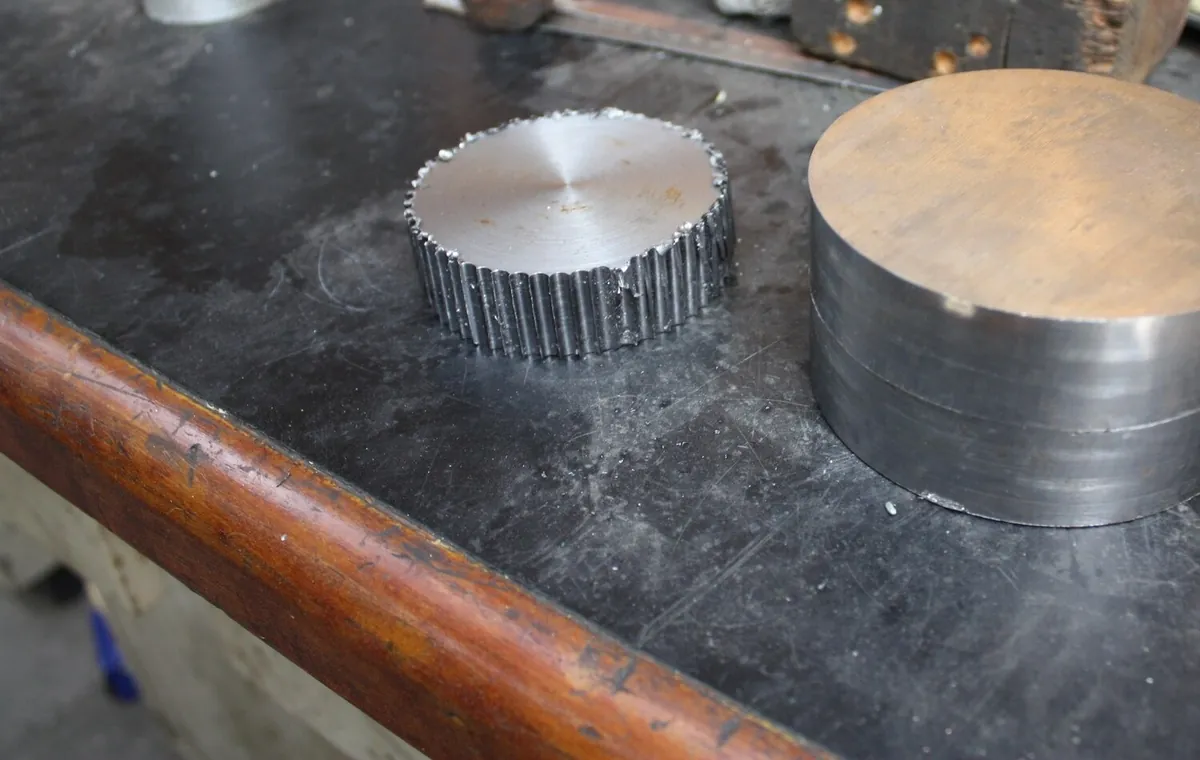
7075 block is thick 7075 material sold as machining stock. Most blocks are saw-cut from 7075-T651 or T7351 plate, which is stretched after quenching so that it stays stable during heavy machining. Larger sections are open-die forged and compression stress-relieved (T652 or T7352).
The appeal is strength per kilogram. A 7075-T651 part can often replace a steel part of similar section at about one third of the weight, and it machines several times faster than steel. That is why 7075 block dominates aerospace fittings, high-end fixtures, and blow and injection moulds for medium production runs.
There are trade-offs. 7075 is not suited to arc welding, has lower corrosion resistance than 6061, and in the peak-aged T6/T651 temper it can suffer stress-corrosion cracking when stressed across the short-transverse direction of thick plate. Thick-section aerospace parts therefore often specify T7351, which is over-aged to resist that risk.
| Element | Minimum | Maximum | Role |
|---|---|---|---|
| Zinc (Zn) | 5.1 | 6.1 | Main strengthening element with Mg (MgZn2 precipitates) |
| Magnesium (Mg) | 2.1 | 2.9 | Combines with Zn for age hardening |
| Copper (Cu) | 1.2 | 2.0 | Adds strength and improves stress-corrosion behaviour |
| Chromium (Cr) | 0.18 | 0.28 | Grain control; improves SCC resistance |
| Silicon (Si) | — | 0.40 | Impurity |
| Iron (Fe) | — | 0.50 | Impurity |
| Manganese (Mn) | — | 0.30 | Impurity |
| Titanium (Ti) | — | 0.20 | Grain refiner |
| Others, each / total | — | 0.05 / 0.15 | |
| Aluminium (Al) | Remainder | About 87 – 91 % |
Typical values below are handbook figures. In thick plate the specified minimums decrease with thickness, and properties in the short-transverse direction (through the thickness) are lower than in the rolling direction. For thick parts, check the ASTM B209 or AMS table for your thickness band and the transverse direction that matters for your design.
| Temper | Tensile strength | Yield strength (0.2 %) | Elongation | Hardness | Electrical conductivity |
|---|---|---|---|---|---|
| O (annealed) | 228 MPa / 33 ksi | 103 MPa / 15 ksi | 17 % | 60 HB | ≈ 45 % IACS |
| T6 / T651, typical | 572 MPa / 83 ksi | 503 MPa / 73 ksi | 11 % | 150 HB | ≈ 33 % IACS |
| T73 / T7351, typical | 503 MPa / 73 ksi | 434 MPa / 63 ksi | 13 % | ≈ 135 HB | ≈ 40 % IACS |
| Temper | Process | Strength | Stress-corrosion resistance | Typical use |
|---|---|---|---|---|
| T651 | Solution treated, stretched, peak aged | Highest | Low in short-transverse direction | Moulds, tooling, general high-strength parts |
| T7351 | Solution treated, stretched, over-aged | About 10 – 15 % lower | High | Aerospace fittings, thick parts under sustained stress |
| T7651 | Stretched, partially over-aged | Between T651 and T7351 | Improved exfoliation resistance | Mostly sheet and thinner plate |
| T652 / T7352 | Forged, compression stress-relieved | Similar to plate tempers | As T6 / T73 family | Very thick or large blocks |
| Product | Specification |
|---|---|
| Plate (commercial) | ASTM B209; EN 485-2 |
| Plate (aerospace) | AMS 4045 (T6 / T651); AMS 4078 (T7351); AMS-QQ-A-250/12 |
| Forgings | ASTM B247; AMS forging specifications |
| Ultrasonic inspection | AMS-STD-2154 or ASTM B594 |
| System | Designation |
|---|---|
| Aluminum Association / UNS | 7075 / A97075 |
| European (EN) | EN AW-7075 / EN AW-AlZn5.5MgCu |
| German Werkstoff | 3.4365 |
| ISO | AlZn5.5MgCu |
| Japan (JIS) | A7075 |
| China (GB) | 7075 |
| Historical | 75S; zicral; "aircraft aluminium" |
7075 is slightly heavier than 6061. Weight in kg = thickness × width × length (mm) × 2.81 ÷ 1,000,000.
| Block size (mm) | Weight (kg) |
|---|---|
| 50 × 100 × 200 | 2.81 |
| 50 × 300 × 300 | 12.64 |
| 75 × 200 × 400 | 16.86 |
| 100 × 200 × 300 | 16.86 |
| 100 × 300 × 500 | 42.15 |
| 150 × 300 × 600 | 75.87 |
| 200 × 400 × 600 | 134.88 |
| 250 × 500 × 1000 | 351.25 |
| 300 × 600 × 1200 | 606.96 |
Among the best-machining aluminium alloys. Carbide tools at high speed with coolant give excellent finishes; chips break well. Plan roughing and finishing passes to manage residual stress in thick blocks.
Used for blow moulds, prototype and bridge injection moulds, and thermoforming tools. Hardness of around 150 HB gives reasonable wear life for medium runs; hard anodising or nickel coating extends it.
Avoid arc welding. Repairs on moulds are done with specialist procedures or inserts.
Responds well to hard anodising, clear anodising and chromate or trivalent conversion coatings.
Protect finished parts. Use T7351 where sustained stress meets humidity or salt.
Avoid long exposure above about 120 °C, which over-ages the T651 temper and reduces strength.
| Property | 7075-T651 | 6061-T651 | 2024-T351 | 7050-T7451 |
|---|---|---|---|---|
| Typical tensile strength | 572 MPa | 310 MPa | 470 MPa | ≈ 510 – 525 MPa |
| Hardness | ≈ 150 HB | ≈ 95 HB | ≈ 120 HB | ≈ 140 HB |
| Thick-section toughness | Moderate | Good | Good | Very good |
| Stress-corrosion resistance | Low (T651) | High | Moderate | High |
| Relative cost | High | Low | High | Very high |
For blocks thicker than about 75 – 100 mm in aerospace use, 7050-T7451 often replaces 7075 because it keeps its properties better through the thickness. For general mould and tooling work, 7075-T651 remains the cost-effective choice. See 7050 vs 7075 for details.
7075-T651 has a typical tensile strength of about 570 MPa, comparable to many medium-carbon structural steels, at about one third of the density. Its stiffness is lower, so deflection-limited parts need a larger section.
T7351 is over-aged. It is about 10 – 15 % weaker but much more resistant to stress-corrosion cracking, which is why it is preferred for thick aerospace fittings.
Yes, for blow moulds and prototype or medium-run injection moulds. It machines fast, conducts heat well and can be hard-anodised for wear resistance.
Multiply thickness × width × length in mm by 2.81 and divide by 1,000,000. A 100 × 200 × 300 mm block weighs about 16.9 kg.
Arc welding is not recommended because of cracking and strength loss. Use mechanical fastening or design the part from one piece.
Yes. Metline supplies 7075 blocks cut to size, with EN 10204 3.1 certificates and export packing, to customers worldwide.
Send the sizes, temper, quantity and specification. We will reply with availability and a delivered price.






