Bending
Bend with the pattern on the outside of the bend where possible. 3003 and 5754 in H114 bend readily; 6061-T6 needs larger radii.



Aluminium tread plate, also called checker plate or diamond plate, is sheet or plate rolled with a raised pattern on one face to give grip underfoot and a hard-wearing, decorative surface. It is specified by alloy, pattern and base thickness, not by overall height. Metline supplies tread plate in 3003, 5052, 5754 and other grades, in five-bar, diamond and other patterns, cut to size, to customers worldwide.
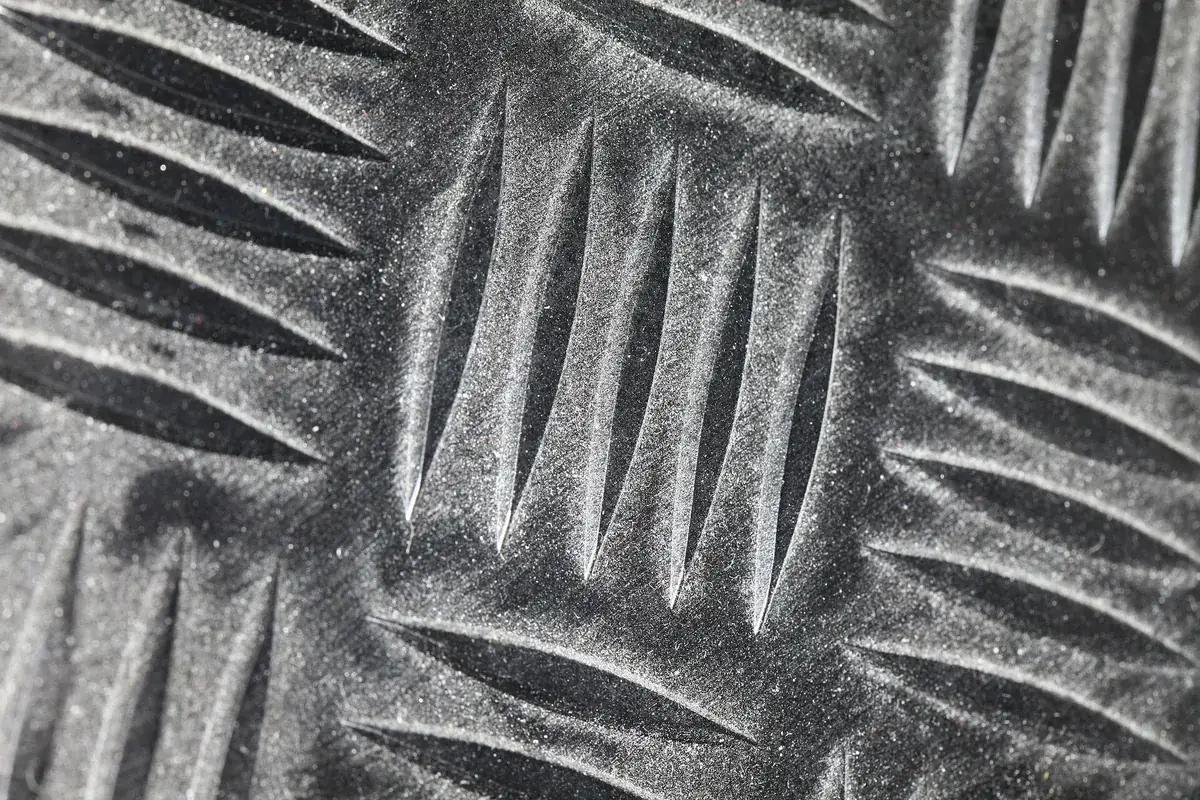
Tread plate is made by passing sheet or plate through a final rolling stand in which one roll is engraved with the pattern. The raised features stand above a flat base, and the underside stays smooth. The pattern adds slip resistance for feet and wheels, hides scratches and dents, and stiffens the sheet slightly.
Aluminium tread plate weighs about one third as much as steel checker plate of the same thickness and does not rust, which is why it dominates truck and trailer floors, toolboxes, steps, ramps, walkways and boat decks. Bright finish tread plate is also used decoratively on vehicles, shop fittings and wall protection.
The most common buying mistake is mixing up base thickness and overall thickness. Standards and suppliers quote the base (the flat sheet beneath the pattern); the raised pattern adds height and weight on top. A "3 mm" tread plate is roughly 3 mm at the base, with the pattern rising above it.
| Pattern | Appearance | Strengths | Typical uses |
|---|---|---|---|
| Five-bar (quintet) | Groups of five short parallel bars set at right angles to neighbouring groups | Good grip in all directions, easy to clean, widely stocked | Vehicle floors, steps, walkways, toolboxes |
| Diamond (checker) | Elongated raised diamonds in a diagonal grid | Classic look, strong grip, bright finish available | Truck bodies, trailers, fire engines, decorative trim |
| One-bar (single bar) | Single raised bars in a herringbone or alternating layout | Robust grip for heavy traffic | Industrial flooring, ramps |
| Two-bar and three-bar | Groups of two or three bars | Intermediate grip and appearance | Steps, platforms, transport |
| Lentil, almond and other | Rounded or oval raised dots | Easy to clean, lower profile | Interiors, food areas, decorative panels |
Pattern height and spacing vary by mill and roll design. If slip resistance must be demonstrated, for example under DIN 51130 ramp testing for workplaces, ask for test evidence for the exact plate, because the alloy, pattern, wear and contamination all affect the result.
| Grade and temper | Typical tensile | Typical yield | Character | Typical uses |
|---|---|---|---|---|
| 1050 / 1060-H14 | about 105 – 110 MPa | about 100 MPa | Soft, inexpensive, bright | Light decorative and interior use |
| 3003-H22 / H24 | about 150 – 165 MPa | about 130 – 145 MPa | Bright finish, good formability | North American diamond plate, toolboxes, trim |
| 5052-H32 / H114 | about 228 MPa | about 190 MPa | Stronger, marine resistant | Trailer and boat decks, ramps |
| 5754-H114 | about 190 MPa or more (O / H111 minimum) | about 80 MPa or more | European standard tread plate grade | Vehicle floors, walkways, stairs |
| 5086-H114 | about 270 MPa | about 130 MPa | Highest-strength 5xxx tread plate | Heavy-duty marine and transport floors |
| 6061-T6 | about 310 MPa | about 276 MPa | Heat-treated, strongest | Structural flooring, ramps and platforms |
H114 is a temper designation used specifically for patterned or embossed sheet, which is strain-hardened slightly more than O temper by the pattern-rolling pass. Values are typical or indicative; minimums come from EN 1386, ASTM B632 and the mill certificate.
The table shows the weight of the flat base only at 2.70 kg/m² per mm (5xxx grades are about 1 % lighter). The raised pattern adds a further amount that depends on the pattern design and height, so ask for the producer's actual kg/m² figure when weight matters for freight or vehicle payload.
| Base thickness (mm) | Base weight (kg/m²) | 1220 × 2440 mm base weight (kg) | 1250 × 2500 mm base weight (kg) |
|---|---|---|---|
| 1.5 | 4.05 | 12.1 | 12.7 |
| 2 | 5.40 | 16.1 | 16.9 |
| 2.5 | 6.75 | 20.1 | 21.1 |
| 3 | 8.10 | 24.1 | 25.3 |
| 3.5 | 9.45 | 28.1 | 29.5 |
| 4 | 10.80 | 32.1 | 33.8 |
| 4.5 | 12.15 | 36.2 | 38.0 |
| 5 | 13.50 | 40.2 | 42.2 |
| 6 | 16.20 | 48.2 | 50.6 |
| 8 | 21.60 | 64.3 | 67.5 |
Bend with the pattern on the outside of the bend where possible. 3003 and 5754 in H114 bend readily; 6061-T6 needs larger radii.
3003, 5052, 5754 and 5086 weld well by MIG or TIG with 5xxx filler; joints are usually made from the smooth underside.
Shear, saw, laser or waterjet. Clean burrs on edges that people will handle or walk over.
Countersunk screws, rivets or adhesive bonding to timber or steel subfloors; isolate from steel to avoid galvanic corrosion.
Polished tread plate is supplied with film; it dulls outdoors unless lacquered or regularly cleaned.
5xxx grades are preferred for marine, de-icing salt and wet environments.
They are names for the same product family: sheet or plate with a raised anti-slip pattern. "Diamond plate" usually refers to the diamond pattern, popular in North America; "tread plate" and "checker plate" are common in Europe, India and Australia, often for the five-bar pattern.
Normally without: the quoted thickness is the base thickness of the flat sheet, and the pattern rises above it. Always confirm on the order whether a figure is base or overall thickness.
5754-H114, 5052-H114 or 5086-H114 are preferred for strength and corrosion resistance in wet and salty conditions. 3003 is common for toolboxes and bright decorative use.
H114 is the temper for patterned or embossed sheet: the metal is annealed, then given a small amount of strain hardening by the pattern-rolling pass, so it is a little stronger than O temper and still formable.
Yes. 3003, 5052, 5754 and 5086 tread plate weld readily by MIG or TIG, normally with 5xxx filler wire and from the smooth side.
Yes. Tread plate can be supplied in standard sheets or cut to panels, with mill certificates and export packing, and shipped worldwide.
Send alloy, pattern, base thickness, size and quantity. We will reply with availability, certification and a delivered price.






