Cladding ratio
Measured on cross-sections by microscopy for each lot and reported on the certificate.



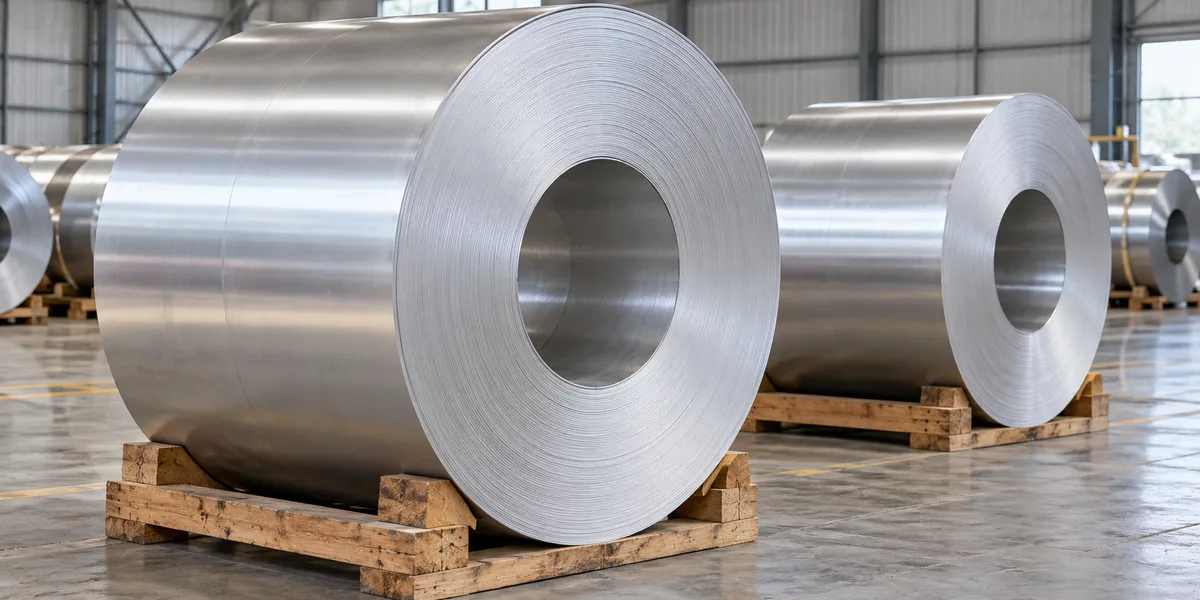
Brazing clad coil is a multi-layer aluminium strip: a strong core alloy roll-bonded to a thin aluminium-silicon filler layer that melts in the brazing furnace and joins the heat exchanger together. It is the base material for tubes, headers, plates and side supports in vehicle radiators, condensers, heater cores, oil coolers and EV battery cold plates. Metline supplies clad coil in 0.05 – 6 mm thickness and slit widths to drawing, worldwide.
A modern automotive heat exchanger is assembled from dozens or hundreds of parts and then joined in a single furnace pass. The joining metal comes from the parts themselves: tube stock, headers and plates are clad on one or both sides with an Al-Si alloy whose melting point is 30 – 60 °C below that of the core. In the furnace the clad melts, flows by capillary action into every joint and solidifies as a fillet.
Clad coil is produced by hot-rolling a core slab together with thinner filler-alloy liner plates until they bond metallurgically, then cold-rolling to final gauge and annealing or temper-rolling. The result is a strip whose cladding ratio (filler thickness as a percentage of total thickness) is controlled to a tolerance of about ±1 – 3 percentage points.
Different heat-exchanger parts need different combinations. A radiator tube might be 4343 / long-life 3xxx / 7072, with braze clad on the air side and a sacrificial zinc liner on the coolant side. A header might be 4343 / 3003 with clad on one face only. A stacked-plate oil cooler may use 4343 on both sides of a 3003 core.
Filler alloys are chosen by brazing process and joint geometry; core alloys by strength, corrosion life and furnace temperature. The Chinese national grades 4A13 and 4A17 are close relatives of 4343 and 4047 respectively and can be supplied where specified.
| Filler (clad) alloy | Silicon, wt % | Other key elements | Melting range (approx.) | Process | AWS class |
|---|---|---|---|---|---|
| 4343 | 6.8 – 8.2 | — | 577 – 613 °C | CAB (flux) | BAlSi-2 |
| 4045 | 9.0 – 11.0 | — | 577 – 591 °C | CAB (flux) | BAlSi-5 |
| 4047 | 11.0 – 13.0 | — | 577 – 582 °C | CAB, flame, induction | BAlSi-4 |
| 4004 | 9.0 – 10.5 | Mg 1.0 – 2.0 | about 559 – 591 °C | Vacuum (fluxless) | BAlSi-7 |
| 4104 | 9.0 – 10.5 | Mg 1.0 – 2.0, Bi 0.02 – 0.20 | about 559 – 591 °C | Vacuum (fluxless) | BAlSi-11 |
| Core or liner alloy | Key alloying | Why it is used |
|---|---|---|
| 3003 | Mn 1.0 – 1.5, Cu 0.05 – 0.20 | Standard core: solidus about 640 °C, well above brazing temperature; good formability |
| Long-life 3xxx cores | Mn with added Cu and Ti | Higher post-braze strength and a layered corrosion structure that resists perforation |
| 3005 | Mn 1.0 – 1.5, Mg 0.20 – 0.60 | More strength; magnesium must be limited for CAB because it reacts with flux |
| 6063 / 6951 | Mg-Si (6951 also Cu) | Heat-treatable cores for higher post-braze strength; mainly vacuum-brazed plates and evaporators |
| 7072 liner | Zn 0.8 – 1.3 | Sacrificial water-side liner that corrodes preferentially and protects the core |
| 1050 / 1100 liner | Commercially pure | Soft inner layer used in some tube and plate designs |
7072 is a low-strength, zinc-bearing liner alloy used for sacrificial protection. It is not a high-strength structural 7xxx alloy, despite its series number.
Typical specified ranges for 4xxx clad on 3003-type cores. Properties apply to the as-delivered coil; after brazing, the material is effectively annealed and design should use post-braze values agreed with the supplier.
| Temper | Tensile strength Rm | Yield Rp0.2 (min.) | Elongation A50 (min., 0.2 – 1.3 mm) |
|---|---|---|---|
| O | 95 – 160 MPa | 35 MPa | 18 % |
| H12 / H22 | 120 – 170 MPa | 90 / 80 MPa | 4 / 6 % |
| H14 / H24 | 150 – 200 MPa | 125 / 115 MPa | 2 / 3 % |
| H16 / H26 | 170 – 230 MPa | 150 / 140 MPa | 1 / 2 % |
| H18 | ≥ 200 MPa | 170 MPa | 1 % |
For 6xxx-core composites (for example 4045 / 6951 / 4045) in the O temper, tensile strength is normally limited to about 160 MPa maximum before brazing, and post-braze strength rises after natural or artificial ageing.
| Thickness (mm) | Width ≤ 100 mm | > 100 – 300 mm | > 300 – 900 mm | > 900 – 1400 mm |
|---|---|---|---|---|
| 0.20 – 0.40 | ±0.1 | ±0.2 | ±0.3 | ±0.5 |
| 0.40 – 0.80 | ±0.1 | ±0.2 | ±0.5 | ±0.8 |
| 0.80 – 1.50 | ±0.1 | ±0.3 | ±0.8 | ±1.0 |
| 1.50 – 3.00 | ±0.2 – 0.3 | ±0.3 – 0.4 | ±0.8 – 1.0 | ±1.2 |
| 3.00 – 6.00 | ±0.4 | ±0.5 | ±1.2 | ±1.5 |
Slit-width tolerances above are typical. Strip for welded or folded tube needs tighter control of edge burr, layer separation at the edge and coil telescoping, because any defect shows up as a leak in the tube seam. These limits are agreed per order.
Vacuum brazing uses magnesium-bearing fillers (4004, 4104) instead of flux: magnesium evaporates and breaks up the oxide film. Bismuth in 4104 improves wetting and makes the process more tolerant of furnace conditions.
| Part | Typical structure | Notes |
|---|---|---|
| Radiator and heater tubes (welded or folded) | 4343 / long-life 3xxx / 7072 | Thin gauge, tight seam quality |
| Headers and tanks | 4343 / 3003 or 4045 / 3003 | Thicker gauge, one-side clad |
| Condenser headers and side plates | 4343 / 3003 / 4343 | Both sides clad |
| Oil and transmission coolers (stacked plate) | 4343 / 3003 / 4343 | Formability for embossed plates |
| EV battery cold plates | 4343 / 3003 or 6xxx core | Flat, leak-tight brazed channels |
| Charge-air coolers | 4343 / 3xxx | Higher temperature service |
Measured on cross-sections by microscopy for each lot and reported on the certificate.
Tensile tests before brazing; post-braze tests after a simulated braze cycle on request.
Free of oil residue, oxide staining and roll marks that would hinder wetting.
Acidified salt spray (SWAAT, ASTM G85 A3) or neutral salt spray to the hours required by the vehicle maker.
The thickness of the filler layer as a percentage of total strip thickness, per side. Tube and plate stock is commonly 5 – 15 %; the tolerance is typically ±1 – 3 percentage points depending on the ratio.
4343 has a wider melting range and less fluidity, suiting thicker clad on tubes and plates. 4045 melts over a narrower range and flows more, which suits fin stock and joints that need more filler. Both are used with flux in CAB furnaces.
It contains about 1 % zinc, which makes it electrochemically more active than the core. It corrodes slowly and sacrificially, protecting the core from pitting perforation.
Only with care. Magnesium reacts with fluoride flux and reduces wetting, so CAB cores are normally kept low in magnesium. Higher-Mg and 6xxx cores are usually vacuum-brazed with 4004 or 4104 filler.
O or H2x for parts that are deep-drawn or heavily formed; H14 or H16 for tube stock that needs stiffness for welding or folding. Your forming process and sag resistance needs decide the choice.
Yes. Coil can be slit from about 7 mm wide, with burr and telescoping limits agreed for tube-making lines.
Send your layer structure, gauge, width and volume. We will reply with availability, certification and a delivered price.





