Controlled-atmosphere (CAB)
The best fit. 4047 contains almost no magnesium, so it works well with non-corrosive potassium fluoroaluminate flux in a nitrogen furnace.



A 4047 brazing disc is a pre-cut piece of aluminium-12 % silicon filler metal that is placed in or beside a joint and melted in the furnace or by torch to braze aluminium parts together. Because 4047 is close to the aluminium-silicon eutectic, it melts over a very narrow range of about 577 – 582 °C and flows freely into tight joints. Metline supplies 4047 discs, washers, rings and shaped preforms, bare or clad, to drawing, worldwide.
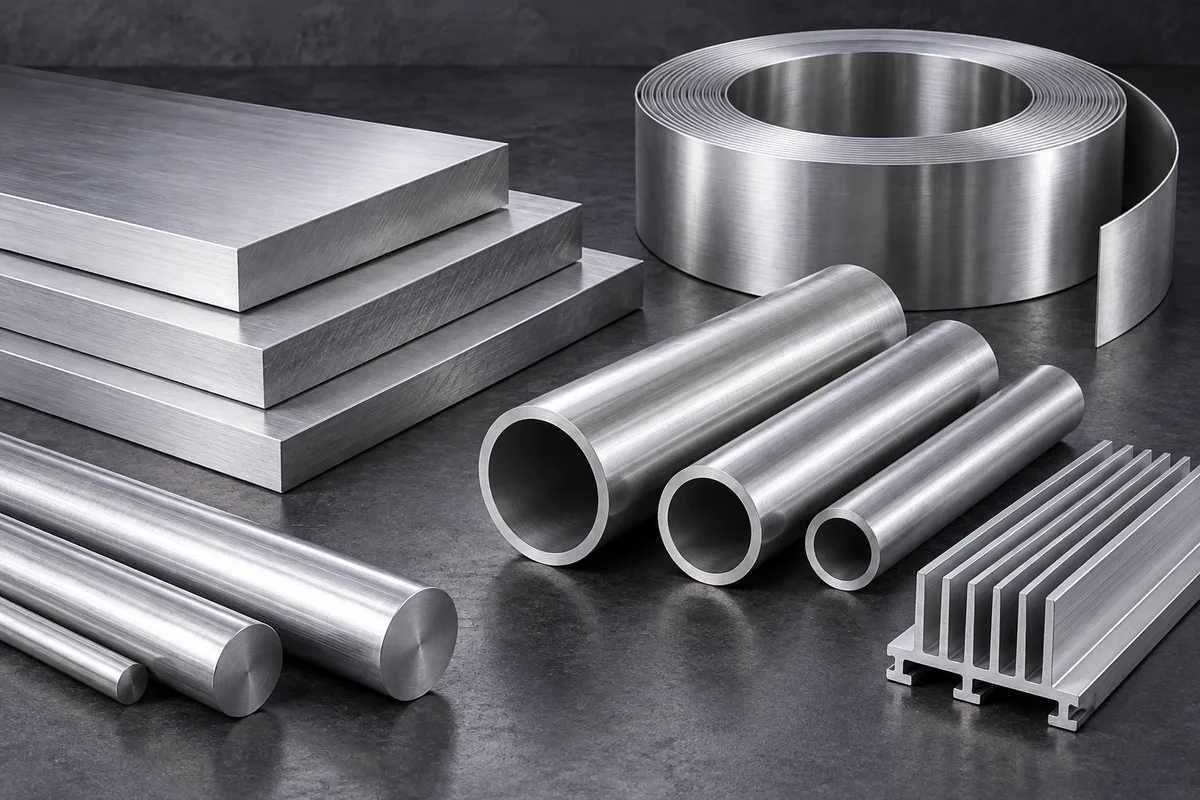
Brazing joins two parts by melting a filler metal whose melting point is below that of the parts. For aluminium, the fillers are aluminium-silicon alloys, and 4047 is the one with the most silicon: 11 – 13 %. At that level the alloy is nearly eutectic, so it changes from solid to liquid almost at a single temperature rather than over a wide mushy range.
That behaviour makes 4047 the most fluid of the common aluminium fillers. It wets well, fills long capillary gaps and forms smooth fillets, and it leaves a useful margin below the solidus of base alloys such as 1100, 3003, 3103, 6063 and 6951. Discs and other preforms put exactly the right amount of filler where it is needed, which gives more consistent joints than hand-fed rod and suits batch furnace and automated brazing.
Typical preform shapes include flat discs for face-to-face joints (for example a fitting brazed to a plate), washers and rings around tube or stud joints, and custom stamped shapes that match a part outline. Discs can be plain 4047 or clad, where a 3003 core carries 4047 on one or both faces.
| Element | Minimum | Maximum | Note |
|---|---|---|---|
| Silicon (Si) | 11.0 | 13.0 | Near-eutectic; lowers melting point |
| Iron (Fe) | — | 0.80 | Impurity |
| Copper (Cu) | — | 0.30 | |
| Manganese (Mn) | — | 0.15 | |
| Magnesium (Mg) | — | 0.10 | Kept low for flux brazing |
| Zinc (Zn) | — | 0.20 | |
| Others, each / total | — | 0.05 / 0.15 | |
| Aluminium (Al) | Remainder |
Aluminum Association limits for 4047. The same alloy is classified as BAlSi-4 in AWS A5.8 and Al 112 in ISO 17672.
Melting values are approximate and vary slightly within the composition range.
| Filler | Si % | Approx. melting range | Approx. brazing range | When to choose |
|---|---|---|---|---|
| 4047 (BAlSi-4) | 11 – 13 | 577 – 582 °C | 582 – 604 °C | Best fluidity; tight gaps; lowest brazing temperature |
| 4045 (BAlSi-5) | 9 – 11 | 577 – 591 °C | 588 – 604 °C | Most common clad layer for CAB brazing sheet |
| 4343 (BAlSi-2) | 6.8 – 8.2 | 577 – 613 °C | 599 – 621 °C | Less erosion of thin cores; wider melting range |
| 4004 / 4104 | 9 – 10.5 + Mg | ≈ 559 – 591 °C | Vacuum brazing | Magnesium-bearing filler for fluxless vacuum brazing |
The best fit. 4047 contains almost no magnesium, so it works well with non-corrosive potassium fluoroaluminate flux in a nitrogen furnace.
Used for repair and small batches. Apply flux to the joint, heat the parts evenly and let the disc melt from the heat of the parts, not the flame.
Plain 4047 lacks the magnesium that disrupts the oxide film in vacuum. Use Mg-bearing 4004 / 4104 preforms, or add a magnesium getter, for fluxless vacuum work.
Possible in molten salt baths, now less common because of flux handling and cleaning.
Good practice for any route: degrease parts, remove heavy oxide, keep clearances even, fixture parts so the disc stays in contact as it melts, and do not overshoot the brazing range, because excess temperature or time causes the filler to erode thin base metal.
To size a disc, estimate the joint volume (fillet plus gap) and add 10 – 30 % for flow losses. A 30 mm diameter, 0.2 mm thick 4047 disc contains about 0.14 cm³ of filler, roughly 0.38 g.
About 577 °C solidus and 582 °C liquidus. Brazing is usually done between about 582 and 604 °C.
Alloys with a solidus well above 600 °C, such as 1xxx, 3003, 3103, 6063 and 6951. Alloys such as 6061, 2024 and 7075 are not suitable for furnace brazing with Al-Si filler.
Yes for torch, induction and CAB brazing. For vacuum brazing, use a magnesium-bearing filler such as 4004 or 4104 instead.
4047 has 11 – 13 % silicon and a very narrow melting range; 4045 has 9 – 11 % silicon and a slightly wider range. 4047 is more fluid; 4045 is the usual cladding on CAB brazing sheet.
Yes. Discs, washers, rings and stamped shapes can be produced to your drawing in bare or clad material.
Yes. Metline ships 4047 preforms worldwide with certificates and protective packing.
Send the drawing, quantity and brazing process. We will confirm construction, certification and a delivered price.





