6082-T651
Solution treated, stretched to relieve stress and aged. Standard for plate over about 6 mm that will be machined; stays flat as material is removed.



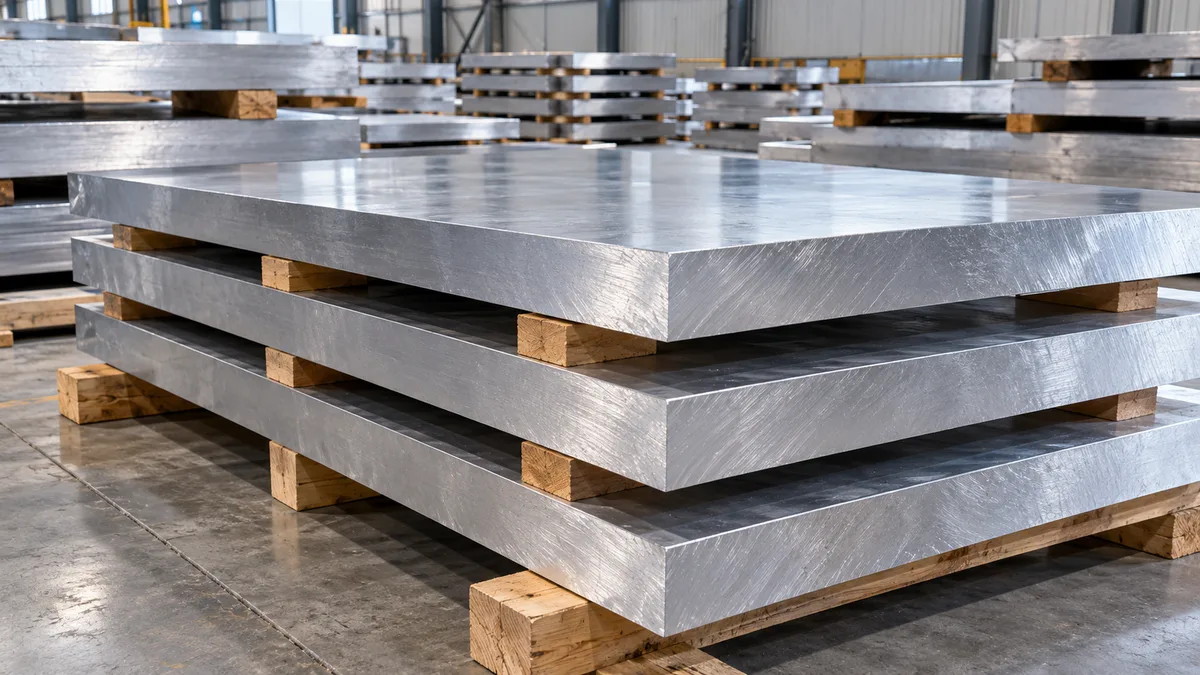
6082 is the standard heat-treatable structural aluminium alloy in Europe, the Middle East and much of Asia, with the highest strength of the common 6xxx grades. 6082-T651 plate machines well, welds readily and resists corrosion, making it the usual choice for machined parts, structural plates and welded frames built to EN standards. Metline supplies 6082 sheet and plate in T6, T651 and other tempers, cut to size, worldwide.
6082 is an Al-Si-Mg-Mn alloy. It carries more silicon than 6061 and a substantial manganese addition (0.4 – 1.0 %) instead of copper. Manganese controls grain structure and gives a fine-grained, tough plate, while the silicon excess pushes aged strength slightly above 6061 in thick sections.
The alloy replaced the British HE30/H30 and German AlMgSi1 grades and is now the reference structural 6xxx alloy in EN 1999 (Eurocode 9) design. It is supplied as sheet, plate, bar, tube and extrusions, which lets designers keep one alloy across a whole fabrication.
In practice, 6082-T651 is to European workshops what 6061-T651 is in North America: the default plate for jigs, fixtures, base plates, machine frames, vehicle parts and offshore and marine fittings. The two are close substitutes, but they are not identical, so a substitution should always be checked against the design standard.
| Element | Minimum | Maximum | Role |
|---|---|---|---|
| Silicon (Si) | 0.70 | 1.30 | Forms Mg2Si with Mg; excess Si adds strength |
| Iron (Fe) | — | 0.50 | Impurity |
| Copper (Cu) | — | 0.10 | Kept low for corrosion resistance |
| Manganese (Mn) | 0.40 | 1.00 | Grain control, toughness and strength |
| Magnesium (Mg) | 0.60 | 1.20 | Main strengthening element with Si |
| Chromium (Cr) | — | 0.25 | Grain control |
| Zinc (Zn) | — | 0.20 | Impurity |
| Titanium (Ti) | — | 0.10 | Grain refiner |
| Others, each / total | — | 0.05 / 0.15 | |
| Aluminium (Al) | Remainder |
Limits per EN 573-3 and the Aluminum Association registration. Actual analysis is reported on each mill certificate.
EN 485-2 sets minimum properties that fall as plate gets thicker, because thick sections cool more slowly during quenching. The table summarises the commonly published minimums; your certificate will show the exact limits and test results for the thickness ordered.
| Temper | Thickness | Tensile Rm (min) | Proof Rp0.2 (min) | Elongation (min) |
|---|---|---|---|---|
| O | 0.4 – 25 mm | ≤ 150 MPa | ≤ 85 MPa | 14 – 18 % |
| T4 / T451 | 0.4 – 25 mm | 205 MPa | 110 MPa | 12 – 14 % |
| T6 | 0.4 – 6 mm | 310 MPa | 260 MPa | 6 – 10 % |
| T651 | 6 – 12.5 mm | 300 MPa | 255 MPa | 9 % |
| T651 | 12.5 – 100 mm | 295 MPa | 240 MPa | 7 – 8 % |
| T651 | 100 – 150 mm | 275 MPa | 240 MPa | 6 % |
Typical T6/T651 results in thinner plate are around 330 – 340 MPa tensile and 300 – 310 MPa proof stress.
Solution treated, stretched to relieve stress and aged. Standard for plate over about 6 mm that will be machined; stays flat as material is removed.
Same strength without stretching. Normal for sheet up to about 6 mm used flat or lightly formed.
Naturally aged; easier to form. Age to T6 after forming if strength is needed.
Annealed for maximum formability. Re-heat-treat after forming to restore strength.
| System | Designation | Standard |
|---|---|---|
| European (EN) | EN AW-6082 / AlSi1MgMn | EN 485-1/-2/-3/-4, EN 573-3 |
| German Werkstoff | 3.2315 (formerly AlMgSi1) | DIN EN 485 |
| British (former) | HE30 / H30 (HS30 sheet) | Superseded by EN |
| UNS | A96082 | — |
| ISO | AlSi1MgMn | ISO 6361 |
| India (IS) | 64430 | IS 736 / IS 737 |
| China (GB) | 6082 | GB/T 3880, GB/T 3190 |
| Thickness (mm) | kg per m² | 1250 × 2500 mm (kg) | 1500 × 3000 mm (kg) |
|---|---|---|---|
| 1 | 2.70 | 8.4 | 12.2 |
| 2 | 5.40 | 16.9 | 24.3 |
| 3 | 8.10 | 25.3 | 36.5 |
| 4 | 10.80 | 33.8 | 48.6 |
| 5 | 13.50 | 42.2 | 60.8 |
| 6 | 16.20 | 50.6 | 72.9 |
| 8 | 21.60 | 67.5 | 97.2 |
| 10 | 27.00 | 84.4 | 121.5 |
| 12 | 32.40 | 101.3 | 145.8 |
| 15 | 40.50 | 126.6 | 182.2 |
| 20 | 54.00 | 168.8 | 243.0 |
| 25 | 67.50 | 210.9 | 303.8 |
| 30 | 81.00 | 253.1 | 364.5 |
| 40 | 108.00 | 337.5 | 486.0 |
| 50 | 135.00 | 421.9 | 607.5 |
| 60 | 162.00 | 506.2 | 729.0 |
| 80 | 216.00 | 675.0 | 972.0 |
| 100 | 270.00 | 843.8 | 1215.0 |
Good in T6/T651, with short chips when tools are sharp. T651 minimises distortion in pocketed parts. Use carbide with high positive rake and flood coolant.
Readily welded by MIG and TIG with 4043, 5356 or 5183 filler. EN 1999-1-1 applies reduced strength in the heat-affected zone, typically to around half of the T6 proof stress, so welds are placed away from peak stresses.
Thin T6 sheet bends with inside radii of about 1.5 – 3 × thickness. For tight forming, use O or T4 and age afterwards.
Gives a good protective anodised finish, though slightly less bright than 6063; the manganese can give a faint grey tint.
Good resistance to atmospheric and marine exposure; copper content is low, so it outperforms copper-bearing alloys in salt air.
Like other aged 6xxx alloys, strength falls with prolonged exposure above about 150 °C.
| Property | 6082-T651 | 6061-T651 | 7020-T651 |
|---|---|---|---|
| Typical tensile strength | 330 – 340 MPa | 310 MPa | about 360 – 380 MPa |
| Typical yield strength | 300 – 310 MPa | 276 MPa | about 300 – 320 MPa |
| Weldability | Good | Good | Good (HAZ recovers by natural ageing) |
| Main standard system | EN | ASTM / AMS | EN |
See 6061 vs 6082 for a detailed comparison, or 7020 plate when a weldable alloy with more strength is needed.
Both are solution treated and artificially aged. T651 is also stretched after quenching to relieve internal stress, so it stays flat when machined. T6 is normal for sheet; T651 for plate.
No, but they are close substitutes. 6082 uses manganese instead of copper and is slightly stronger in thick plate; 6061 anodises a little brighter and is more common in the Americas.
Yes. It welds well by MIG and TIG with 4043, 5356 or 5183 filler, but the heat-affected zone loses roughly half its proof strength, which design codes account for.
HE30 for extrusions and H30 / HS30 for other forms. Many drawings still use these names.
2.70 kg per m² per millimetre. A 1500 × 3000 × 10 mm plate weighs about 121.5 kg.
Send the temper, thickness, size, quantity and destination. We will confirm availability, certification and a delivered price.





