Cold heading
O and H12 wire heads well into rivets and small parts; strength rises with the cold work of heading.



3003 aluminium wire is a manganese-alloyed wire that is about 20 % stronger than pure aluminium wire while keeping excellent formability, weldability and corrosion resistance. It is used for low-strength rivets, cold-headed parts, mesh and screens, tie and binding wire, springs for light duty and decorative or craft work. Metline supplies 3003 wire in soft to hard tempers, in coils, spools or straight lengths, to customers worldwide.
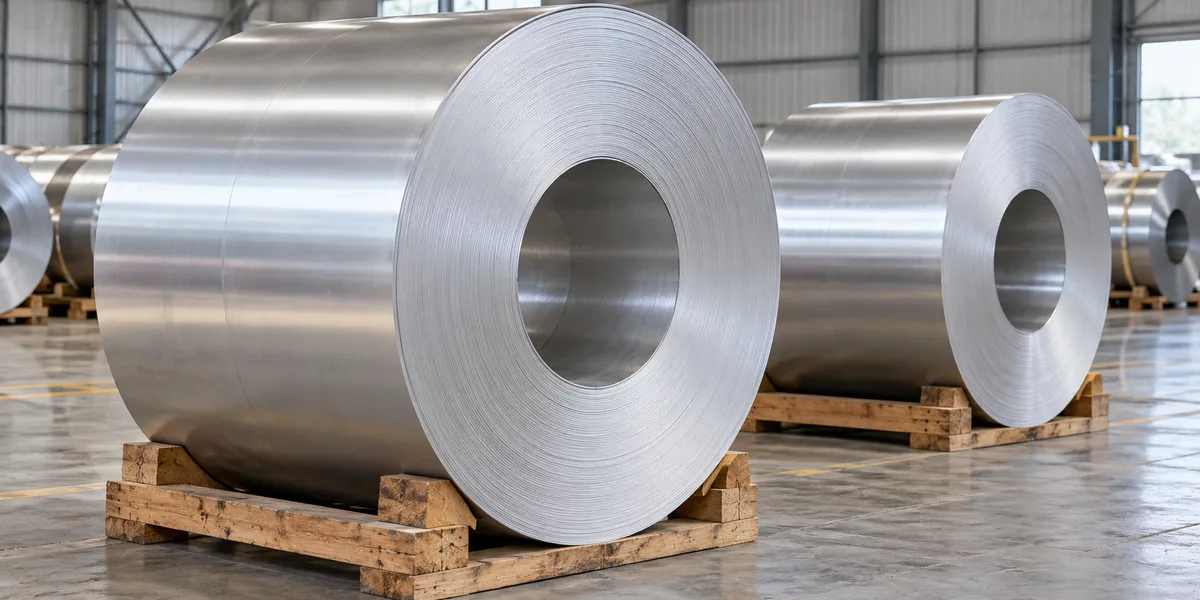
3003 is the most widely used non-heat-treatable aluminium alloy. About 1.2 % manganese and a little copper raise its strength above 1100 commercially pure aluminium, while ductility and corrosion resistance remain very high.
Because 3003 cannot be strengthened by heat treatment, its strength in wire form is set by cold drawing. Each pass through a drawing die work-hardens the metal, so the same alloy can be supplied dead soft (O temper) for wrapping, twisting and severe cold heading, or hard drawn (H18) for straight, springy wire. Intermediate tempers such as H14 give a balance of stiffness and bendability for mesh and formed parts.
Typical uses take advantage of that formability. Soft 3003 wire is cold-headed into rivets and small parts that need moderate strength and good corrosion resistance, knitted or woven into mesh, used for tie and binding wire, and sold as craft and jewellery wire because it bends easily and anodises in bright colours. Half-hard and hard wire is used for formed clips, light springs, hooks, hangers and wire forms. It also welds and brazes easily, unlike most higher-strength alloys.
| Element | Min | Max | Role |
|---|---|---|---|
| Silicon (Si) | — | 0.6 | Impurity |
| Iron (Fe) | — | 0.7 | Impurity |
| Copper (Cu) | 0.05 | 0.20 | Small strength increase |
| Manganese (Mn) | 1.0 | 1.5 | Main strengthening element |
| Zinc (Zn) | — | 0.10 | |
| Others each / total | — | 0.05 / 0.15 | |
| Aluminium | Remainder |
Aluminum Association limits; EN AW-3003 (AlMn1Cu) in EN 573-3 is aligned. The Chinese grade 3A21 is similar but has no copper addition.
Typical values are shown; minimum and maximum limits for each temper are set by the order specification and appear on the mill certificate. Elongation in fine wire is measured over a short gauge and can differ from sheet values.
| Temper | Tensile strength | Yield strength | Character |
|---|---|---|---|
| O (annealed) | 110 MPa / 16 ksi | 40 MPa / 6 ksi | Dead soft; heading, twisting, wrapping |
| H12 (quarter hard) | 130 MPa / 19 ksi | 125 MPa / 18 ksi | Soft but holds shape |
| H14 (half hard) | 150 MPa / 22 ksi | 145 MPa / 21 ksi | Mesh, formed parts, general use |
| H16 (three-quarter hard) | 180 MPa / 26 ksi | 170 MPa / 25 ksi | Stiffer formed parts |
| H18 (full hard) | 200 MPa / 29 ksi | 185 MPa / 27 ksi | Straight, springy wire |
3003 is not a conductor alloy; for electrical wire use 1350 or 6101, which have far higher conductivity.
| System | Designation / standard | Covers |
|---|---|---|
| ASTM | B211 / B211M | Rolled or cold-finished bar, rod and wire |
| ASTM | B316 / B316M | Rivet and cold-heading wire, where 3003 is ordered for heading |
| UNS | A93003 | |
| Europe | EN AW-3003 (AlMn1Cu), 3.0517 | EN 573-3 chemistry; EN 1301 drawn wire |
| Japan | A3003W | JIS H4040 |
| China (similar) | 3A21 | GB/T 3190 |
Weight of round 3003 wire in kg per 1000 m = 0.785 × d² × 2.73, with d in mm.
| Diameter (mm) | kg per 1000 m | Metres per kg |
|---|---|---|
| 0.5 | 0.54 | 1865.6 |
| 0.8 | 1.37 | 728.7 |
| 1 | 2.14 | 466.4 |
| 1.6 | 5.49 | 182.2 |
| 2 | 8.58 | 116.6 |
| 2.5 | 13.40 | 74.6 |
| 3 | 19.30 | 51.8 |
| 3.2 | 21.96 | 45.5 |
| 4 | 34.31 | 29.1 |
| 4.8 | 49.40 | 20.2 |
| 5 | 53.60 | 18.7 |
| 6 | 77.19 | 13.0 |
| 6.35 | 86.46 | 11.6 |
| 8 | 137.22 | 7.3 |
| 10 | 214.41 | 4.7 |
| 12 | 308.76 | 3.2 |
For automated wire-forming or heading machines, coil weight, winding pattern and cast (the natural curvature of wire from the coil) affect productivity as much as the alloy itself. State them on the order if your machines need them.
O and H12 wire heads well into rivets and small parts; strength rises with the cold work of heading.
Bends without cracking even in H14; suitable for mesh, baskets, clips and wire forms.
Welds readily by TIG and MIG and can be brazed or soldered with suitable fluxes.
Hard wire can be softened by annealing at about 415 °C.
Takes clear and dyed anodic coatings, popular for decorative and craft wire.
Very good in atmospheric service and fresh water; better than 2xxx and similar to 1100.
| 1100-H14 | 3003-H14 | 5052-H32 | 6061-T6 | |
|---|---|---|---|---|
| Typical tensile | 125 MPa | 150 MPa | 230 MPa | 310 MPa |
| Heat-treatable | No | No | No | Yes |
| Formability | Excellent | Excellent | Good | Fair in T6 |
| Corrosion resistance | Excellent | Very good | Excellent (marine) | Good |
| Typical use | Conductive, chemical | General forming, mesh | Marine, rivets | Structural fasteners |
Low-strength rivets and cold-headed parts, mesh and screens, tie wire, wire forms such as clips and hooks, and craft or decorative wire.
It depends on temper. O temper is dead soft, H14 is half hard and H18 is full hard. Choose the temper by how much bending and how much stiffness the part needs.
No. 3003 is non-heat-treatable; it gains strength only by cold work. Heating it anneals the wire and makes it softer.
Not as a conductor. Its conductivity is around 40 – 50 % IACS; use 1350 or 6101 alloys for electrical conductors.
3A21 is a Chinese grade with a similar manganese content but no deliberate copper addition. Properties are close, but they are not formally identical.
Send diameter, temper, finish, packaging and destination, and we will reply with availability and a delivered price.





