8011
Aluminium-iron-silicon alloy and the volume grade for air-conditioner fins. Good strength and elongation balance for drawn collars, widely available bare or coated.



Aluminium fin stock is thin foil or strip, usually 0.06 to 0.25 mm thick, that is pressed or corrugated into the fins of air-conditioning coils, radiators, condensers and evaporators. It comes in two families: clad fin stock with a brazing layer for furnace-brazed heat exchangers, and non-clad (bare or pre-coated) fin stock for mechanically expanded tube-and-fin coils. This guide explains how to choose between them and what to put on the order.
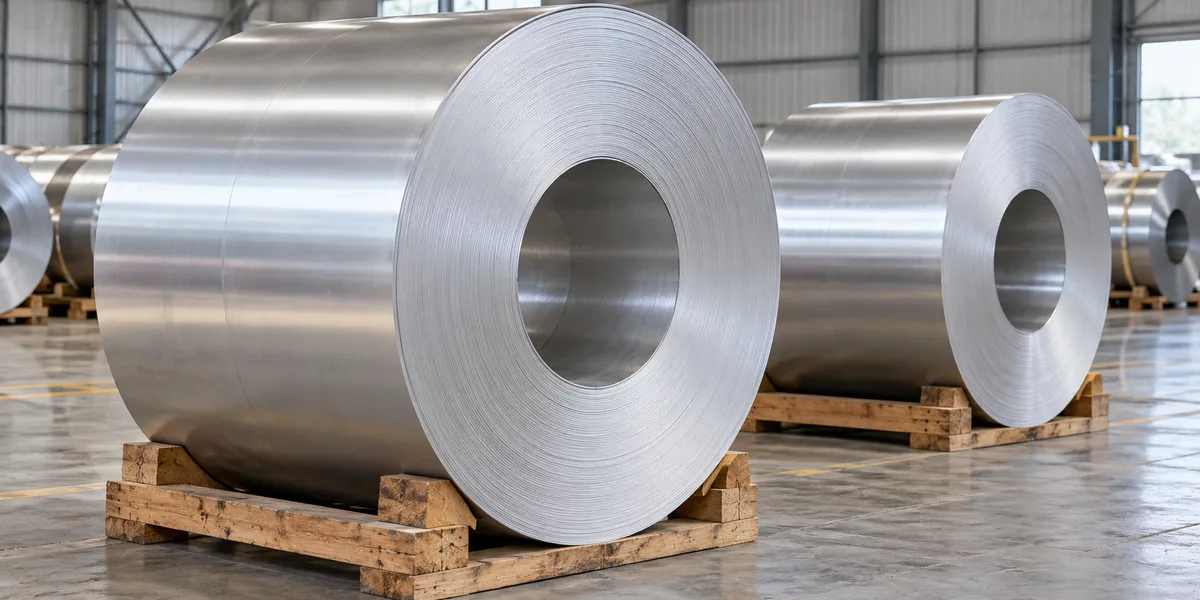
Fins multiply the air-side surface of a heat exchanger, because air carries heat far less effectively than the refrigerant or coolant inside the tubes. The fin material has to conduct heat well, be thin enough to pack hundreds of fins per metre, form without cracking at high press speeds, and survive years of condensate, road salt or coastal air.
Aluminium meets all of these needs at a lower weight and cost than copper. Commercially pure and lightly alloyed grades conduct heat at roughly 200 – 230 W/m·K, can be rolled to foil a few hundredths of a millimetre thick, and form a protective oxide film. A modern room air conditioner or automotive radiator uses aluminium fins almost without exception, and most residential coils now pair aluminium fins with copper or aluminium tubes.
Fin stock is sold as narrow slit coils matched to the fin press or fin mill. Its value lies less in the alloy name than in tight thickness tolerance, consistent mechanical properties along the coil, flatness, clean edges and, for coated grades, a uniform coating. Variations in any of these cause fin collar splits, tears, or uneven fin pitch on the production line.
| Feature | Clad (brazing) fin stock | Non-clad fin stock |
|---|---|---|
| Construction | Core alloy with a thin aluminium-silicon braze layer on one or both sides | Single alloy, bare or with organic coatings |
| Typical alloys | 4343/3003-based core, 4343/core/4343, 4045 clad | 8011, 8006, 8079, 3102, 3003, 1100, 1200, 7072 |
| Joining to tube | Furnace brazing (controlled-atmosphere or vacuum) | Mechanical expansion of tubes through drawn fin collars |
| Typical tempers | H14, H16, O | O, H22, H24, H26, H18 |
| Typical thickness | About 0.06 – 0.10 mm | About 0.08 – 0.25 mm |
| Main products | Car radiators, condensers, evaporators, charge-air coolers, microchannel coils | Room and commercial AC coils, chillers, refrigeration evaporators, heat pumps |
| Relative cost | Higher: multi-layer rolling and tighter process control | Lower: simpler rolling and annealing |
Clad fin stock is chosen when the tube itself is not clad, for example an extruded microchannel tube; the braze alloy on the fin melts in the furnace and forms the fillets that join fin to tube. When the tube or header carries the cladding, the fins can be bare brazing-grade strip instead. In both cases the fin alloy is usually made slightly more electrochemically active than the tube, often with a zinc addition, so that the fin corrodes sacrificially and protects the tube from pitting.
Aluminium-iron-silicon alloy and the volume grade for air-conditioner fins. Good strength and elongation balance for drawn collars, widely available bare or coated.
Higher iron and manganese give more strength than 8011 at the same thickness, so fins can be thinner. Common for hydrophilic and coloured coated fins.
Aluminium-iron alloy with high elongation in soft tempers; used where collars are deep or fins are heavily formed.
Commercially pure grades with the highest thermal conductivity and good corrosion resistance; lower strength limits how thin they can go.
Manganese alloys for brazed and mechanical fins needing more strength and sag resistance. Zinc-modified versions make the fin sacrificial.
Aluminium-zinc alloy used as a sacrificial fin material and as cladding on tubes, giving the fin pack a protective anodic role.
Clad fin stock: an aluminium-silicon skin (about 7.5 % Si for 4343, 10 % Si for 4045) on a manganese core that keeps its shape in the brazing furnace.
Temper is chosen from the fin geometry. Drawn-collar fins for mechanically expanded coils need high elongation, so H22, H24 or H26 (strain-hardened then partially annealed) or O temper are normal. Flat or lightly louvred fins can run in harder H18 or H19 temper. Brazed fins are typically supplied in H14 or H16, and the key property is sag resistance: the fin must not slump or let silicon penetrate the core at brazing temperature, roughly 600 °C.
Pre-coated fin stock is bare foil that has been cleaned, chemically pre-treated and roll-coated on both sides with thin organic layers before slitting. Most mechanical-coil fins are now coated, because coatings manage condensate and corrosion better than bare aluminium. The common types are:
Rolled and annealed foil with no surface treatment. Lowest cost; still used for dry-coil condensers and where the coil maker applies its own coating after assembly.
A water-loving top coat makes condensate spread into a thin film that drains away instead of forming droplets that bridge between fins. This keeps air flowing, cuts fan noise and limits water carry-over into the room.
An epoxy, polyurethane or acrylic base coat, often gold or blue, that protects fins in coastal and industrial atmospheres. It is frequently combined with a hydrophilic top coat.
A water-repellent coat that sheds droplets quickly, used on outdoor heat-pump coils to reduce frost build-up and speed defrosting.
A coating that lets the fin press run with little or no evaporative press oil, removing a degreasing step and reducing odour in the finished unit.
Adds agents that inhibit mould growth on wet evaporator fins, improving indoor air quality in humid climates.
Coating weights are only a few micrometres per side. Specify the coating type, colour and the performance tests you need rather than a coating brand.
| Test | What it shows | Typical method |
|---|---|---|
| Thickness and width tolerance | Consistent fin pitch and collar height on the press | Micrometer and continuous gauge records along the coil |
| Tensile strength and elongation | Whether collars draw without splitting | Tensile test per EN 546-2 / ASTM B479 or the customer drawing |
| Cupping (Erichsen) | Formability of thin foil | Erichsen cupping depth |
| Salt spray | Corrosion resistance of bare or coated foil | Neutral salt spray to ASTM B117 or ISO 9227 (5 % NaCl, 35 °C) |
| Humidity resistance | Coating stability in hot, wet service | Constant humidity cabinet exposure |
| Alkali resistance | Coating resistance to cleaning agents and alkaline condensate | Immersion in a sodium hydroxide solution, then inspection |
| Hydrophilicity | How well condensate spreads, before and after ageing | Water contact angle measurement |
| Coating adhesion | Coating survives stamping without flaking | Cross-cut test (ISO 2409) and cupping |
| Odour and solvent resistance | No smell in indoor units; coating integrity | Heat-and-smell test, solvent rub |
| Brazing tests (clad stock) | Fillet formation and fin sag in the furnace | Sag test and braze trial in the customer's cycle |
Pass levels, such as hours in salt spray or the maximum contact angle after ageing, are set by the heat exchanger maker and vary between products. Agree them in the purchase specification so that every coil is tested the same way.
Clad fin stock has a thin aluminium-silicon braze layer that melts in a brazing furnace to join the fins to the tubes; it is used in automotive and microchannel heat exchangers. Non-clad fin stock is a single alloy, bare or coated, used in coils where the tubes are mechanically expanded into collars punched in the fins.
8011 is the most common, followed by 8006 where a thinner, stronger fin is needed. Pure grades such as 1100 are used for maximum conductivity, and 3102 or zinc-modified 3003 where more strength or sacrificial corrosion protection is required.
On a cooling coil, moisture condenses on the fins. Without a hydrophilic coat it forms droplets that bridge the gaps between fins, blocking airflow and raising fan power and noise. The coating makes water spread into a film that drains quickly.
Most mechanical-coil fin stock is between about 0.08 and 0.15 mm, with heavier gauges up to around 0.25 mm for industrial coils. Brazed automotive fins are thinner, typically about 0.06 to 0.10 mm.
Choose a temper with high elongation, usually H22, H24 or H26, or O temper for very deep collars. Harder tempers such as H18 suit flat or lightly formed fins.
Yes. Fin stock is supplied slit to the width, core size and coil weight your fin press needs, with mill certificates and export packing, to customers worldwide.
Tell us the alloy, temper, thickness, slit width, coating and annual quantity. We will reply with availability, documents and a delivered price.





