Forming
Outstanding: 1050-O can be bent flat on itself, deep drawn and spun. H14 and H24 still bend tightly; H24 has better elongation than H14 at the same strength.



1050 is commercially pure aluminium with at least 99.5 % Al, valued for very high formability, excellent corrosion resistance and high thermal and electrical conductivity rather than strength. Sheet and plate in 1050 and its close European variant 1050A are used for chemical equipment, reflectors, signage, heat exchangers and deep-drawn parts. Metline supplies 1050 sheet and plate in all common tempers to customers worldwide.
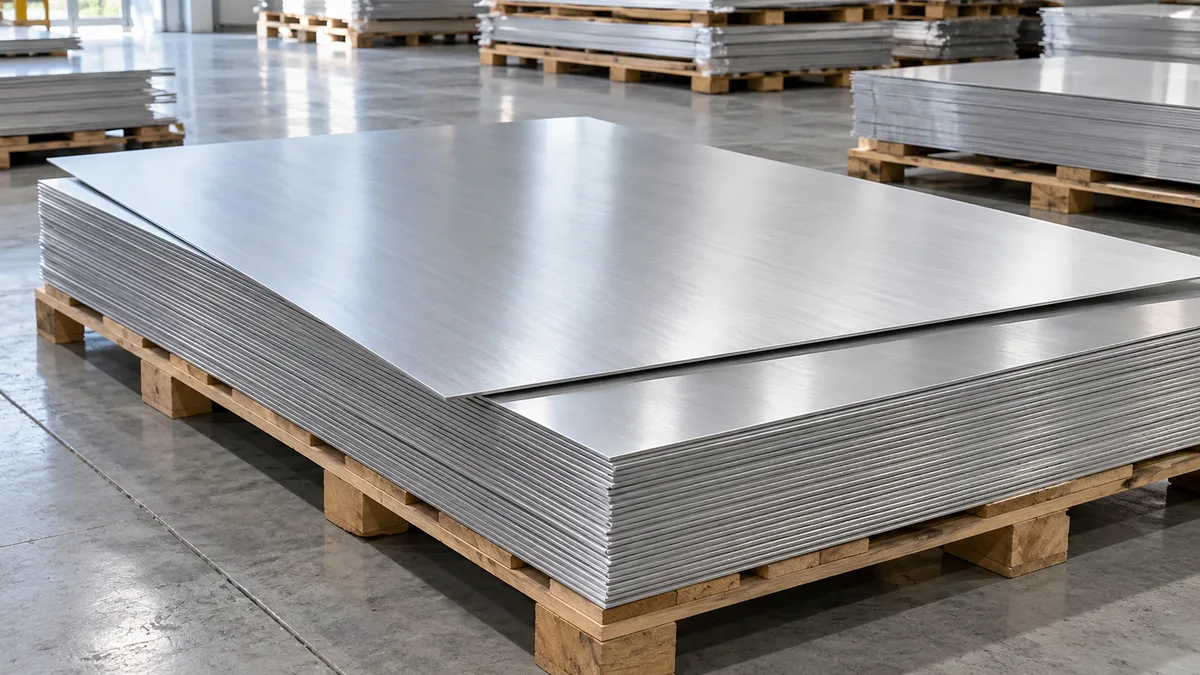
1050 belongs to the 1xxx series, where the last two digits give the minimum aluminium content above 99 %: 1050 means 99.50 % Al. With almost no alloying elements, it is soft, extremely ductile and highly resistant to corrosion, and it conducts heat and electricity better than any alloyed grade except higher-purity 1060, 1070 and 1350.
Strength comes only from cold work. Annealed 1050-O is about as soft as aluminium gets; full-hard H18 is roughly twice as strong but still far below 3003 or 5052. For that reason, 1050 is chosen when the part must be deep drawn, spun, bent flat or anodised to a bright finish, or when conductivity and chemical resistance matter more than load-bearing capacity.
In Europe and much of Asia the standard variant is EN AW-1050A, which differs slightly in its zinc and titanium limits; the two are interchangeable for almost every use. In North America 1050 is less common, and buyers usually specify 1060 or 1100 under ASTM B209 for similar applications.
| Element | 1050 (Aluminum Association) | EN AW-1050A (EN 573-3) |
|---|---|---|
| Silicon (Si) | 0.25 max | 0.25 max |
| Iron (Fe) | 0.40 max | 0.40 max |
| Copper (Cu) | 0.05 max | 0.05 max |
| Manganese (Mn) | 0.05 max | 0.05 max |
| Magnesium (Mg) | 0.05 max | 0.05 max |
| Zinc (Zn) | 0.05 max | 0.07 max |
| Titanium (Ti) | 0.03 max | 0.05 max |
| Vanadium (V) | 0.05 max | — |
| Others, each | 0.03 max | 0.03 max |
| Aluminium (Al) | 99.50 min | 99.50 min |
Each delivery carries a mill test certificate reporting the actual analysis of the lot.
The specified ranges below are EN 485-2 values for EN AW-1050A sheet of moderate thickness; exact limits depend on the thickness band. Typical values describe what the material usually achieves.
| Temper | Tensile strength (EN 485-2) | Yield strength min. (EN 485-2) | Typical tensile | Typical elongation |
|---|---|---|---|---|
| O / H111 (annealed) | 65 – 95 MPa | 20 MPa | about 75 MPa | 30 – 40 % |
| H12 (quarter hard) | 85 – 125 MPa | 65 MPa | about 95 MPa | about 8 – 12 % |
| H22 | 85 – 125 MPa | 55 MPa | about 95 MPa | about 12 – 15 % |
| H14 (half hard) | 105 – 145 MPa | 85 MPa | about 110 MPa | about 6 – 10 % |
| H24 | 105 – 145 MPa | 75 MPa | about 115 MPa | about 8 – 12 % |
| H16 (three-quarter hard) | 120 – 160 MPa | 100 MPa | about 130 MPa | about 4 – 8 % |
| H18 (full hard) | 140 MPa min. | 120 MPa | about 155 MPa | about 2 – 6 % |
| System | Designation | Sheet and plate standard |
|---|---|---|
| Aluminum Association / UNS | 1050 / A91050 | Ordered to EN or JIS standards, or to ASTM B209 by agreement |
| European | EN AW-1050A (EN AW-Al 99.5) | EN 485-1 to -4, EN 573-3 |
| German Werkstoff | 3.0255 (Al99.5) | DIN EN 485 |
| ISO | Al99.5 | ISO 6361 |
| Japan | A1050P | JIS H4000 |
| China | 1050 / 1050A | GB/T 3880, GB/T 3190 |
| India | 19500 | IS 737 |
1050 weighs 2.705 kg/m² per millimetre of thickness.
| Thickness (mm) | kg per m² | 1000 × 2000 mm (kg) | 1220 × 2440 mm (kg) | 1500 × 3000 mm (kg) |
|---|---|---|---|---|
| 0.5 | 1.35 | 2.7 | 4.0 | 6.1 |
| 1 | 2.71 | 5.4 | 8.1 | 12.2 |
| 1.5 | 4.06 | 8.1 | 12.1 | 18.3 |
| 2 | 5.41 | 10.8 | 16.1 | 24.3 |
| 3 | 8.12 | 16.2 | 24.2 | 36.5 |
| 4 | 10.82 | 21.6 | 32.2 | 48.7 |
| 5 | 13.53 | 27.1 | 40.3 | 60.9 |
| 6 | 16.23 | 32.5 | 48.3 | 73.0 |
| 8 | 21.64 | 43.3 | 64.4 | 97.4 |
| 10 | 27.05 | 54.1 | 80.5 | 121.7 |
| 12 | 32.46 | 64.9 | 96.6 | 146.1 |
| 20 | 54.10 | 108.2 | 161.0 | 243.4 |
Outstanding: 1050-O can be bent flat on itself, deep drawn and spun. H14 and H24 still bend tightly; H24 has better elongation than H14 at the same strength.
Welds very easily by TIG, MIG, resistance and friction stir; use 1100 or 4043 filler, or 1050/1070 filler for conductivity and colour match.
Soft and gummy; use sharp, polished, high-rake tools and lubricant to avoid built-up edge.
Gives a clear, bright and uniform anodic film; widely used for decorative and reflective anodised products.
Excellent resistance to atmosphere, water and many chemicals, including nitric acid and some food products.
Readily brazed and can be soldered with suitable fluxes.
| Property | 1050 | 1060 | 1100 | 3003 |
|---|---|---|---|---|
| Minimum Al | 99.50 % | 99.60 % | 99.00 % | about 97 % |
| Typical H14 tensile | about 110 MPa | about 97 MPa | about 125 MPa | about 150 MPa |
| Conductivity (O) | about 61 – 62 % IACS | about 62 % IACS | about 59 % IACS | about 50 % IACS |
| Formability | Excellent | Excellent | Excellent | Very good |
| Main standard | EN 485 / JIS H4000 | ASTM B209 | ASTM B209 | ASTM B209 / EN 485 |
Pick 1060 or 1070 when conductivity is the priority, 1100 for a little more strength with similar forming, and 3003 when the part must carry more load while staying easy to form.
Both are 99.5 % minimum aluminium. 1050A is the European registration and allows slightly more zinc (0.07 % vs 0.05 %) and titanium (0.05 % vs 0.03 %), with no separate vanadium limit. In practice they are interchangeable.
No, it is one of the softest aluminium grades: about 75 MPa tensile when annealed and around 155 MPa when full hard. Choose it for formability, conductivity and corrosion resistance, not for structural loads.
O or H111 for the tightest bends and deep drawing; H24 for a good balance of stiffness and bendability; H14 when flatness and a little more stiffness matter and bends are moderate.
Yes. Its high purity gives a clear, bright and uniform anodised finish, which is why it is widely used for reflectors and decorative anodised parts.
1050 is a registered Aluminum Association grade (UNS A91050), but North American mills more commonly supply 1060 or 1100 sheet to ASTM B209 for similar uses.
About 2.705 kg per m² per millimetre. A 1220 × 2440 × 1 mm sheet weighs about 8.1 kg and a 1500 × 3000 × 3 mm sheet about 36.5 kg.
Send temper, thickness, size, finish and quantity. We will reply with availability, certification and a delivered price.





