Machine bases
45×90 and 90×90 members carry spindles, presses and test equipment on levelling feet.



45 series profiles are 45 mm modular T-slot extrusions with 10 mm slots, built for frames that a 40 series cannot carry stiffly enough: machine bases, robot cells, heavy guarding and conveyor structures. Metline supplies 45 × 45, 45 × 90, 45 × 180 and 90 × 90 mm sections in light and heavy walls, anodised, cut and machined to your list, for delivery worldwide.
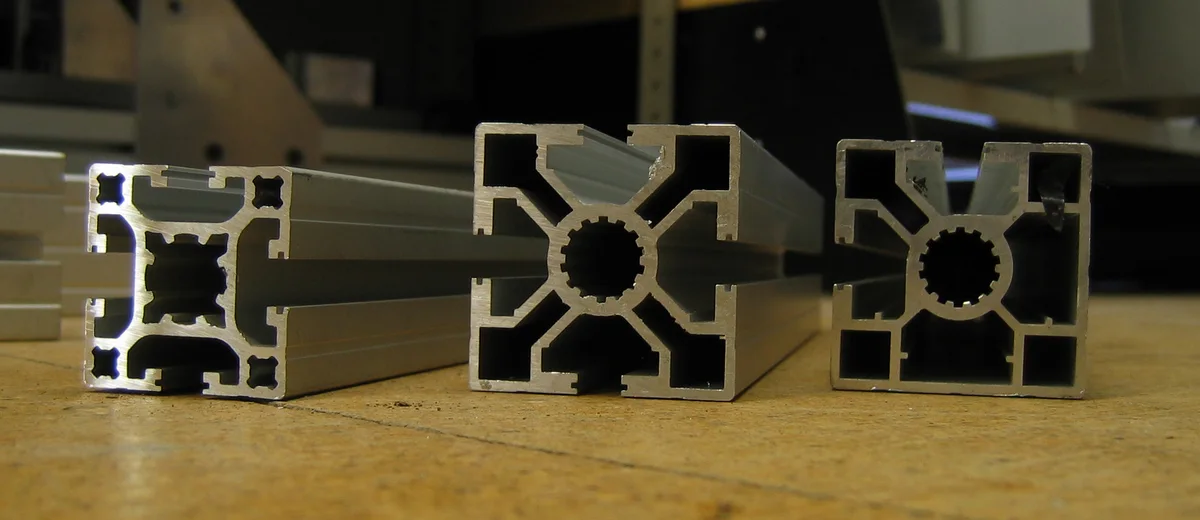
The 45 series is a metric T-slot system based on a 45 mm module. The basic profile is 45 × 45 mm, and larger sections are multiples of it: 45 × 90, 45 × 180 and 90 × 90 mm. Every face carries a 10 mm slot, so the whole family shares one set of nuts, brackets and accessories.
Compared with the 40 series, the extra 5 mm of section and the 10 mm slot give a profile that is stiffer, takes larger fasteners and carries heavier brackets. A standard 45 × 45 profile has a moment of inertia of roughly 11 – 14 cm4, against about 9 cm4 for a standard 4040, so for the same span and load it deflects around a third less. That makes the 45 series a common choice for machine builders who want one system for the base frame, the guarding and the operator stations.
The 45 mm module is used by several European framing system brands, and many machine builders standardise on it. Because slot details differ slightly between brands, Metline matches the profile to the drawing or system you already use rather than assuming a single geometry.
| Section | Slots | Typical weight (kg/m) | Moment of inertia (cm4) | Typical use |
|---|---|---|---|---|
| 45 × 45 light | 4 | about 1.5 | about 10.8 | Guards, light frames, panels |
| 45 × 45 standard | 4 | about 1.9 | about 11 | General frames and workstations |
| 45 × 45 heavy | 4 | about 2.0 – 2.1 | about 13.8 | Machine frames, uprights |
| 45 × 45 with closed faces | 1 – 3 | about 1.6 – 2.0 | similar to open versions | Clean, wipeable outer faces |
| 45 × 90 | 6 | about 3 – 3.5 | several times 45×45 on the strong axis | Beams, base frames, conveyor rails |
| 45 × 180 | 10 | about 6 – 7 | very high on the strong axis | Long spans, gantries, machine beds |
| 90 × 90 | 8 | about 5 – 7 | high on both axes | Columns, heavy bases, robot pedestals |
Indicative values from published data for common 45 mm systems; light, standard and heavy versions differ by brand. We send the drawing and certified section data with the quotation.
Quarter-round, half-round and 45° angled versions of the 45 × 45 are available for rounded corners and angled frames, and smooth-sided "panel" profiles are used where a frame face must stay flat.
45 series profiles are extruded from 6063 or 6105 aluminium. Both are heat-treatable Al-Mg-Si alloys that flow well through the multi-cavity hollow dies needed for T-slot shapes and give a clean anodised surface. 6105-T5 is stronger and is preferred for heavy sections; 6063-T5/T6 gives the finest surface.
| Alloy and temper | Min. tensile strength | Min. yield strength | Standard |
|---|---|---|---|
| 6063-T5 (wall ≤ 10 mm) | 175 MPa | 130 MPa | EN 755-2 |
| 6063-T6 (wall ≤ 10 mm) | 215 MPa | 170 MPa | EN 755-2 |
| 6063-T66 (wall ≤ 10 mm) | 245 MPa | 200 MPa | EN 755-2 |
| 6105-T5 | 262 MPa (38 ksi) | 241 MPa (35 ksi) | ASTM B221 |
Older datasheets sometimes quote the lower 6063-T6 minimums (about 205 MPa tensile and 170 MPa yield under ASTM B221) as if they were typical values. The mill certificate for your lot gives the actual results.
Stiffness is usually the limit. For a simply supported member with a central load, deflection = F × L³ / (48 × E × I). A 1,200 mm standard 45 × 45 (I ≈ 11 cm4) with a 1,000 N central load deflects about 1,000 × 1,200³ / (48 × 69,000 × 110,000) ≈ 4.6 mm. Turning the same member into a 45 × 90 with the 90 mm side vertical cuts that to well under 1 mm.
| Span, 1,000 N central load | 45 × 45 light (10.8 cm4) | 45 × 45 heavy (13.8 cm4) |
|---|---|---|
| 500 mm | 0.3 mm | 0.3 mm |
| 800 mm | 1.4 mm | 1.1 mm |
| 1000 mm | 2.8 mm | 2.2 mm |
| 1200 mm | 4.8 mm | 3.8 mm |
| 1500 mm | 9.4 mm | 7.4 mm |
Cut ends and machined holes show bare metal after anodising; end caps close the open ends and protect operators. For frames in washdown or outdoor areas, specify a thicker anodic film (20 µm class) and stainless steel fasteners to avoid galvanic staining.
45×90 and 90×90 members carry spindles, presses and test equipment on levelling feet.
Rigid pedestals and perimeter guarding from a single slot system, with interlocked doors on slot hinges.
Side frames, cross members and legs that can be re-spaced when the line changes.
Ergonomic benches with height-adjustable shelves, tool rails and lighting clamped to the slots.
Closed-face profiles and anodised surfaces for electronics and medical assembly.
Carts, racks and flow shelving that are bolted, not welded, and easily rebuilt.
A 10 mm slot on every face. 10 mm slot nuts, brackets and panel gaskets fit across the 45×45, 45×90, 45×180 and 90×90 sections, but slot undercut details vary by brand, so check compatibility with existing hardware.
Yes. A standard 45×45 profile is roughly 20 – 50 % stiffer than a standard 4040, depending on the versions compared, and the 10 mm slot takes larger fasteners. Use 45 series for heavier machines and longer spans.
About 1.5 kg/m for a light version and about 2.0 kg/m for a heavy version. Larger sections scale up: a 45×90 is typically 3 – 3.5 kg/m.
6063 in T5, T6 or T66 temper, or 6105-T5 for higher strength. Both anodise well. Stiffness is almost the same for every aluminium alloy, so choose a heavier section rather than a stronger alloy to reduce deflection.
Yes. Profiles can be cut to length, tapped, drilled for anchor fasteners and packed as labelled kits with brackets and fasteners.
Send your sections, cut list and finish. We will confirm the profile drawing, section data and a delivered price.





