


Aluminium Microchannel Tube (Multi-Port Extrusion): Complete Guide
Aluminium microchannel tube, also called multi-port extrusion (MPE) or parallel-flow flat tube, is a thin flat extrusion with a row of small internal channels. Brazed to louvred fins and headers, it forms compact, light and refrigerant-efficient heat exchangers for car air conditioning, residential and commercial HVAC, heat pumps and battery cooling. This guide covers alloys, sizes, coatings, brazing, corrosion protection and how to specify the tube.
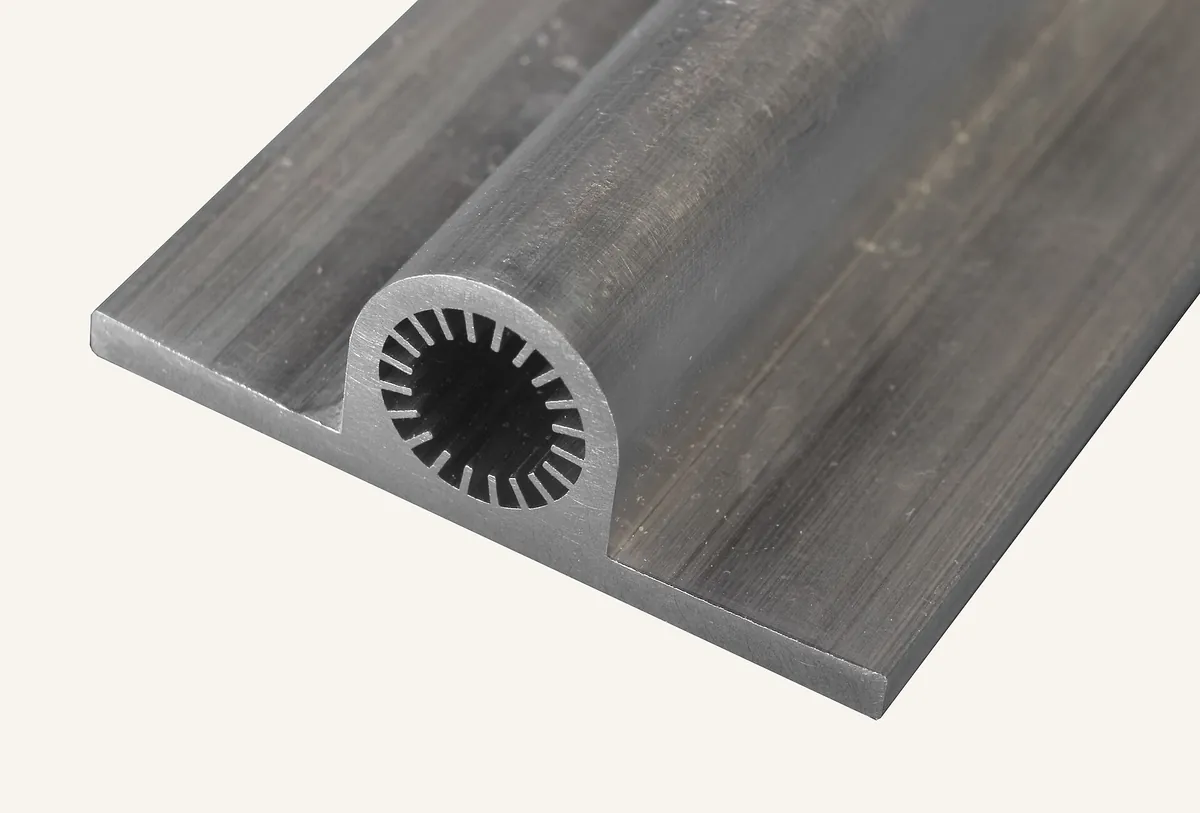
- Alloys
- 1100 · 1050 · 3102 · 3003 · 6063
- Width
- about 4 – 120 mm (larger on request)
- Wall
- down to about 0.15 mm
- Coatings
- Zinc arc spray · flux · Si-flux
What is an aluminium microchannel tube?
A microchannel tube is a flat aluminium extrusion, typically 1 – 3 mm high for air-conditioning use, containing anything from three to more than forty parallel ports separated by thin webs. Refrigerant or coolant flows through the ports; air flows over brazed fins on the flat faces. The many small channels give a very large internal surface for the volume of the tube and let thin walls hold high pressure.
Compared with the older round-tube-plate-fin (RTPF) coil made from copper tube and aluminium fins, an all-aluminium microchannel heat exchanger is lighter, more compact, needs considerably less refrigerant charge, and avoids galvanic corrosion between copper and aluminium. That is why it replaced round tubes in automotive condensers decades ago and is now widely used in residential and commercial air-conditioning condensers, heat pumps and chillers.
The tube is made by hot extrusion through a porthole (bridge) die, or by continuous rotary extrusion from aluminium rod. Both routes produce a seamless profile with no weld, so the channels are uniform along the length. After extrusion the tube is usually zinc-sprayed in line and either cut to length or coiled.
Alloys for microchannel tube
Microchannel tube alloys must extrude through very fine dies at high speed, braze well in a controlled-atmosphere brazing (CAB) furnace and resist corrosion after brazing. That rules out most high-strength alloys and favours low-alloy 1xxx and 3xxx grades.
| Alloy | Main alloying | Strengths | Typical use |
|---|---|---|---|
| 1100 / 1050 / 1070 | Essentially pure aluminium | Easiest to extrude, highest conductivity, very thin walls possible | Residential AC coils, evaporators, small condensers |
| 3102 | Mn 0.05 – 0.40 | The classic MPE alloy: extrudes almost as easily as 1xxx with better strength and corrosion behaviour | Automotive and HVAC condensers |
| 3003 | Mn 1.0 – 1.5, Cu 0.05 – 0.20 | Higher strength and pressure capacity; harder to extrude | Higher-pressure and larger tubes |
| Long-life 3xxx variants | Controlled Mn, Si, Fe, Cu, Zn, Ti | Improved post-braze corrosion resistance and strength | Automotive and coastal HVAC, CO2 systems |
| 6063 | Mg 0.45 – 0.9, Si 0.2 – 0.6 | Good extrudability and strength; Mg interferes with standard CAB flux | Mechanically joined or adhesive-bonded cooling plates, not standard CAB-brazed coils |
Composition limits follow the Aluminum Association registrations. Magnesium above roughly 0.3 – 0.4 % reacts with potassium fluoroaluminate flux and impairs CAB brazing, which is why Mg-bearing alloys are avoided in brazed microchannel coils.
Ask your heat exchanger customer which alloy is qualified on their drawing; switching alloy, even between 1xxx and 3102, can change extrusion behaviour, brazing and corrosion life, so it normally needs requalification.
Sizes, port layouts and tolerances
Typical geometry range
- Width
- About 4 – 60 mm for most HVAC and automotive tubes; wide tubes to about 120 mm and special profiles beyond
- Height (thickness)
- About 0.5 – 5 mm; up to about 10 mm on large tubes
- Outer and web wall
- Down to about 0.15 mm, commonly 0.2 – 0.6 mm
- Ports
- From 3 to more than 40, round, rectangular or with rounded corners; internal fins or teeth on request
- Length
- Cut lengths (for example 3 m or 6 m) or coils for in-line cutting
- Mass
- About 0.1 – 2.5 kg/m depending on size and port design
Mass per metre = (outline area − total port area) × 2.70 g/cm³; with dimensions in mm², the result × 0.0027 gives kg/m.
Common small tubes used in air-conditioning and automotive coils:
| Width × height (mm) | Typical application |
|---|---|
| 4.0 × 0.5 | Very small evaporators, electronics |
| 6.0 × 1.0 | Compact condensers and coolers |
| 7.0 × 1.0 | Compact condensers |
| 7.94 × 1.0 | Residential AC coils |
| 8.0 × 1.0 | Residential AC coils |
| 9.05 × 1.5 | Heat pumps, dehumidifiers |
| 9.52 × 1.0 | Residential AC coils |
| 10.0 × 1.0 | Residential and light commercial coils |
| 12.7 × 1.2 | Automotive and commercial condensers |
| 15.88 × 1.2 | Automotive condensers |
| 16.0 × 1.0 | Automotive condensers and evaporators |
Examples of larger multi-port sections used in commercial units, bus air-conditioning, battery cooling and industrial coolers: 22 × 4 mm, 12 ports, 25 × 6 mm, 3 or 8 ports, 32 × 3.5 mm, 7 ports, 38.6 × 7 mm, 6 ports, 49 × 6.1 mm, 9 ports, 58 × 4.6 mm, 10 ports, 65 × 6.4 mm, 18 ports, 72 × 6 mm, 16 ports, 85 × 7 mm, 12 ports, 104 × 6.4 mm, 23 or 30 ports. Many more die designs exist; see the microchannel extrusion tooling library for available sections.
| Dimension | Typical precision tolerance |
|---|---|
| Width | About ± 0.05 mm |
| Height | About ± 0.03 – 0.05 mm |
| Outer wall and webs | About ± 0.03 – 0.05 mm, per drawing |
| Straightness and twist | Per drawing; critical for automatic core assembly |
| Cut length | Per drawing, typically a few tenths of a millimetre |
Tolerances are agreed on the drawing for each profile. Tight height control matters most, because it decides how well the tube fits the header slots and fin stack.
Zinc, flux and Si-flux coatings
| Coating | What it does | Typical loading |
|---|---|---|
| Zinc arc spray | Zinc diffuses into the tube surface during brazing, creating a sacrificial layer that corrodes laterally instead of pitting through the wall | Commonly about 6 – 15 g/m² (for example 8, 10 or 13 g/m² nominal) |
| Pre-flux coating | Potassium fluoroaluminate flux in a binder, applied before delivery so the core can be brazed without separate fluxing | Commonly about 8 – 25 g/m² |
| Si-flux coating | Silicon powder plus flux in a binder: provides the filler metal on the tube itself so bare (unclad) fins can be used | Set by the brazing design |
| Uncoated | For cores where flux and filler come from clad fins and headers and corrosion protection is provided elsewhere | — |
Zinc load needs a balance. Too little and the tube is not protected; too much and the zinc-rich layer and fillets can corrode quickly, sometimes leading to fin detachment. The right value depends on the alloy, braze cycle and service environment, and is normally fixed by the heat exchanger maker's qualification.
Brazing and joining microchannel tube
- Core assemblyTubes are cut to length and stacked with louvred fins between them; tube ends are inserted into slotted header pipes.
- FluxingNon-corrosive potassium fluoroaluminate flux is applied, unless the tube or other parts are pre-fluxed.
- CAB brazingThe core passes through a nitrogen-atmosphere furnace, typically peaking around 600 °C. The Al-Si cladding on fins and headers (or the Si coating on the tube) melts and forms the joints.
- Cooling and testingAfter brazing, the core is leak-tested (often with helium) and pressure-tested to the customer specification.
Brazing anneals the tube, so the design must rely on post-braze strength. For mechanically assembled designs, such as some battery cooling plates, tubes can instead be joined by adhesive bonding, mechanical expansion into fittings or laser welding, which opens the door to 6xxx alloys.
Related brazing materials: condenser header pipe, fin stock, brazing sheet and brazing flux.
Corrosion protection and testing
Thin-walled tubes in coastal or road-salt environments fail by pitting through the wall. Microchannel coils resist this by combining a corrosion-resistant core alloy, a zinc diffusion layer that sacrifices itself laterally, and fins that are slightly more anodic than the tube so they protect it.
| Test | Purpose |
|---|---|
| SWAAT (ASTM G85 Annex A3) | Acidified synthetic seawater fog cycle; the industry's standard accelerated test for brazed aluminium heat exchangers |
| Neutral salt spray (ASTM B117 / ISO 9227) | General corrosion screening of tubes and coatings |
| Burst and proof pressure | Confirms the tube and joints hold the required pressure with margin |
| Helium or air leak test | Detects leaks in finished cores |
| Dimensional and visual inspection | Height, width, wall, port integrity and surface defects |
| Coating weight check | Zinc and flux loading per m² measured by stripping or XRF |
Pressure requirements depend heavily on the refrigerant. Coils for R134a, R1234yf, R410A and R32 operate at very different pressures, and CO2 (R744) gas coolers run far higher still, so wall thickness, port size and alloy must be chosen for the specific system. State the required burst pressure on the drawing.
Extruded microchannel versus folded tube
| Feature | Extruded microchannel (MPE) | Folded tube |
|---|---|---|
| Made from | Extruded from billet or rod | Roll-formed from clad brazing strip |
| Seam | Seamless | Folded and brazed web |
| Wall thickness | Thin; limited by extrusion | Can be thinner, using clad strip |
| Corrosion protection | Zinc spray and alloy choice | Built into the clad strip layers |
| Pressure capacity | Very high, suits CO2 designs | Good for conventional refrigerants |
| Typical use | Condensers, evaporators, heat pumps, battery cooling | Automotive condensers and radiators |
Read our comparison of folded and extruded microchannel tube and the folded tube page for more.
Where microchannel tube is used
| Sector | Heat exchangers | Typical tube |
|---|---|---|
| Automotive | AC condensers, evaporators, heat pump exchangers, radiators | 12 – 32 mm wide, 3102 or long-life alloys, zinc sprayed |
| Electric vehicles | Battery cooling tubes and plates, chillers | Wide multi-port tubes, often serpentine-bent |
| Residential and commercial HVAC | Outdoor condensers, heat pump coils, rooftop units | 8 – 25 mm wide, 1xxx or 3102 |
| Refrigeration | Display cases, chillers, CO2 gas coolers | Thick-wall designs for high pressure |
| Energy storage and electronics | BESS and inverter cooling, data-centre and telecom liquid cooling | Wide flat tubes and plates |
| Appliances | Dehumidifiers, heat-pump dryers, water heaters | Small tubes |
| Rail and bus | Roof-top air-conditioning condensers | Larger multi-port tubes |
For automotive programmes, see automotive micro-channel tube; for the standard product data sheet, see the micro-channel tube specification.
How to specify and order microchannel tube
- ProfileDrawing with width, height, wall and web thickness, port number and shape, and tolerances; or an existing section from the tooling library.
- AlloyThe alloy qualified for your heat exchanger, for example 1100, 3102 or a long-life 3xxx grade.
- CoatingZinc arc spray load, pre-flux or Si-flux coating, or uncoated.
- Form and lengthCut lengths with length tolerance, or coils with coil weight and inner diameter.
- Testing and documentsBurst pressure, coating weight, dimensional sampling plan, mill certificate (EN 10204 3.1); delivery on EXW, FOB, CIF or DAP terms.
References and standards
- ASTM G85 – Modified Salt Spray (Fog) Testing, Annex A3 (SWAAT)
- ASTM B117 – Operating Salt Spray (Fog) Apparatus
- EN 573-3 – Chemical composition and form of wrought aluminium products
- ASTM B221 – Aluminum and Aluminum-Alloy Extruded Bars, Rods, Wire, Profiles, and Tubes
- The Aluminum Association – International Alloy Designations and Chemical Composition Limits
- AWS C3.7 – Specification for Aluminum Brazing
Aluminium (aluminum) microchannel tube: frequently asked questions
What is the difference between microchannel tube and MPE tube?
They are the same product. Microchannel tube, multi-port extrusion (MPE), multi-port tube and parallel-flow flat tube all describe a flat aluminium extrusion with several internal channels.
Which alloy is best for microchannel tube?
3102 is the traditional choice for brazed condensers because it extrudes easily and resists corrosion well. 1100 suits very thin residential coils, 3003 and long-life 3xxx alloys give more strength and corrosion life, and 6063 is used only where the tube is not CAB-brazed.
Why is microchannel tube zinc-sprayed?
During brazing the zinc diffuses into the surface, forming a sacrificial layer. Corrosion then spreads sideways through this layer instead of pitting straight through the thin wall, extending the life of the coil.
Can microchannel tube be used for CO2 (R744) systems?
Yes, with designs that have suitable wall and web thickness, port size and alloy. CO2 systems run at much higher pressures than conventional refrigerants, so burst requirements must be specified.
What sizes are available?
Small HVAC and automotive tubes range from about 4 × 0.5 mm to 16 × 1 mm and beyond, while larger multi-port sections reach about 120 mm wide. Port count ranges from 3 to more than 40.
Is microchannel tube supplied in coils?
Yes. Tubes can be supplied in coils for in-line straightening and cutting at the core plant, or as cut lengths.
How is extruded microchannel tube different from folded tube?
Extruded tube is seamless and suits very high pressures; folded tube is roll-formed from clad strip and can have thinner walls with corrosion protection built into the strip.
Need aluminium microchannel tube?
Send the profile, alloy, coating, length or coil format and annual volume. We will check the die, confirm samples and send a delivered price.






