T3
Solution treated, cold drawn, naturally aged. The standard drawn seamless tube temper for aircraft and high-stress parts.



2024 aluminium round tube is a copper-alloyed, heat-treatable tube with roughly 50 % more strength than 6061-T6 and excellent fatigue resistance, which is why it is used for aircraft struts, control rods and other highly stressed tubular parts. It is supplied mainly as drawn seamless tube in T3 to AMS 4088 and ASTM B210, and as extruded tube in T3511. Metline supplies 2024 round tube with full certification, worldwide.
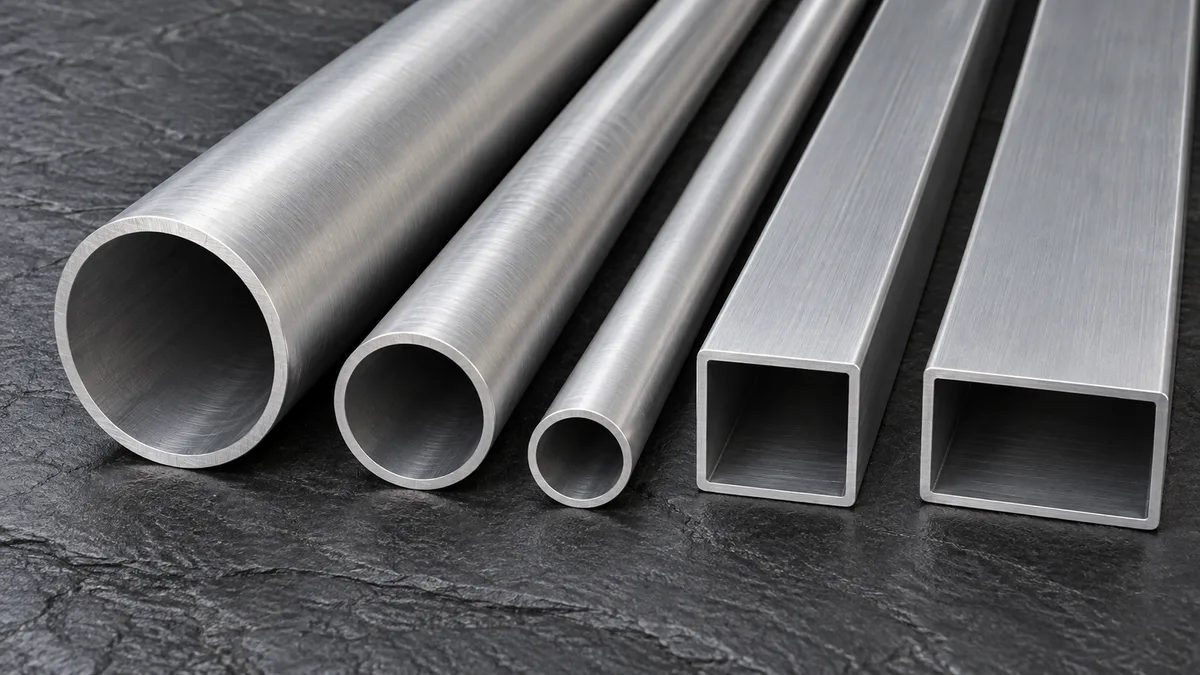
2024 is the classic aircraft alloy of the 2xxx series, strengthened by about 4.4 % copper and 1.5 % magnesium. In tube form it combines high tensile strength, a stiff section and very good resistance to fatigue crack growth, so it is chosen for tubes that are loaded repeatedly.
The common condition for drawn tube is T3: solution heat-treated, cold worked by the drawing process, then naturally aged at room temperature. Drawing after solution treatment adds strength and gives tight dimensional control and a smooth surface, which matters for push-pull rods, hydraulic actuator parts and struts that slide in bushes. Extruded 2024 tube is supplied in T3511 (stress-relieved by stretching, with minor straightening allowed) for larger diameters and thicker walls.
The trade-off for that strength is corrosion behaviour. Copper-rich 2024 has the lowest general corrosion resistance of the common structural alloys and should be protected by anodising (often chromic or sulphuric acid), conversion coating and primer in service. It is also not suitable for fusion welding. Where welding or marine exposure matters more than fatigue strength, 6061 or 5xxx tube is the better choice.
Registered Aluminum Association limits, also used by EN 573-3 for EN AW-2024 (AlCu4Mg1). The mill certificate reports the actual analysis.
| Element | Minimum | Maximum | Role in the alloy |
|---|---|---|---|
| Silicon (Si) | — | 0.50 | Impurity |
| Iron (Fe) | — | 0.50 | Impurity; lower levels improve toughness |
| Copper (Cu) | 3.8 | 4.9 | Main strengthening element (Al2CuMg precipitates) |
| Manganese (Mn) | 0.30 | 0.9 | Strength and grain control |
| Magnesium (Mg) | 1.2 | 1.8 | Works with copper to raise strength and natural-ageing response |
| Chromium (Cr) | — | 0.10 | Impurity |
| Zinc (Zn) | — | 0.25 | Impurity |
| Titanium (Ti) | — | 0.15 | Grain refiner |
| Others, each / total | — | 0.05 / 0.15 | |
| Aluminium (Al) | Remainder |
Design to the specified minimums of the order specification. For drawn tube these depend mainly on wall thickness (elongation rises with wall); for extruded tube they depend on the section thickness band.
| Temper / product | Basis | Tensile strength | Yield strength | Elongation |
|---|---|---|---|---|
| O, drawn tube | Typical | 186 MPa / 27 ksi | 76 MPa / 11 ksi | 20 % |
| T3, drawn seamless tube | Specified minimum (ASTM B210 / AMS 4088) | 441 MPa / 64 ksi | 290 MPa / 42 ksi | 10 – 16 % (by wall) |
| T3 / T4, general | Typical | 469 – 483 MPa / 68 – 70 ksi | 324 – 345 MPa / 47 – 50 ksi | 18 – 20 % |
| T3511, extruded tube (thin sections) | Specified minimum (ASTM B221) | About 395 MPa / 57 ksi | About 290 MPa / 42 ksi | 12 % |
Extruded 2024 minimums increase for thicker sections. Exact limits by wall or section band are shown in the current edition of the order specification and on the mill certificate.
Solution treated, cold drawn, naturally aged. The standard drawn seamless tube temper for aircraft and high-stress parts.
Extruded tube, solution treated, stretched for stress relief with minor straightening, naturally aged. For larger and thicker tube that will be machined.
Solution treated and naturally aged without controlled cold work. T42 is the condition achieved when the user heat-treats from O.
Annealed for bending, flaring and forming; parts are then heat-treated to T42 by the user.
Artificially aged after cold work for higher yield and better stress-corrosion resistance, available on request for specific programmes.
| System | Designation | Tube specification |
|---|---|---|
| SAE AMS | 2024-T3 drawn seamless | AMS 4088; AMS-WW-T-700/3 (formerly WW-T-700/3) |
| ASTM / ASME | 2024 | ASTM B210 (drawn seamless), B221 and B241 (extruded), B483 (drawn general purpose) |
| UNS | A92024 | — |
| European (EN) | EN AW-2024 (AlCu4Mg1) | EN 754-2, EN 755-2; aerospace EN 2000-series |
| German Werkstoff | 3.1355 | — |
| Japan (JIS) | A2024 | JIS H4080 |
Drawn seamless 2024 tube is normally ordered in fractional-inch outside diameters and decimal-inch walls; extruded tube in larger diameters and metric sizes. Weight below uses a density of 2.78 g/cm³.
| OD (in) | Wall (in) | OD × wall (mm) | kg/m | lb/ft |
|---|---|---|---|---|
| 0.25 | 0.035 | 6.35 × 0.89 | 0.042 | 0.028 |
| 0.375 | 0.035 | 9.52 × 0.89 | 0.067 | 0.045 |
| 0.5 | 0.049 | 12.70 × 1.24 | 0.125 | 0.084 |
| 0.625 | 0.058 | 15.88 × 1.47 | 0.185 | 0.125 |
| 0.75 | 0.065 | 19.05 × 1.65 | 0.251 | 0.169 |
| 1 | 0.065 | 25.40 × 1.65 | 0.342 | 0.230 |
| 1 | 0.125 | 25.40 × 3.17 | 0.616 | 0.414 |
| 1.25 | 0.083 | 31.75 × 2.11 | 0.546 | 0.367 |
| 1.5 | 0.095 | 38.10 × 2.41 | 0.752 | 0.505 |
| 1.75 | 0.120 | 44.45 × 3.05 | 1.102 | 0.741 |
| 2 | 0.125 | 50.80 × 3.17 | 1.321 | 0.887 |
| 2.5 | 0.125 | 63.50 × 3.17 | 1.673 | 1.124 |
| 3 | 0.188 | 76.20 × 4.78 | 2.979 | 2.002 |
| 4 | 0.250 | 101.60 × 6.35 | 5.282 | 3.550 |
Machines well in T3 and T3511 with carbide tools, producing short chips and good finishes. Annealed material is gummy; machine in a heat-treated temper.
Not recommended for arc welding: hot cracking and a large loss of strength in the heat-affected zone. Use mechanical joints, adhesive bonding or friction processes.
T3 tube accepts moderate bends with mandrel support. For tight bends, form in O or freshly solution-treated (W) condition, then age.
Anodise (chromic, sulphuric or boric-sulphuric), apply conversion coating and primer, and seal tube ends. Avoid direct contact with carbon fibre or stainless steel without isolation.
Retains strength better than 6061 up to about 120 – 150 °C; long exposure above that alters the naturally aged structure.
Aerospace orders usually require traceability to heat lot, tensile results and, where specified, non-destructive inspection.
| Property | 6061-T6 | 2024-T3 | 7075-T6 |
|---|---|---|---|
| Typical tensile strength | 310 MPa | 483 MPa | 572 MPa |
| Typical yield strength | 276 MPa | 345 MPa | 503 MPa |
| Fatigue strength | 96 MPa | 138 MPa | 159 MPa |
| Corrosion resistance | Good | Fair (needs protection) | Fair |
| Weldability | Good | Poor | Poor |
| Typical use | General structures | Fatigue-loaded aircraft tube | Highest-strength tube |
2024 is preferred over 7075 where damage tolerance and fatigue crack growth resistance govern; 7075 where static strength governs. See also 7075 tube and 2024 vs 7075.
Solution heat-treated, cold worked and naturally aged. For drawn tube the cold work comes from the final drawing pass, which adds strength and gives accurate dimensions.
Specified minimums under ASTM B210 and AMS 4088 are about 441 MPa (64 ksi) tensile and 290 MPa (42 ksi) yield, with elongation of 10 – 16 % depending on wall. Typical values are higher, around 470 – 480 MPa tensile.
Not by normal arc welding: it is prone to hot cracking and loses much of its strength near the weld. Use mechanical fastening, bonding or friction welding instead.
Less so than 5xxx or 6xxx alloys because of its copper content. In service it is normally anodised or conversion coated and painted, and ends are sealed.
AMS 4088 is an aerospace specification specific to 2024-T3 drawn seamless tubing, with aerospace testing and traceability requirements. ASTM B210 is a general specification for drawn seamless tube covering many alloys and tempers.
Yes. Metline supplies 2024 tube worldwide from Mumbai, with mill certificates, capped ends and export crating.
Send size, specification, quantity and destination. We will confirm availability, certification and a delivered price.





