O and H111
Annealed or only lightly strain hardened. Softest condition with the best formability; used where the plate will be bent or rolled, or where toughness matters more than strength.



Marine, structural, aerospace and tooling plate in 1xxx to 7xxx series alloys. Metline Industries supplies aluminium plate from Mumbai to fabricators, OEMs and project contractors across India and export markets, with the grade, temper and documentation your drawing calls for.
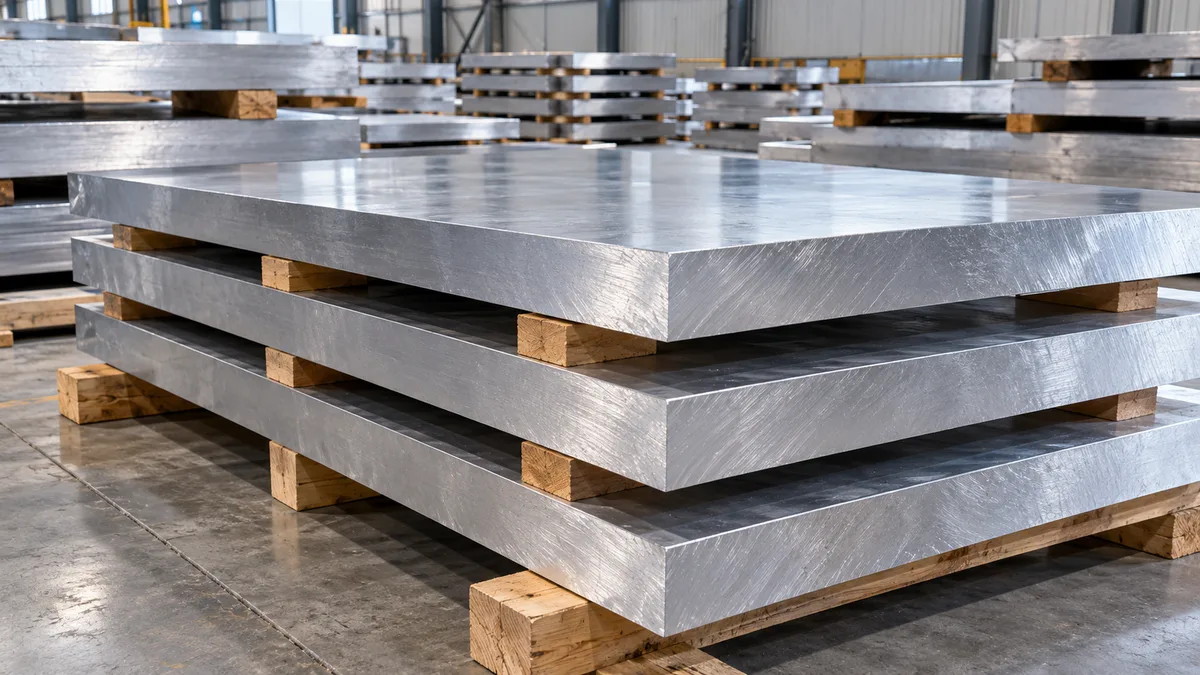
Aluminium plate is flat rolled aluminium that is thicker than sheet. Most specifications draw the line at roughly 6 mm (0.25 in): below that the product is sheet, above it the product is plate. The extra thickness changes how the material is made, stocked and used. Plate is hot rolled from a cast ingot, often stretched after heat treatment to relieve internal stress, and is usually bought to be machined, welded into structures or cut into heavy components rather than formed.
That is why choosing plate is mostly a question of three things: the alloy, which sets strength, corrosion resistance and weldability; the temper, which sets how the metal has been strengthened and how stable it will be when you machine it; and the thickness and size, which decide how much material you buy and how much you remove.
Every series trades strength against corrosion resistance, weldability and cost. Use this table to narrow the field, then open the grade page for detailed data.
| Alloy | Family | What it is good at | Typical uses |
|---|---|---|---|
| 1050 / 1060 | Commercially pure | Excellent corrosion resistance and conductivity, very easy to work; low strength | Chemical and food process equipment, reflectors, electrical parts |
| 3003 | Al–Mn | Moderate strength with good formability and weldability | Tanks, ducting, general fabrication |
| 5052 | Al–Mg | Good strength without heat treatment, very good resistance to marine atmospheres, weldable | Boat fittings, fuel tanks, truck and trailer bodies |
| 5083 | Al–Mg | Highest strength of the non-heat-treatable alloys, excellent seawater resistance, keeps toughness at very low temperatures | Ship hulls and decks, LNG and cryogenic tanks, pressure vessels |
| 5754 | Al–Mg | Balanced strength and formability, good corrosion resistance | Tread and floor plate, vehicle panels, welded structures |
| 6061 | Al–Mg–Si | The versatile all-rounder: heat treatable, weldable, machines well, good corrosion resistance | Machine parts, jigs and fixtures, frames, base plates |
| 6082 | Al–Mg–Si | Structural alloy widely specified to European standards; strong, weldable and machinable | Structural members, cranes, trailers, bridges |
| 2024 | Al–Cu | High strength and fatigue resistance; lower corrosion resistance, not normally welded | Aircraft structures, fittings, high-stress parts |
| 7075 | Al–Zn | Among the strongest aluminium alloys; excellent for precision machining; not suited to fusion welding | Aerospace components, moulds and tooling, high-load parts |
Need help choosing? Send us the application and the loads or environment it will see, and our team will recommend a grade and temper.
Typical room-temperature values for common plate grades. They are for comparison only. Guaranteed minimums depend on the standard and the plate thickness, and are confirmed on the mill test certificate.
| Alloy & temper | Tensile strength (MPa) | Yield strength (MPa) | Density (g/cm³) | Heat treatable |
|---|---|---|---|---|
| 5052-H32 | 228 | 193 | 2.68 | No |
| 5083-H116 | 317 | 228 | 2.66 | No |
| 6061-T651 | 310 | 276 | 2.70 | Yes |
| 2024-T351 | 469 | 324 | 2.78 | Yes |
| 7075-T651 | 572 | 503 | 2.81 | Yes |
The letters and numbers after the alloy describe how the plate was strengthened. Getting the temper right matters as much as the alloy, especially for parts that will be heavily machined.
Annealed or only lightly strain hardened. Softest condition with the best formability; used where the plate will be bent or rolled, or where toughness matters more than strength.
Strain hardened and stabilised tempers for 5xxx alloys. H116 and H321 are tested for resistance to exfoliation and intergranular corrosion, which is why shipbuilders specify them.
Solution heat treated and artificially aged for full strength in 2xxx, 6xxx and 7xxx alloys.
T6 plus controlled stretching to relieve residual stress. The plate stays flat and stable when you machine deep pockets, so it is the standard choice for machined parts, tooling and fixtures.
Naturally aged and stress relieved by stretching. The usual supply condition for 2024 plate.
Over-aged 7xxx temper that gives up a little strength for much better resistance to stress corrosion cracking, used in critical aerospace parts.
Hulls, decks, superstructures and offshore equipment in 5083 and 5086, where seawater resistance and weldability come first.
Trailer chassis, tipper bodies, rail car structures and tanker shells that need strength with less weight.
Machined frames, ribs and fittings in 2024 and 7075, bought with full traceability and certification.
Blow and injection moulds, jigs, fixtures and machine base plates in 6061 and 7075, where flatness and machinability save hours on the shop floor.
Structural brackets, cladding sub-frames, bridge decks and walkways that must resist weather for decades.
Chemical tanks, cryogenic vessels and conductive parts in pure and 5xxx alloys.
Aluminium plate is usually supplied in standard mill sizes or cut to the dimensions you need. Availability depends on the alloy, temper and thickness, so share your full requirement and we will confirm what can be supplied and how quickly.
Ranges vary by alloy and temper. Confirm your exact size when you enquire.
A complete enquiry gets you an accurate price and lead time on the first reply. Include as many of these as you can.
Pure, marine, structural and aerospace plate from a single supplier, so one purchase order covers a whole project.
We talk alloy, temper and tolerance, not just price, and we tell you when a different grade will do the job better or for less.
Headquartered in Mumbai, close to the Nhava Sheva (JNPT) port, we serve customers across India and ship plate to export markets.
Generally from about 6 mm (0.25 in) upwards. Thinner material is classed as sheet. The exact boundary depends on the standard, so state the standard you are buying to.
5083 is the usual first choice for hulls and decks because it combines high strength with excellent seawater resistance and good weldability. 5086 and 5052 are also widely used. For immersed or wetted structures, specify a marine temper such as H116 or H321.
7075-T651 is roughly twice as strong in yield as 6061-T651 and is preferred for highly loaded machined parts and tooling. 6061 is easier to weld, more corrosion resistant and costs less, which makes it the better all-round choice for frames, fixtures and general engineering.
T651 plate has been stretched after heat treatment to relieve internal stress. It stays flat when material is machined away unevenly, which reduces distortion and rework on precision parts.
No. 5083 is a non-heat-treatable alloy. Its strength comes from magnesium in solution and from strain hardening, which is why it is supplied in O, H111, H116 and H321 tempers.
Yes. Tell us the sizes and the certification you need when you enquire, and we will confirm availability, lead time and documentation with our quote.
Send us the alloy, temper, sizes and quantity. Our Mumbai team will reply with availability, lead time and a competitive quote.





