6061-T651
Solution heat-treated, stretched 1.5 – 3 % to relieve quench stresses, then artificially aged. The standard choice for plate over 6 mm that will be machined, because it does not warp as material is removed.



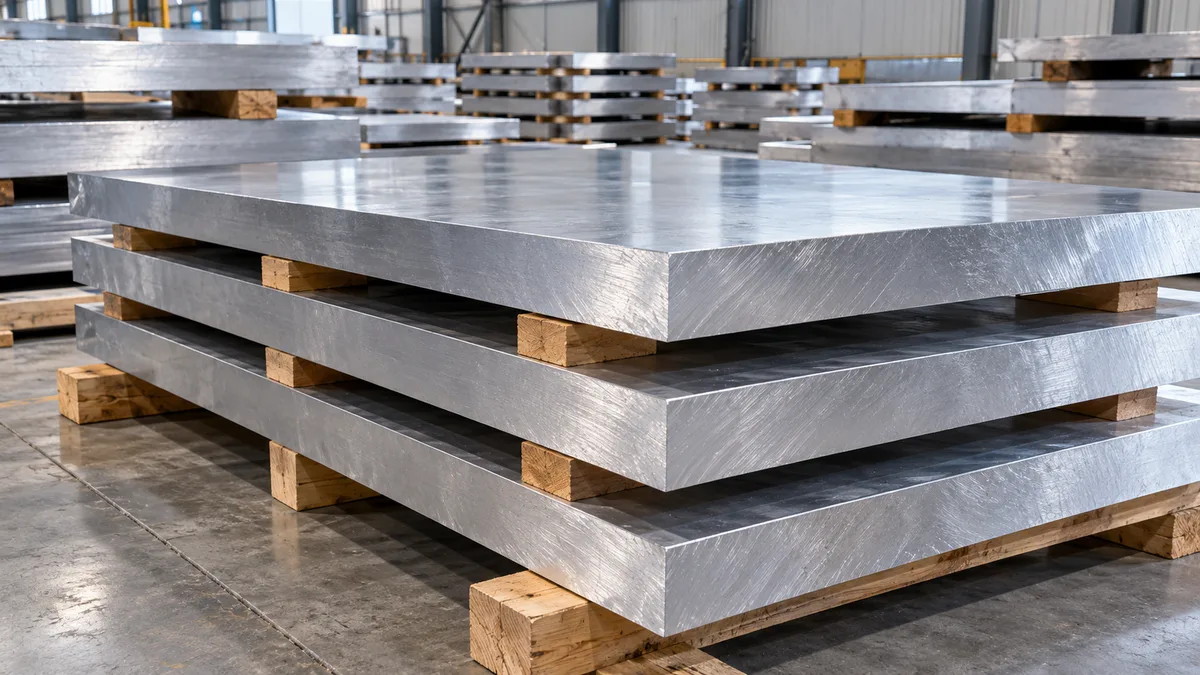
6061 aluminium plate (6061 aluminum plate in the US) is cut from the most widely used heat-treatable aluminium alloy in the world: strong, easy to machine, weldable and resistant to corrosion. Metline supplies 6061 sheet and plate in T6, T651 and other tempers, cut to size and certified to ASTM, AMS and EN standards, to customers worldwide from our base in Mumbai.
6061 belongs to the 6xxx family, where magnesium and silicon combine to form magnesium silicide (Mg2Si). Heat treatment dissolves and then precipitates these particles, which is why 6061-T6 is far stronger than non-heat-treatable grades: about twice the tensile strength of 3003 and about 40 % more than 5052.
The alloy was introduced in 1935 as "61S" and has been the default general-engineering aluminium ever since. A small copper addition raises strength, and chromium controls grain structure and improves resistance to stress corrosion. The result is a plate that machines cleanly, takes an excellent anodised finish, welds with standard MIG and TIG procedures and keeps its properties across a wide temperature range.
In practice, 6061 plate is the material engineers reach for when a part needs more strength than 5xxx alloys but does not justify the cost, corrosion sensitivity or poor weldability of 2xxx and 7xxx aerospace grades. Machine frames, jigs and fixtures, base plates, vacuum chambers, marine fittings, vehicle structures and semiconductor equipment are all routinely cut from 6061-T651.
Limits below are the registered Aluminum Association values, which ASTM B209 and EN 573-3 (EN AW-6061) both follow. Every Metline delivery carries a mill test certificate that reports the actual analysis of the lot.
| Element | Minimum | Maximum | Role in the alloy |
|---|---|---|---|
| Silicon (Si) | 0.40 | 0.80 | Combines with Mg to form the strengthening Mg2Si phase |
| Iron (Fe) | — | 0.70 | Impurity; kept low for toughness and finish |
| Copper (Cu) | 0.15 | 0.40 | Adds strength; slightly reduces corrosion resistance |
| Manganese (Mn) | — | 0.15 | Grain control |
| Magnesium (Mg) | 0.80 | 1.20 | Main strengthening element with Si |
| Chromium (Cr) | 0.04 | 0.35 | Controls recrystallisation, improves stress-corrosion resistance |
| Zinc (Zn) | — | 0.25 | Impurity |
| Titanium (Ti) | — | 0.15 | Grain refiner |
| Others, each / total | — | 0.05 / 0.15 | |
| Aluminium (Al) | Remainder | About 95.8 – 98.6 % |
Typical values describe what the material usually achieves; specified minimums are what the standard guarantees and what you should design to. Minimum values for T6/T651 fall slightly as plate gets thicker, because the centre of a thick plate cools more slowly during quenching.
| Temper | Tensile strength | Yield strength (0.2 %) | Elongation | Brinell hardness |
|---|---|---|---|---|
| O (annealed) | 125 MPa / 18 ksi | 55 MPa / 8 ksi | 25 – 30 % | 30 HB |
| T4 | 240 MPa / 35 ksi | 145 MPa / 21 ksi | 22 % | 65 HB |
| T6 / T651, typical | 310 MPa / 45 ksi | 276 MPa / 40 ksi | 12 % | 95 HB |
| T651 plate, specified minimum (≤ 100 mm) | 290 MPa / 42 ksi | 240 MPa / 35 ksi | 6 – 10 % (by thickness) | — |
Specified minimums summarised from ASTM B209 and EN 485-2; the exact limits depend on thickness band and are shown on the mill certificate.
Solution heat-treated, stretched 1.5 – 3 % to relieve quench stresses, then artificially aged. The standard choice for plate over 6 mm that will be machined, because it does not warp as material is removed.
Same strength as T651 without the stretching step. Normal for sheet up to about 6 mm, where residual stress is low and the sheet is used flat or formed lightly.
Solution treated and naturally aged. Softer and more formable; parts can be bent in T4 and then artificially aged to T6 after forming.
Fully annealed for maximum formability: deep bends, spinning and drawing. Strength is restored by full heat treatment after forming.
Stretched tempers for extruded bar and profiles rather than rolled plate; listed here because buyers often compare them.
If you need extreme flatness rather than strength, consider a cast and precision-milled tooling plate (for example 5083 cast) alongside 6061-T651.
6061 is registered in every major standards system, so the same plate can be certified for projects in North America, Europe, the Middle East and Asia. Tell us the specification on your drawing and we will supply and certify to it.
| System | Designation | Common plate / sheet standard |
|---|---|---|
| Aluminum Association / ASTM | 6061 | ASTM B209 (ASME SB-209) |
| Aerospace (SAE) | 6061-T6 / T651 | AMS 4025, AMS 4026, AMS 4027 |
| UNS | A96061 | — |
| European (EN) | EN AW-6061 / EN AW-AlMg1SiCu | EN 485-1/-2, EN 573-3 |
| German Werkstoff | 3.3211 | DIN EN 485 |
| ISO | AlMg1SiCu | ISO 6361 |
| Japan (JIS) | A6061P | JIS H4000 |
| China (GB) | 6061 | GB/T 3880, GB/T 3190 |
| India (IS) | 65032 | IS 737 |
Standard sizes ship fastest; non-standard widths and lengths are cut from larger plate or ordered from the mill.
Weight of 6061 plate is 2.70 kg per square metre for every millimetre of thickness. The table gives quick reference weights; use the plate weight calculator for any size.
| Thickness (mm) | kg per m² | 1220 × 2440 mm sheet (kg) | 1250 × 2500 mm sheet (kg) |
|---|---|---|---|
| 1 | 2.7 | 8.0 | 8.4 |
| 2 | 5.4 | 16.1 | 16.9 |
| 3 | 8.1 | 24.1 | 25.3 |
| 4 | 10.8 | 32.1 | 33.8 |
| 5 | 13.5 | 40.2 | 42.2 |
| 6 | 16.2 | 48.2 | 50.6 |
| 8 | 21.6 | 64.3 | 67.5 |
| 10 | 27.0 | 80.4 | 84.4 |
| 12 | 32.4 | 96.4 | 101.2 |
| 16 | 43.2 | 128.6 | 135.0 |
| 20 | 54.0 | 160.7 | 168.8 |
| 25 | 67.5 | 200.9 | 210.9 |
| 30 | 81.0 | 241.1 | 253.1 |
| 40 | 108.0 | 321.5 | 337.5 |
| 50 | 135.0 | 401.9 | 421.9 |
| 60 | 162.0 | 482.2 | 506.3 |
| 80 | 216.0 | 643.0 | 675.0 |
| 100 | 270.0 | 803.7 | 843.8 |
Unless your drawing states otherwise, 6061 plate is supplied to the standard tolerance tables of the order specification. Tighter tolerances, such as precision-milled faces or saw-cut blanks to ±0.5 mm, are available as a processing option.
In T6/T651 temper 6061 produces short, broken chips and a bright finish. Use sharp carbide tools with high positive rake, high spindle speeds and flood coolant. T651 keeps parts flat when large amounts of material are removed from one side.
MIG and TIG weld readily. ER4043 filler resists hot cracking and suits parts that will be heat-treated after welding; ER5356 gives higher shear strength in fillet welds and a better colour match after anodising. Expect the heat-affected zone to fall to roughly T4-level strength (design codes use about 165 MPa / 24 ksi) unless the assembly is re-heat-treated.
T6 has limited ductility: allow inside bend radii of about 1.5 – 3 × thickness and bend across the rolling direction. For tight bends, form in O or T4 and age afterwards.
Takes clear, coloured and hard (Type III) anodic coatings well, giving a uniform appearance and a wear-resistant surface. Machined faces anodise more evenly than mill-finish faces.
Good resistance to atmospheric and fresh-water corrosion and fair in seawater. For permanent immersion in seawater, 5083 or 5086 is the better choice; for 6061 in marine service, anodise or paint.
Retains useful strength up to about 100 – 150 °C. Prolonged exposure above that over-ages the alloy and reduces strength. Performs well at cryogenic temperatures.
| Property | 6061-T651 | 6082-T651 | 5083-H111 | 7075-T651 |
|---|---|---|---|---|
| Typical tensile strength | 310 MPa | 310 – 340 MPa | 290 MPa | 570 MPa |
| Typical yield strength | 276 MPa | 260 – 300 MPa | 145 MPa | 505 MPa |
| Machinability | Very good | Very good | Fair (gummy) | Excellent |
| Weldability | Good | Good | Excellent | Poor |
| Seawater corrosion | Fair–good | Good | Excellent | Poor–fair |
| Anodising response | Excellent | Good | Fair | Good |
| Relative cost | Low | Low | Low–medium | High |
| Typical market | Americas, Asia, global | Europe | Marine, cryogenic | Aerospace, high-stress parts |
In Europe, 6082 is often specified where 6061 would be used elsewhere; the two are close substitutes, with 6082 slightly stronger in thick sections. Choose 5083 when the part is permanently in seawater or must be welded without strength loss, and 7075 when strength matters more than cost or weldability. See our full plate range for these grades.
Both are solution heat-treated and artificially aged and have the same strength. T651 plate is additionally stretched by 1.5 – 3 % after quenching to relieve internal stresses, so it stays flat when machined. Order T651 for plate that will be machined; T6 is normal for thinner sheet.
It performs well above the waterline and in splash zones, especially when anodised or painted. For hulls or parts permanently immersed in seawater, 5083 or 5086 marine plate offers better corrosion resistance and keeps its strength after welding.
Yes, by MIG or TIG with ER4043 or ER5356 filler. The heat-affected zone loses part of its T6 strength, so welded structures are designed to reduced allowable stresses, or the assembly is heat-treated again after welding.
A 6061 sheet weighs 2.70 kg per m² for each millimetre of thickness. A 1220 × 2440 × 6 mm sheet weighs about 48.2 kg, and a 1250 × 2500 × 10 mm plate about 84.4 kg.
EN AW-6061 (AlMg1SiCu, Werkstoff 3.3211). In practice many European projects specify 6082, which has very similar properties and is more widely stocked there.
Yes. Metline supplies customers worldwide from Mumbai, with export packing, mill certificates and shipping by sea or air on EXW, FOB, CIF or DAP terms.
Send the temper, size, quantity and destination. Our team will reply with availability, certification and a delivered price.





