H116
Strain-hardened with controlled processing so that the plate meets both strength and corrosion-test requirements. Widely used for hull shell, decks and bulkheads.



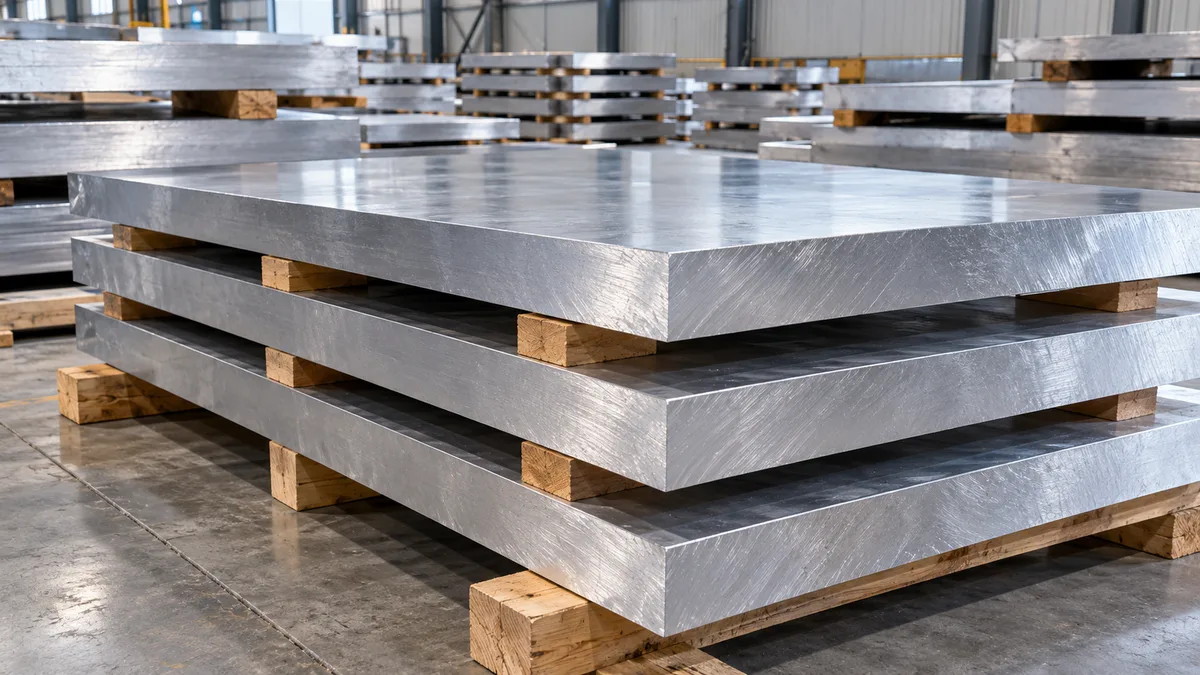
5083 is the standard aluminium alloy for welded ship and boat hulls. In the H116 and H321 tempers it combines a minimum yield of 215 MPa with proven resistance to exfoliation and intergranular corrosion, and it keeps most of its strength after welding. Metline supplies 5083 plate in H116, H321, H111 and O to ASTM B928, EN 485 and classification-society rules, worldwide.
5083 contains 4.0 – 4.9 % magnesium, 0.4 – 1.0 % manganese and a little chromium. It is the strongest of the widely available non-heat-treatable aluminium alloys, and because its strength comes from solid solution and cold work rather than precipitation hardening, welding reduces it only to the annealed level rather than destroying it.
That welded strength, combined with outstanding resistance to seawater, is why 5083 has been the backbone of aluminium shipbuilding for decades: ferries, workboats, patrol craft, fishing vessels, yachts, superstructures on steel ships, and offshore modules. It also keeps its toughness at very low temperature, which makes 5083-O a standard material for LNG tanks and cryogenic vessels.
For hull use the temper matters as much as the alloy. Ordinary strain-hardened tempers such as H32 can become susceptible to exfoliation when the magnesium-rich beta phase forms continuous films at grain boundaries. The H116 and H321 tempers are produced and tested specifically to avoid this, and are the only rolled tempers that classification rules accept for most hull plating.
ASTM, EN, JIS and the IACS rules all use the registered Aluminum Association limits. Each plate is branded with its cast or batch number and certified with the actual analysis.
| Element (wt %) | 5083 |
|---|---|
| Silicon (Si) | 0.40 |
| Iron (Fe) | 0.40 |
| Copper (Cu) | 0.10 |
| Manganese (Mn) | 0.40 – 1.0 |
| Magnesium (Mg) | 4.0 – 4.9 |
| Chromium (Cr) | 0.05 – 0.25 |
| Zinc (Zn) | 0.25 |
| Titanium (Ti) | 0.15 |
| Others, each / total | 0.05 / 0.15 |
| Aluminium (Al) | Remainder |
Single figures are maximums. Manganese and chromium form dispersoids that control grain structure and add strength.
Specified minimums from IACS UR W25 for plate 3 – 50 mm. ASTM B928 gives the same values up to about 40 mm and lower minimums for thicker plate (for H116 / H321 from 40 to 80 mm: tensile 285 MPa, yield 200 MPa).
| Alloy | Temper | Thickness | Yield Rp0.2 min (MPa) | Tensile Rm (MPa) | Elongation A50 / A5 min (%) |
|---|---|---|---|---|---|
| 5083 | O / H111 | 3 – 50 mm | 125 | 275 – 350 | 16 / 14 |
| 5083 | H112 | 3 – 50 mm | 125 | 275 | 12 / 10 |
| 5083 | H116 | 3 – 50 mm | 215 | 305 | 10 / 10 |
| 5083 | H321 | 3 – 50 mm | 215 – 295 | 305 – 385 | 12 / 10 |
| Temper | Typical tensile strength | Typical yield strength | Typical elongation |
|---|---|---|---|
| O / H111 | about 290 MPa | about 145 MPa | about 22 % |
| H116 / H321 | about 317 MPa | about 228 MPa | about 16 % |
Typical values from ASM and Aluminum Association data, for guidance only. Design to specified minimums and to the welded values given in the applicable rules.
Strain-hardened with controlled processing so that the plate meets both strength and corrosion-test requirements. Widely used for hull shell, decks and bulkheads.
Strain-hardened and thermally stabilised, with a controlled maximum strength. Same minimums as H116 under UR W25, certified separately.
Annealed and slightly strain-hardened. Used where plates are formed heavily, and for many offshore and pressure applications.
Fully annealed. For deep forming and cryogenic tanks; LNG containment commonly uses 5083-O.
As hot-rolled, mainly for thicker plate. Listed for marine use with lower minimum strength than H116.
A general-engineering temper without the marine corrosion controls. Fine for many industrial uses, but not a substitute for H116 / H321 in hull plating.
Under IACS UR W25 and ASTM B928, H116 and H321 plate for hulls is accepted only after showing resistance to exfoliation and intergranular corrosion.
| Test | Acceptance criterion |
|---|---|
| ASTM G66 (ASSET), exfoliation | No evidence of exfoliation; pitting rating PB or better |
| ASTM G67 (NAMLT), intergranular | Mass loss not more than 15 mg/cm² |
| Metallographic examination | Grain-boundary precipitation matches the approved reference micrograph at 500× |
These tests prove the plate leaves the mill in good condition. In service, avoid prolonged temperatures above about 65 °C, which can still sensitise 5083 over time. That is why exhaust trunks and hot tanks are designed in 5454 or insulated.
| Standard or rule | Scope |
|---|---|
| ASTM B928 / B928M | High-magnesium marine plate and profiles with mandatory corrosion testing |
| ASTM B209 / ASME SB-209 | General sheet and plate; also used for pressure vessels |
| AMS-QQ-A-250/6 | 5083 plate for aerospace and defence orders |
| EN 485-1 / -2 / -3, EN 573-3 | European plate: delivery, properties, tolerances, composition |
| EN 13195 | Wrought and cast aluminium products for marine applications |
| IACS UR W25 and member-society rules | Hull material: approval, testing, branding and certification (ABS, BV, ClassNK, DNV, KR, LR, RINA and others) |
| JIS H4000 | Japanese plate (A5083P) |
| ISO 12215-5 | Small-craft scantlings, using the alloy's welded properties |
| System | 5083 | 5383 |
|---|---|---|
| Aluminum Association / ASTM | 5083 | 5383 |
| UNS | A95083 | A95383 |
| European (EN 573-3) | EN AW-5083 / AlMg4.5Mn0.7 | EN AW-5383 / AlMg4.5Mn0.9 |
| German Werkstoff | 3.3547 | — |
| ISO | AlMg4.5Mn0.7 | — |
| Japan (JIS) | A5083 | — |
| China (GB/T 3190) | 5083 | 5383 |
5083 weighs 2.66 kg per m² per millimetre of thickness, not 2.8 as sometimes quoted. Use the plate weight calculator for other sizes.
| Thickness (mm) | kg per m² | 1500 × 3000 mm (kg) | 2000 × 6000 mm (kg) |
|---|---|---|---|
| 3 | 7.98 | 35.9 | 96 |
| 4 | 10.64 | 47.9 | 128 |
| 5 | 13.30 | 59.9 | 160 |
| 6 | 15.96 | 71.8 | 192 |
| 8 | 21.28 | 95.8 | 255 |
| 10 | 26.60 | 119.7 | 319 |
| 12 | 31.92 | 143.6 | 383 |
| 15 | 39.90 | 179.6 | 479 |
| 20 | 53.20 | 239.4 | 638 |
| 25 | 66.50 | 299.2 | 798 |
| 30 | 79.80 | 359.1 | 958 |
| 40 | 106.40 | 478.8 | 1277 |
| 50 | 133.00 | 598.5 | 1596 |
Underthickness limits for class-certified plate follow UR W25 (below); other tolerances follow ASTM B209 / ANSI H35.2 or EN 485-3.
| Nominal thickness | Width ≤ 1500 mm | 1500 – 2000 mm | 2000 – 3500 mm |
|---|---|---|---|
| 3 – 4 mm | 0.10 mm | 0.15 mm | 0.15 mm |
| 4 – 8 mm | 0.20 mm | 0.20 mm | 0.25 mm |
| 8 – 12 mm | 0.25 mm | 0.25 mm | 0.25 mm |
| 12 – 20 mm | 0.35 mm | 0.40 mm | 0.50 mm |
| 20 – 50 mm | 0.45 mm | 0.50 mm | 0.65 mm |
MIG and TIG with ER5183 filler, the standard for 5083 hulls. In the heat-affected zone strength falls to about the O-temper level (minimum yield 125 MPa), which class rules use for welded design.
Clean and brush joints just before welding, keep filler wire dry and sealed, and shelter welding from wind. Hydrogen from moisture and oil is the main cause of porosity.
H116 and H321 bend to moderate radii; allow for springback. For severe shapes, form in O or H111. Hot forming above about 200 °C should be avoided unless approved, because it can affect corrosion properties.
Plasma, waterjet, saw and router cutting are all used. Dress back plasma-cut edges that will be welded.
Fair; the alloy is gummy. Sharp carbide, high rake and good coolant are needed. For machined tooling, cast and stress-relieved 5083 plate is a separate product.
Isolate from steel and copper alloys, use aluminium-compatible antifouling, fit anodes and avoid crevices that trap water.
| UR W25 minimum, 3 – 50 mm | 5086-H116 | 5083-H116 / H321 | 5383-H116 / H321 | 5059-H116 / H321 (≤ 20 mm) |
|---|---|---|---|---|
| Yield strength | 195 MPa | 215 MPa | 220 MPa | 270 MPa |
| Tensile strength | 275 MPa | 305 MPa | 305 MPa | 370 MPa |
| Annealed yield (welded approximation) | 95 MPa | 125 MPa | 145 MPa | 160 MPa |
| Availability | Good | Very good | Moderate | Made to order |
Choose 5086 for slightly easier forming at lower strength, 5383 or 5059 when the design takes advantage of higher welded strength, and 5083 for the best balance of strength, availability and cost. For non-structural interiors and small craft, 5052 or 5754 sheet may be enough.
Both meet the same minimum strengths (yield 215 MPa, tensile 305 MPa) and must pass exfoliation and intergranular corrosion tests. H321 includes a final thermal stabilisation and has a controlled maximum strength; H116 is produced by controlled rolling. They are certified separately; order the one on the drawing.
It is not recommended for class-built hulls. H32 lacks the corrosion-test controls of H116 and H321, and IACS UR W25 does not list it. It is fine for many industrial uses.
2.66 g/cm³. A 2000 × 6000 × 10 mm plate weighs about 319 kg.
ER5183 is the standard filler for hulls. ER5356 can be used for lightly stressed joints. Avoid 4043 and 4047.
5083-O keeps its toughness at LNG temperatures and is widely used for cryogenic storage and transport tanks.
About 65 °C for sustained service. Longer exposure at higher temperatures can sensitise the alloy to intergranular corrosion.
Yes, where the producing mill holds approval from the society you name. We confirm certificate type and corrosion testing before you order.
Send thickness, sizes, temper, quantity and classification requirement. We will reply with availability, certificates and a delivered price.





