O
Annealed. Automotive inner panels, tank heads, deep-drawn and stretch-formed parts.



5182 is a 4.5 % magnesium sheet alloy that combines high strength with excellent formability in the annealed state. It is the standard material for beverage can ends, a leading choice for automotive inner body panels, and a common shell plate for road tankers. Metline supplies 5182 sheet and coil in O, H111, H19 and H48 to ASTM B209 and EN 485, worldwide.
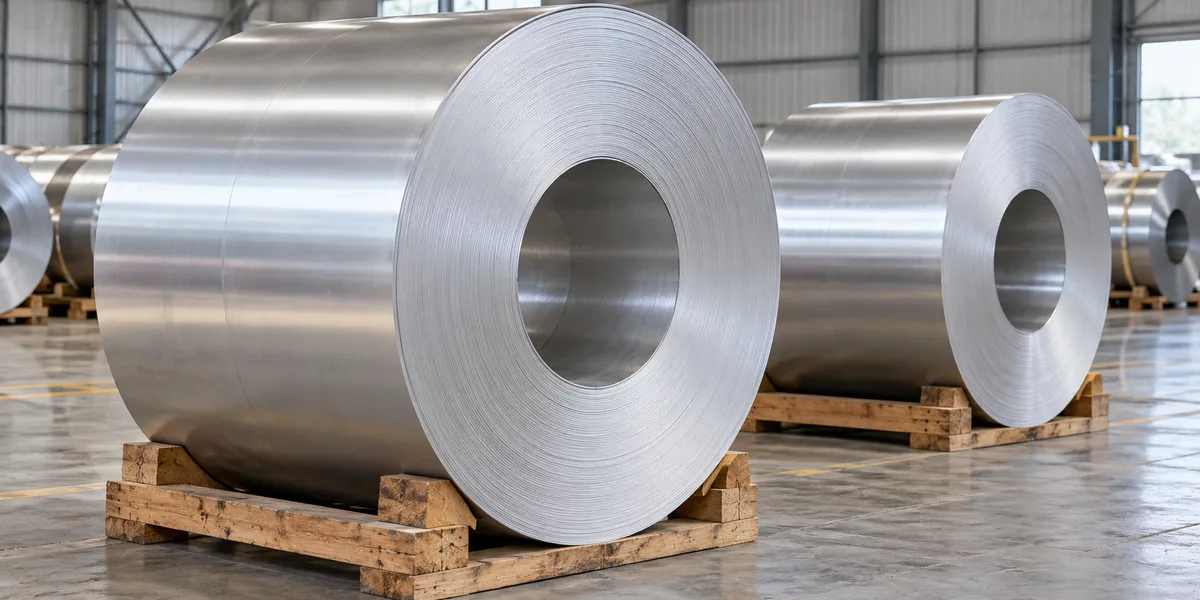
5182 is a high-magnesium (4.0 – 5.0 %) alloy with a lower manganese content than 5083. That chemistry gives very high work hardening, so annealed sheet stretches and draws deeply while finished parts end up strong.
Three industries depend on it. In packaging, 5182-H19 and H48 are rolled very thin for beverage and food can ends, where high strength allows thinner gauge and the alloy survives the severe forming of the rivet and score for the opening tab. In automotive, 5182-O is used for inner door, bonnet and boot-lid panels, where its deep-drawing ability matters more than surface appearance. In road transport, 5182-O and H111 plate is rolled into tanker shells and pressed into heads under EN 14286.
One limitation shapes its use on cars: 5182-O forms Lüders bands (stretcher-strain marks) after small amounts of plastic strain. These visible lines are unacceptable on outer panels, so 5182 is used for inner panels while outer skins use 6xxx alloys. Special stretcher-strain-free processing reduces the effect where needed.
| Element | Minimum | Maximum | Role |
|---|---|---|---|
| Silicon (Si) | — | 0.20 | Impurity |
| Iron (Fe) | — | 0.35 | Impurity |
| Copper (Cu) | — | 0.15 | |
| Manganese (Mn) | 0.20 | 0.50 | Grain control |
| Magnesium (Mg) | 4.0 | 5.0 | Main strengthener; drives work hardening |
| Chromium (Cr) | — | 0.10 | |
| Zinc (Zn) | — | 0.25 | |
| Titanium (Ti) | — | 0.10 | Grain refiner |
| Others, each / total | — | 0.05 / 0.15 | |
| Aluminium (Al) | Remainder |
Aluminum Association limits, adopted in ASTM B209 and EN 573-3 for EN AW-5182 (AlMg4.5Mn0.4).
| Temper | Tensile strength | Yield strength (0.2 %) | Elongation | Basis |
|---|---|---|---|---|
| O / H111 | 255 – 315 MPa | ≥ 110 MPa | ≥ 11 – 12 % | EN 485-2 specified (thin sheet) |
| O typical | about 275 MPa | about 130 – 140 MPa | about 21 – 25 % | Typical |
| H19 typical (can end) | about 420 MPa | about 360 – 395 MPa | about 1 – 4 % | Typical, thin gauge |
| H48 (coated can end) | set by customer specification | Strain hardened and lacquered |
Annealed. Automotive inner panels, tank heads, deep-drawn and stretch-formed parts.
Annealed and lightly levelled. Tanker shells and flat plate for welded structures.
Extra-hard cold-rolled can-end stock; high strength in very thin gauges.
Strain hardened then lacquered or coated, the lacquer cure acting as a partial anneal. Standard for coated can ends and tabs.
Intermediate tempers can be produced on request for specific parts; strength is agreed per specification.
5182 is not normally produced in the corrosion-tested H116 or H321 tempers. For hull plating, use 5083 or 5086.
| System | Designation | Standard |
|---|---|---|
| Aluminum Association / ASTM | 5182 | ASTM B209 |
| UNS | A95182 | — |
| European (EN) | EN AW-5182 / AlMg4.5Mn0.4 | EN 485-2, EN 573-3, EN 14286 (tanks), EN 541 (can stock) |
| Japan (JIS) | A5182P | JIS H4000 |
| China (GB) | 5182 | GB/T 3880 |
| Thickness (mm) | kg per m² | 1250 × 2500 mm (kg) | 1500 × 3000 mm (kg) |
|---|---|---|---|
| 0.8 | 2.12 | 6.6 | 9.5 |
| 1 | 2.65 | 8.3 | 11.9 |
| 1.2 | 3.18 | 9.9 | 14.3 |
| 1.5 | 3.97 | 12.4 | 17.9 |
| 2 | 5.30 | 16.6 | 23.8 |
| 2.5 | 6.62 | 20.7 | 29.8 |
| 3 | 7.95 | 24.8 | 35.8 |
| 4 | 10.60 | 33.1 | 47.7 |
| 5 | 13.25 | 41.4 | 59.6 |
| 6 | 15.90 | 49.7 | 71.5 |
Excellent stretch and deep drawing in O. Expect Lüders bands on unpainted visible surfaces; use stretcher-strain-free material or keep parts hidden.
MIG and TIG with ER5183 or ER5356; resistance spot welding and adhesive bonding are common in vehicles.
With more than 3 % magnesium, avoid sustained service above about 65 °C to prevent sensitisation.
Unlike 6xxx outer-panel alloys, 5182 does not gain strength in the paint-bake cycle; it may soften slightly.
Good resistance in atmospheric and many chemical environments.
Takes coil coatings and lacquers well, which is essential for can stock.
| Property (O / H111) | 5182 | 5754 | 5083 | 5088 |
|---|---|---|---|---|
| Magnesium | 4.0 – 5.0 % | 2.6 – 3.6 % | 4.0 – 4.9 % | 4.7 – 5.5 % |
| Min. proof strength | 110 MPa | 80 MPa | 125 MPa | higher than 5083 |
| Formability | Excellent | Excellent | Good | Good |
| Above 65 °C service | No | Yes | No | No |
| Main markets | Cans, car inner panels, tanks | Car structures, tanks, marine | Marine, vessels | Tankers, cryogenics |
For car structures that see heat near the engine, or tanks carrying warm products, choose 5754. For welded marine structures choose 5083.
Its high magnesium content gives very high strength after cold rolling (about 420 MPa in H19), so ends can be made thinner, and it survives the severe forming of the rivet and score.
Usually not. In O temper it forms stretcher-strain marks (Lüders lines) that show through paint. It is used for inner panels; outer skins use 6xxx alloys such as 6016 or 6111.
It resists seawater well, but it is not produced in the corrosion-tested H116 or H321 tempers required for hull plating. Use 5083 or 5086 for marine structures.
Yes, by MIG, TIG and resistance spot welding, normally with ER5183 or ER5356 filler.
H19 is extra-hard as-rolled; H48 is strain hardened then lacquered, the curing cycle slightly stabilising the metal. H48 is supplied ready-coated for can ends.
Send the temper, gauge, width, quantity and application. We will confirm availability, certification and a delivered price.





