Often acceptable
Non-structural parts, brackets, covers and general machinery where the drawing intent is "commercial Al-Mg-Si" or "commercial Al-Mn". АД31 and 6063, or АМц and 3003, are routinely interchanged in non-critical use.



If your drawing calls for a Russian or Soviet aluminium grade such as Д16ч, 1163, В93, 1420 or 1980, the safest route is to source that grade to its own GOST, OST or TU chemistry rather than substitute a Western alloy. Metline supplies flat-rolled Russian-standard aluminium (sheet, plate, coil, strip, foil and circles) and checks the designation, composition, temper and paperwork before quoting.
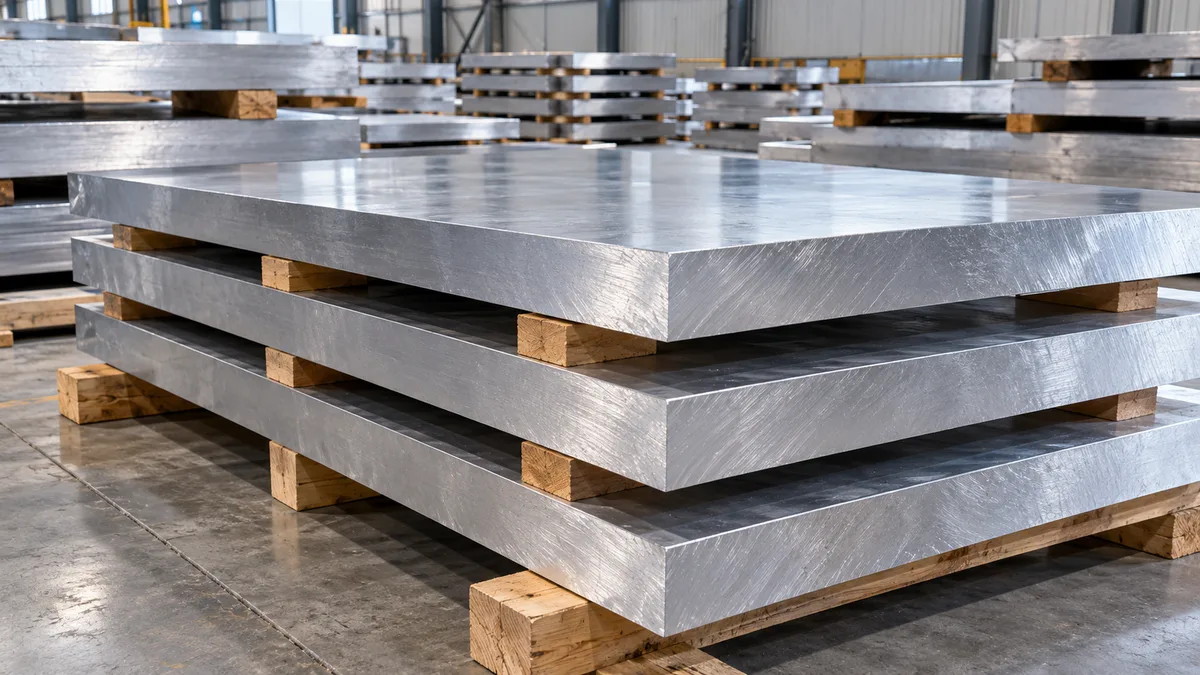
A large installed base of aircraft, ships, rail vehicles, military hardware and industrial plant was designed in the Soviet Union and its successor states. Every part on those drawings refers to a Russian grade, a GOST or OST product standard and a Russian temper code. When that equipment is repaired, overhauled or rebuilt, the material on the drawing still governs.
Swapping in a "near equivalent" such as 2024 for Д16 or 7075 for В95 is tempting, and sometimes acceptable for non-critical parts. For certified, fatigue-loaded or welded structures it usually is not. Composition windows differ, impurity limits (iron and silicon in particular) differ, temper definitions differ, and the guaranteed properties in a GOST sheet or plate standard are not the same numbers as ASTM B209 or EN 485-2. A maintenance organisation or design authority normally needs the original grade, or a formal concession, before a substitute can be fitted.
Metline approaches these enquiries as a materials-matching job first and a supply job second. We confirm the exact designation (including Cyrillic suffixes), the governing document and edition, the temper and any cladding, then propose a production route for the flat-rolled form you need. Where a grade cannot be produced economically in a small lot, we say so and set out the closest documented alternative so your engineers can decide.
Russian wrought aluminium grades are listed in GOST 4784 (the 1997 edition was replaced by GOST 4784-2019). Most grades carry two names: an older letter-and-number name and a four-digit numeric code. Both appear on drawings, often side by side, and you must be able to read either.
| Letter grade | Numeric code | Alloy system | Closest Western family (for orientation only) |
|---|---|---|---|
| Д1 | 1110 | Al-Cu-Mg | 2017 |
| Д16 | 1160 | Al-Cu-Mg | 2024 |
| АД31 | 1310 | Al-Mg-Si | 6063 |
| АД33 | 1330 | Al-Mg-Si | 6061 |
| АК8 | 1380 | Al-Cu-Mg-Si | 2014 |
| АМц | 1400 | Al-Mn | 3003 |
| АМг6 | 1560 | Al-Mg | No direct match (about 6 % Mg) |
| В95 | 1950 | Al-Zn-Mg-Cu | 7075 |
The Western grades in the right-hand column are the usual cross-references, not certified equivalents. Composition limits overlap but are not identical.
In the numeric system the leading 1 marks an aluminium base, and the second digit groups the alloy system (for example 11xx Al-Cu-Mg, 13xx Al-Mg-Si, 15xx Al-Mg, 19xx Al-Zn-Mg). Newer alloys developed from the 1960s onward, such as 1163, 1420, 1920 and 1980, were registered with numeric names only, which is why many aerospace and marine drawings show nothing but four digits.
The grades below cover most of the GOST and OST enquiries we receive. Each is produced to its Russian chemistry; final supply depends on confirming the document, temper, size and quantity.
| Grade | Family | Usual tempers | Typical use on legacy drawings |
|---|---|---|---|
| 1163 (incl. 1163АТ, 1163Т) | Al-Cu-Mg, refined Д16 type | Т, АТ | Fuselage and wing skins, fatigue-critical sheet |
| Д16 / Д16ч | Al-Cu-Mg | М, Т, АТ, Т1 | Airframe sheet, plate, general high-strength parts |
| Д19ч | Al-Cu-Mg, higher Mg | Т, Т1 | Parts needing strength at moderately raised temperature |
| В93 / 1930 | Al-Zn-Mg-Cu | Т1, Т2, Т3 | Heavily loaded structural parts and forgings |
| В95 / В95пч / В95оч | Al-Zn-Mg-Cu | Т1, Т2, Т3 | Compression-loaded wing and frame members |
| 1420 | Al-Mg-Li | Т1 | Low-density welded structures and tanks |
| 1920 | Al-Zn-Mg, weldable | Т, Т1 | Welded structures, spares for legacy machinery |
| 1980 / В48-4 | Al-Zn-Mg, weldable | Т1 | Marine and transport structural plate |
| 1985ч | Al-Zn-Mg, clean variant | Т, Т1 | Shipbuilding sheet and plate |
| 1901 | Al-Zn-Mg | Т1 | Armour and protected-vehicle plate |
| АМг6 / 1561 | Al-Mg | М, Н | Welded hulls, tanks and pressure parts |
| 1105, 1145, 8111 | Commercial-purity / foil alloys | М, Н, Т (foil) | Strip, technical and packaging foil |
| Сил1С, Сил2С | Al-Si brazing alloys | М, Н | Brazing strip and foil, clad layers |
Other grades we can evaluate on request include Д1, АК4-1, АК6, АК8, В95пч, 1561 (АМг61), 1941, 1943 and the aluminium-lithium alloys 1460, 1461 and 1469. Some of these are rarely rolled outside the original producers, so small lots may require a custom cast. We will tell you at quotation stage whether a grade is practical.
A Russian material callout usually names two things: the grade (chemistry from GOST 4784 or a specific OST/TU) and the product standard that fixes dimensions, tolerances, tempers and guaranteed properties. Both must be agreed before production.
| Document | Scope | Why it matters on an order |
|---|---|---|
| GOST 4784-2019 (formerly 4784-97) | Grades and chemical composition of wrought aluminium and alloys | Fixes the melt chemistry; certificate analysis is checked against it |
| GOST 1131 | Wrought alloy ingots for further processing | Relevant when a custom cast or remelt stock is needed |
| GOST 21631 | Sheet in aluminium and aluminium alloys | Thickness bands, tolerances, cladding and sheet properties |
| GOST 17232 | Plate in aluminium and aluminium alloys | Plate thickness, flatness and guaranteed properties |
| GOST 13726 | Strip in aluminium and aluminium alloys | Strip and coil width and thickness tolerances |
| GOST 618-2014 | Technical foil | Foil thickness, width and mechanical requirements |
| GOST 745-2014 | Packaging foil | Food-contact and converting foil grades |
| OST 1 (aviation industry) and other OSTs | Industry standards for semi-finished products | Often stricter inspection or test schedules for aerospace parts |
| TU (технические условия) | Producer- or project-specific technical conditions | Must be supplied by the customer or agreed in writing |
GOST documents are interstate standards adopted across many CIS countries; GOST R documents are Russian national standards. OSTs are industry standards from the Soviet ministries (OST 1 for aviation, OST 5 for shipbuilding), and TUs are technical conditions. Older OSTs and TUs can be hard to obtain; if you hold a copy, send it with your enquiry. Our guide to the GOST system explains the hierarchy in more detail.
The ranges below are typical of what can be rolled for Russian-standard grades. They are a starting point for quotation, not stock positions; the achievable window depends on the alloy, temper and cladding.
| Form | Thickness | Width | Length / package | Grades usually requested |
|---|---|---|---|---|
| Sheet | 0.5 – 10.5 mm | 1000 – 2000 mm | 2000 – 7000 mm | 1163, Д16ч, 1420, В93, 1920, Д19ч, 1980, 1985ч, 1901 |
| Plate | 11 – 200 mm | 1200 – 2000 mm | 2000 – 8000 mm | 1163, 1420, В93, 1920, Д19ч, 1980, 1985ч, 1901 |
| Coil and strip | 0.25 – 10.5 mm | 40 – 2000 mm | Coil ID, OD and weight to order | 1105, 1145, 8111, АМг / AlMgSi types, 1920, Сил1С, Сил2С |
| Foil | 0.007 – 0.200 mm | To order | Roll size to order | 1145, 8111 |
| Circles and discs | From sheet or plate | Diameter to drawing | Cut from sheet or plate | 1105, 1145, 1920, Д19ч, Сил1С, Сил2С |
Wide, thin clad sheet and very thick plate in high-strength 7xxx-type Russian grades are the hardest combinations to produce; expect more discussion on those. Cutting to blanks, circles or saw-cut plate pieces is available on request, which helps MRO buyers who need only a few parts per drawing.
Many enquiries arrive with nothing more than a photocopied title block. A careful review at the start avoids the most expensive mistake in this field: producing the wrong alloy.
Substitution is an engineering decision for the design authority, not the supplier. Our role is to give accurate information on how close two materials are. In general:
Non-structural parts, brackets, covers and general machinery where the drawing intent is "commercial Al-Mg-Si" or "commercial Al-Mn". АД31 and 6063, or АМц and 3003, are routinely interchanged in non-critical use.
Structural parts in Д16 or В95 where 2024 or 7075 is proposed. Properties are close, but impurity limits, cladding and guaranteed minimums differ, so approval is needed.
Grades with no Western twin: 1420 (Al-Mg-Li), 1163, 1980, 1985ч, the Сил brazing alloys and most aerospace Al-Li grades. These are supplied to their own chemistry.
Where a substitute is acceptable, we can supply the Western alloy instead, for example 2024 sheet and plate or 7075 plate, and set out the differences in writing for your file.
Skin panels, doublers, frames, ribs and repair plates on aircraft and helicopters designed to Soviet or Russian specifications.
Armour plate, vehicle structures and equipment housings built to legacy drawings that still cite Russian grades.
Hull and superstructure plate, repair sections and deck structures in Al-Mg and weldable Al-Zn-Mg grades.
Car-body sheet, structural plate and replacement parts for rolling stock designed to Russian standards.
Heat exchangers, brazed assemblies, machine parts and tanks where only a GOST material callout exists.
1145 and 8111 foil to GOST 618 and GOST 745 for technical and packaging lines in CIS markets.
Russian-standard orders are normally inspection-heavy. We agree the document set before production and supply the following as standard or on request:
Metline holds ISO 9001 certification. We do not issue Russian state conformity certificates (EAC or GOST R certification); where your import process needs them, tell us early so the documentation can be planned with your customs broker.
Usually, yes. Send the drawing extract showing the material callout. We identify the grade and governing document, confirm the chemistry and temper, and propose a production route. If key information is missing, we tell you exactly what needs confirming before quotation.
They belong to the same Al-Cu-Mg family and are often cross-referenced, but they are not identical. Composition limits, impurity limits and guaranteed properties differ, and Д16 sheet is commonly clad. Use 2024 in place of Д16 only with approval from the design authority.
It marks a "clean" version of the alloy with lower permitted iron and silicon. Lower impurities improve fracture toughness and fatigue behaviour, which is why clean grades are specified for airframe and marine structures. Do not drop the suffix when ordering.
GOST documents are interstate standards adopted across CIS countries. OSTs are industry standards from former Soviet ministries, for example OST 1 for the aviation industry, and often add tighter inspection rules. TU documents are technical conditions agreed for a producer or project.
Flat-rolled forms: sheet, plate, coil, strip, foil and circles or blanks cut from sheet and plate. Ingot or slab to a Russian chemistry can be considered as a step towards rolled product. Extruded and forged Russian-grade parts are evaluated case by case.
We provide mill test certificates to EN 10204 3.1 that state the Russian grade, standard and batch results, under our ISO 9001 system. We do not issue EAC or GOST R certificates; your importer or a certification body handles those where they are required.
Send the grade, governing GOST, OST or TU, temper, size and quantity. We confirm the designation and reply with a production route, certificate scope and delivered price.





