O
Fully annealed: deep drawing, spinning, severe bends and stretch forming.



3003 is the most widely used aluminium-manganese alloy: about 20 % stronger than pure 1100 while keeping excellent formability, weldability and corrosion resistance. Metline supplies 3003 sheet, plate and tread plate in O, H14, H24 and other tempers, cut to size and certified to ASTM B209 or EN 485, to customers worldwide.
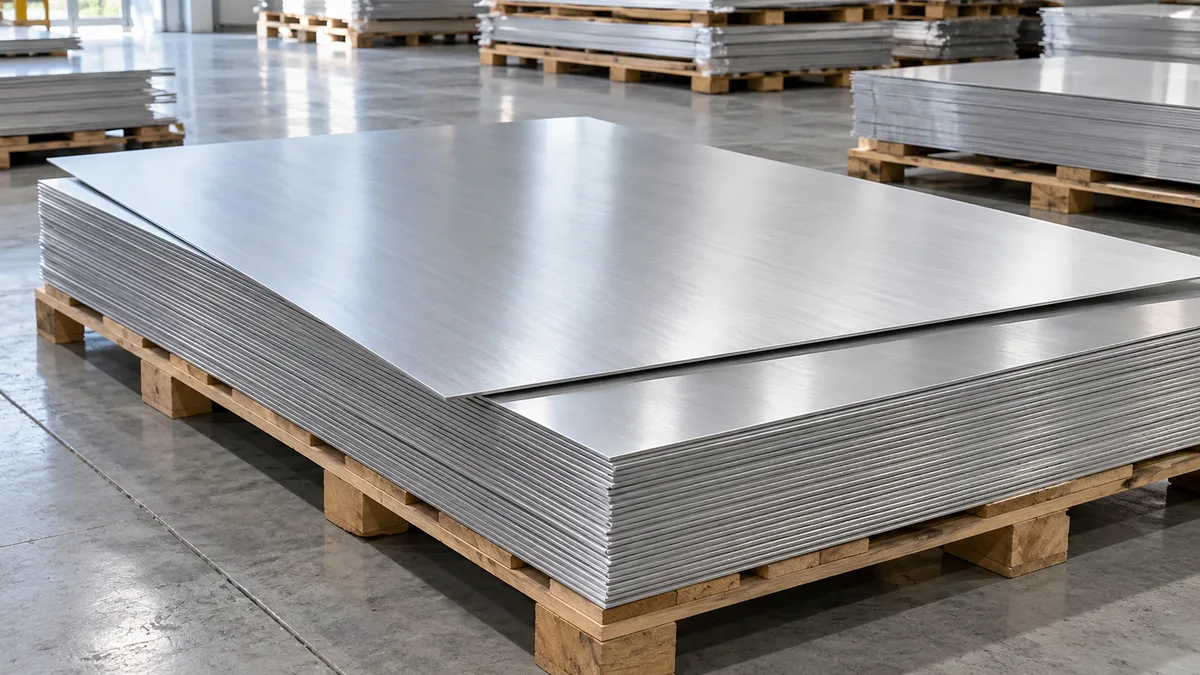
3003 adds about 1.2 % manganese and a little copper to commercially pure aluminium. Manganese forms fine particles that strengthen the metal and refine its grain without hurting corrosion resistance much, so 3003 forms almost as easily as 1100 but is noticeably stiffer and stronger in every temper.
It is non-heat-treatable; strength comes from cold work. Half-hard 3003-H14 is the standard stock temper for general sheet metal work, while O temper is used for deep drawing and spinning, and H16 and H18 for flat, dent-resistant parts.
Typical uses include fuel and chemical tanks, heat-exchanger and radiator components, cooking utensils, roofing and siding, trailer and truck panels, ductwork, signs and tread plate. In brazed heat exchangers, 3003 is the usual core alloy beneath an Al-Si braze cladding such as 4343 or 4045.
| Element | Minimum | Maximum | Role |
|---|---|---|---|
| Silicon (Si) | — | 0.6 | Impurity |
| Iron (Fe) | — | 0.7 | Impurity |
| Copper (Cu) | 0.05 | 0.20 | Small addition for strength |
| Manganese (Mn) | 1.0 | 1.5 | Main alloying element |
| Zinc (Zn) | — | 0.10 | |
| Others, each / total | — | 0.05 / 0.15 | |
| Aluminium (Al) | Remainder | About 96.8 – 99 % |
Aluminum Association limits per ASTM B209; EN AW-3003 (EN 573-3) is the same alloy.
Typical values below are from published Aluminum Association / ASM data. ASTM B209 gives guaranteed tensile ranges and minimum yield and elongation by thickness.
| Temper | Tensile strength | Yield strength | Elongation (1.6 mm) | Brinell hardness |
|---|---|---|---|---|
| 3003-O | 110 MPa / 16 ksi | 41 MPa / 6 ksi | 30 % | 28 HB |
| 3003-H12 | 131 MPa / 19 ksi | 124 MPa / 18 ksi | 10 % | 35 HB |
| 3003-H14 | 152 MPa / 22 ksi | 145 MPa / 21 ksi | 8 % | 40 HB |
| 3003-H16 | 179 MPa / 26 ksi | 172 MPa / 25 ksi | 5 % | 47 HB |
| 3003-H18 | 200 MPa / 29 ksi | 186 MPa / 27 ksi | 4 % | 55 HB |
Fully annealed: deep drawing, spinning, severe bends and stretch forming.
Half hard: the common stock temper for brake-press bending, panels, ducts and tanks.
Half hard but partially annealed: similar strength to H14 with better elongation, preferred for tighter bends and roll forming.
Hard tempers for flat panels, fins and parts that must resist denting.
As-rolled plate for thicker components, tanks and tread plate.
3003-H22 or H24 diamond and five-bar plate for floors, steps and toolboxes (ASTM B632).
| System | Designation | Standard |
|---|---|---|
| Aluminum Association / ASTM | 3003, Alclad 3003 | ASTM B209; ASTM B632 (tread plate) |
| Aerospace / federal | 3003 | AMS-QQ-A-250/2 |
| UNS | A93003 | — |
| European (EN) | EN AW-3003 / AlMn1Cu | EN 485-2, EN 573-3 |
| German Werkstoff | 3.0517 | DIN EN 485 |
| Japan (JIS) | A3003P | JIS H4000 |
| China (GB) | 3003; 3A21 (close) | GB/T 3880, GB/T 3190 |
3003 weighs about 2.73 kg per m² per millimetre:
| Thickness (mm) | kg per m² | 1220 × 2440 mm (kg) | 1500 × 3000 mm (kg) |
|---|---|---|---|
| 0.5 | 1.36 | 4.1 | 6.1 |
| 0.8 | 2.18 | 6.5 | 9.8 |
| 1 | 2.73 | 8.1 | 12.3 |
| 1.2 | 3.28 | 9.8 | 14.7 |
| 1.5 | 4.09 | 12.2 | 18.4 |
| 2 | 5.46 | 16.3 | 24.6 |
| 2.5 | 6.83 | 20.3 | 30.7 |
| 3 | 8.19 | 24.4 | 36.9 |
| 4 | 10.9 | 32.5 | 49.1 |
| 5 | 13.7 | 40.6 | 61.4 |
| 6 | 16.4 | 48.8 | 73.7 |
| 8 | 21.8 | 65.0 | 98.3 |
| 10 | 27.3 | 81.3 | 122.9 |
| 12 | 32.8 | 97.5 | 147.4 |
| 16 | 43.7 | 130.0 | 196.6 |
| 20 | 54.6 | 162.5 | 245.7 |
| 25 | 68.2 | 203.2 | 307.1 |
O and H24 allow tight bends (0 – 1 × t); H14 about 1 × t for thin sheet. Excellent for spinning and deep drawing in O temper.
Easily welded with ER1100 or ER4043 filler, and readily brazed, which is why 3003 is the standard heat-exchanger core.
Gummy in soft tempers; use sharp, high-rake tools and lubricant.
Accepts paint and coil coatings well. Anodised 3003 has a slightly grey tone and is not ideal for decorative bright finishes; choose 5005 for architectural anodising.
Need more strength with similar corrosion resistance? 3004 and 5052 are the usual next steps. For a cheaper, slightly weaker painted sheet, 3105 is common.
Both are half hard with similar tensile strength. H14 is strain-hardened only; H24 is strain-hardened then partially annealed, giving lower yield and better elongation, which helps with tight bends.
Yes, by roughly 20 % in the same temper, with similar formability and slightly lower conductivity.
5052 is about twice as strong and better in seawater; 3003 is cheaper and easier to form. Use 5052 for marine and structural parts, 3003 for general sheet metal.
Yes, easily, by TIG or MIG with ER1100 or ER4043 filler, and it brazes well.
It anodises for protection, but the film is slightly grey and less uniform than on 5005 or 6063, so it is not the first choice for decorative anodising.
Yes, in diamond and five-bar patterns in common thicknesses, cut to size.
Send temper, size, quantity and destination. We will reply with availability and a delivered price.





