Filler choice
Use Al-Mg fillers such as ER5356, ER5183 or ER5556. Silicon fillers (4043) give weaker, less ductile welds on Al-Zn-Mg plate.



1901 is a Russian weldable aluminium-zinc-magnesium alloy, with 5.4–6.2 % zinc and 2.4–3.0 % magnesium, best known as an armour material for light military vehicles. It combines high strength after ageing with the ability to be welded into hulls and protective structures. This guide covers its GOST composition, tempers, welding behaviour, cautions and the Western alloys it is compared with.
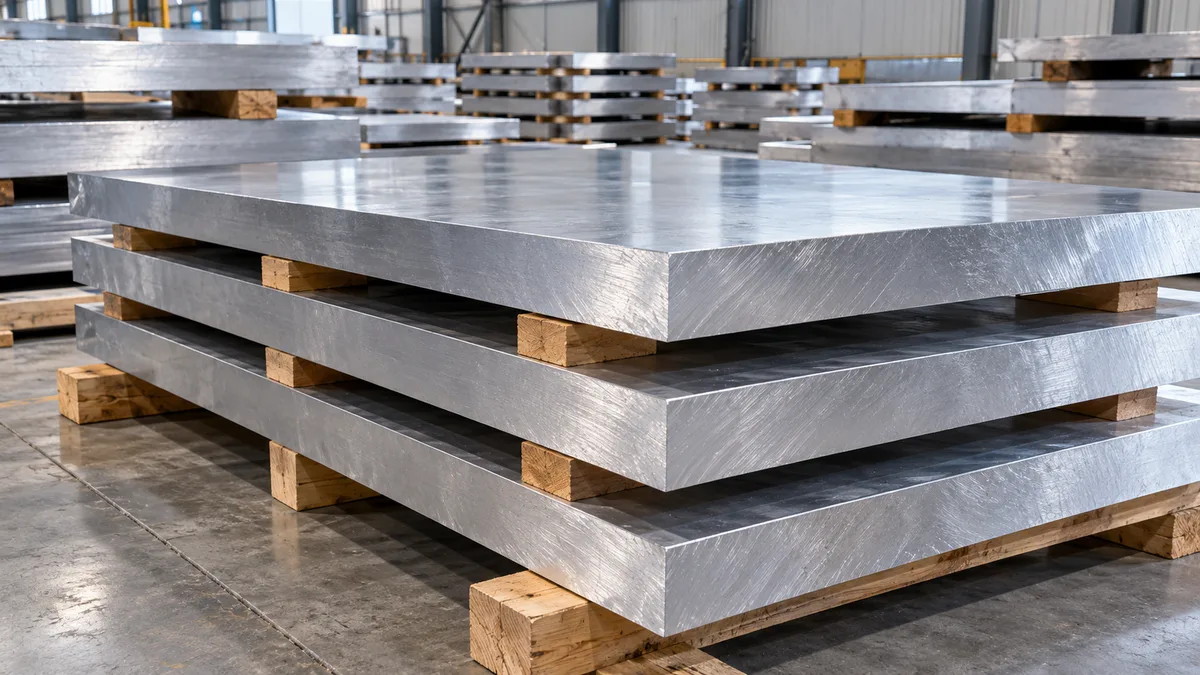
Grades numbered 19xx in the Russian four-digit system belong to the Al-Zn-Mg group, the family that also contains 1915 (equivalent to 7005) and 1920 (В92). 1901 is one of the strongest weldable members of that group, designed for armour plate where ballistic resistance, low weight and weldability must be combined.
Aluminium armour became attractive in the 1960s because a thicker aluminium plate of the same areal weight as steel makes a stiffer hull with fewer internal stiffeners. Soviet infantry fighting vehicles of that era used 1901 for parts of the hull; in the West, the comparable development was 5083 and later 7039 armour plate.
Like all high-zinc Al-Zn-Mg alloys, 1901 gains strength from fine MgZn₂-type precipitates formed during ageing. It also shares the family weakness: sensitivity to stress-corrosion cracking if composition, heat treatment and residual stress are not controlled. Chromium, manganese and zirconium are added for exactly that reason.
Limits from the Al-Zn-Mg table of GOST 4784-97. Single values are maximums.
| Element | Limit (%) | Role |
|---|---|---|
| Zinc (Zn) | 5.4 – 6.2 | Main strengthening element with Mg |
| Magnesium (Mg) | 2.4 – 3.0 | Forms MgZn₂-type strengthening precipitates |
| Manganese (Mn) | 0.1 – 0.3 | Grain structure control |
| Chromium (Cr) | 0.12 – 0.25 | Improves stress-corrosion resistance |
| Zirconium (Zr) | 0.07 – 0.12 | Inhibits recrystallisation; reduces weld cracking |
| Titanium (Ti) | 0.03 – 0.10 | Grain refiner |
| Beryllium (Be) | 0.0002 – 0.005 | Reduces melt oxidation and magnesium loss |
| Iron (Fe) | ≤ 0.3 | Impurity |
| Silicon (Si) | ≤ 0.2 | Impurity |
| Copper (Cu) | ≤ 0.2 | Kept low to preserve weldability and corrosion resistance |
| Others, total | ≤ 0.1 | |
| Aluminium (Al) | Remainder |
GOST gives a nominal density of 2.78 g/cm³, so a 1500 × 3000 × 20 mm plate weighs about 250 kg. Some supplier literature refers to the alloy as АБТ-101; confirm the designation against GOST 4784 and the product specification on any order.
| Condition | Meaning | Use |
|---|---|---|
| М | Annealed | Forming before final heat treatment; lowest strength |
| Т | Quenched and naturally aged | Good strength with better toughness; the HAZ of welds also ages naturally |
| Т1 | Quenched and artificially aged | Highest strength; typical armour condition |
| Over-aged variants | Aged beyond peak strength | Trades some strength for better stress-corrosion resistance |
Al-Zn-Mg alloys have a wide quenching window, so thick plate can be quenched in air or mild water spray without the severe residual stresses of 2xxx or high-copper 7xxx alloys. That is part of what makes them weldable: after welding, the heat-affected zone, which has been briefly solution treated, regains much of its strength over weeks of natural ageing at room temperature.
Guaranteed mechanical properties and ballistic acceptance criteria come from the governing military or aerospace specification. We do not publish generic values for 1901 because they differ by thickness, condition and standard.
| Property | 1901 (Al-Zn-Mg) | 5083 (Al-Mg) | 7039 (Al-Zn-Mg) | RHA steel |
|---|---|---|---|---|
| Density (g/cm³) | 2.78 | 2.66 | 2.74 | 7.85 |
| Strength class | High (aged) | Moderate | High (aged) | Very high |
| Weldability | Good; HAZ re-ages | Excellent | Good; HAZ re-ages | Good with preheat |
| Stress-corrosion sensitivity | Needs control | Low (if not sensitised) | Needs control | Hydrogen cracking risk |
| Typical role | Hulls, add-on panels | Hulls, ramps | Hulls, spaced armour | Hulls, high threat |
Al-Zn-Mg armour generally gives better protection per unit weight than 5083 against armour-piercing small-arms rounds, while 5083 is tougher and more tolerant of corrosion and fabrication. Many vehicles combine both, with 7xxx plates where threat is highest.
Use Al-Mg fillers such as ER5356, ER5183 or ER5556. Silicon fillers (4043) give weaker, less ductile welds on Al-Zn-Mg plate.
Keep heat input low and interpass temperature controlled to narrow the softened zone; multi-pass MIG is standard for thick plate.
Allow time for the HAZ to recover by natural ageing before final testing; specifications often set a minimum waiting period.
Avoid high residual tensile stress in the short-transverse direction; do not leave plate edges and HAZ unprotected; follow the specified post-weld treatment.
Waterjet or saw cutting avoids the heat-affected edges of plasma cutting; machine away heat-affected edges where required.
Conversion coat and paint the finished structure, sealing edges and weld toes.
Outside defence, weldable Al-Zn-Mg alloys like 7020 and 7005 are used for rail vehicles, bicycle frames and bridges, but 1901 itself is rarely specified there.
A weldable aluminium-zinc-magnesium alloy (7xxx type) in the Russian GOST 4784 system, with 5.4–6.2 % Zn and 2.4–3.0 % Mg plus Cr, Mn, Zr and Ti.
Yes. It is welded with Al-Mg fillers such as 5356 or 5183, and the heat-affected zone recovers much of its strength by natural ageing after welding.
There is no exact equivalent. 7039 is the closest armour alloy in purpose; 7020 is a related weldable structural alloy. Substitution requires testing and approval.
Like all high-zinc Al-Zn-Mg alloys it can, if heat treatment, residual stress and protection are not controlled. Chromium and zirconium additions and correct ageing reduce the risk.
Typically tens of millimetres, chosen by ballistic testing for the threat level and vehicle design.
Send the specification, thickness, size and quantity for 1901 or an approved alternative. We will reply on availability and documentation.





