1060-O
Fully annealed for deep drawing, spinning and severe forming, and for the highest conductivity.



1060 is commercially pure aluminium with at least 99.6 % Al, giving slightly higher electrical and thermal conductivity than 1050 together with excellent formability and corrosion resistance. It is the usual choice for busbars, capacitor and battery parts, heat spreaders, chemical tanks and reflective products. Metline supplies 1060 plate and sheet to ASTM B209 and EN 485 in all common tempers, worldwide.
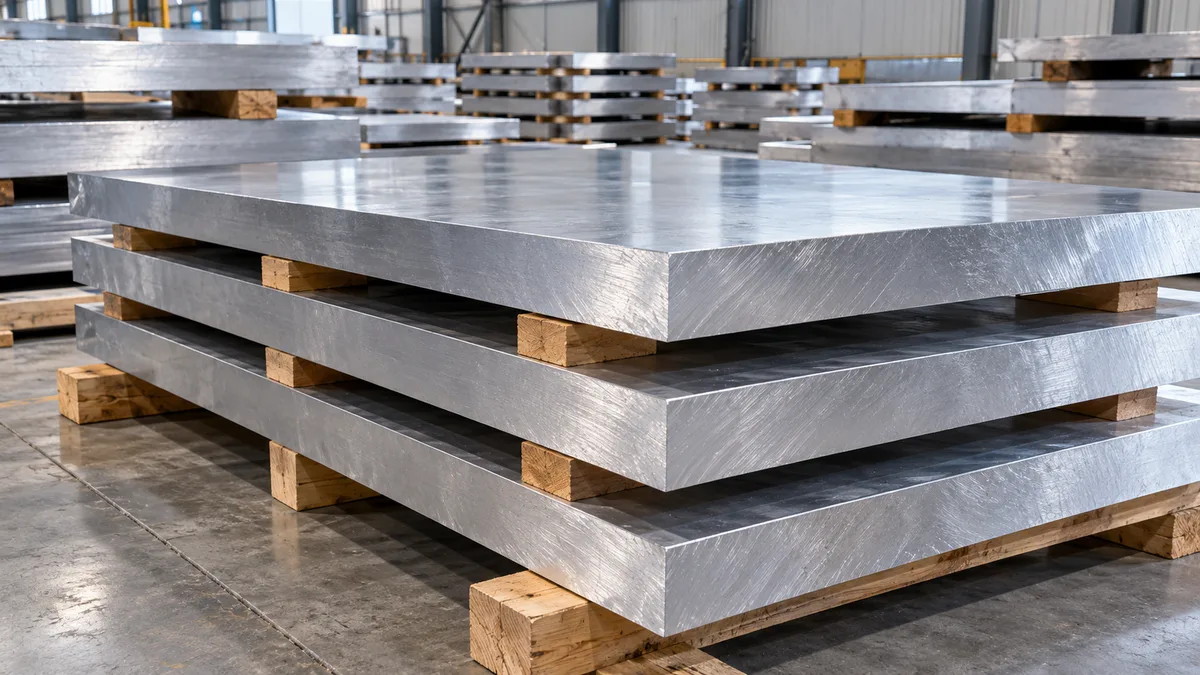
1060 sits one step above 1050 in purity: its 99.60 % aluminium minimum and tighter iron and manganese limits leave fewer impurity atoms to scatter electrons, so it conducts electricity and heat a little better. Like all 1xxx grades it cannot be heat-treated; it is strengthened only by cold rolling, and even full-hard 1060 is a low-strength material.
That combination makes 1060 an electrical and thermal grade first. Busbars and connector plates, capacitor housings, battery tabs and current collectors, transformer windings, heat sinks and heat-spreader plates all use it. Its chemical purity also suits tanks and equipment for chemicals and food, and its bright surface suits reflectors, nameplates and signs.
Unlike 1050, 1060 is listed in ASTM B209, so it is the common commercially pure grade in North American sheet and plate supply. In Europe and Asia it is registered as EN AW-1060 and in GB/T 3880, and is widely produced for the battery and electronics industries.
| Element | Maximum | Comment |
|---|---|---|
| Silicon (Si) | 0.25 | Main impurity with iron |
| Iron (Fe) | 0.35 | Tighter than 1050 (0.40) |
| Copper (Cu) | 0.05 | |
| Manganese (Mn) | 0.03 | Kept low for conductivity |
| Magnesium (Mg) | 0.03 | |
| Zinc (Zn) | 0.05 | |
| Vanadium (V) | 0.05 | Impairs conductivity if high |
| Titanium (Ti) | 0.03 | Impairs conductivity if high |
| Others, each | 0.03 | |
| Aluminium (Al) | 99.60 min |
Limits are the registered Aluminum Association values used by ASTM B209 and EN 573-3. Mill certificates report the actual analysis of each lot.
Typical values from Aluminum Association and ASM data are shown; the minimums you design to are set by ASTM B209 or EN 485-2 for each temper and thickness band and appear on the certificate.
| Temper | Typical tensile strength | Typical yield strength | Typical elongation | Brinell hardness |
|---|---|---|---|---|
| O (annealed) | 69 MPa / 10 ksi | 28 MPa / 4 ksi | 43 % | 19 HB |
| H12 | 83 MPa / 12 ksi | 76 MPa / 11 ksi | 16 % | 23 HB |
| H14 | 97 MPa / 14 ksi | 90 MPa / 13 ksi | 12 % | 26 HB |
| H16 | 110 MPa / 16 ksi | 103 MPa / 15 ksi | 8 % | 30 HB |
| H18 | 131 MPa / 19 ksi | 124 MPa / 18 ksi | 6 % | 35 HB |
Fully annealed for deep drawing, spinning and severe forming, and for the highest conductivity.
Light cold work; still very formable, with a little more stiffness for flat panels.
The most common sheet tempers. H24 is partially annealed, giving better bendability than H14 at similar strength.
Harder, for parts that need to keep their shape with limited forming.
Full hard; used for stamped battery and electronic parts, and for thin strip that must stay flat.
As-rolled plate with minimum properties; common for thick busbar and conductor plate.
| System | Designation | Sheet and plate standard |
|---|---|---|
| Aluminum Association / ASTM | 1060 | ASTM B209 (ASME SB-209) |
| UNS | A91060 | — |
| European | EN AW-1060 (EN AW-Al 99.6) | EN 485-1 to -4, EN 573-3 |
| ISO | Al99.6 | ISO 6361 |
| Japan | A1060P | JIS H4000 |
| China | 1060 | GB/T 3880, GB/T 3190 |
For electrical conductor applications, also check the electrical standard your design follows; dedicated conductor grades such as 1350 (EC grade) and 6101 are covered by separate busbar and conductor specifications.
1060 weighs 2.705 kg/m² per millimetre of thickness; use the plate weight calculator for any size.
| Thickness (mm) | kg per m² | 1000 × 2000 mm (kg) | 1220 × 2440 mm (kg) | 1250 × 2500 mm (kg) |
|---|---|---|---|---|
| 0.3 | 0.81 | 1.6 | 2.4 | 2.5 |
| 0.5 | 1.35 | 2.7 | 4.0 | 4.2 |
| 1 | 2.71 | 5.4 | 8.1 | 8.5 |
| 1.5 | 4.06 | 8.1 | 12.1 | 12.7 |
| 2 | 5.41 | 10.8 | 16.1 | 16.9 |
| 3 | 8.12 | 16.2 | 24.2 | 25.4 |
| 5 | 13.53 | 27.1 | 40.3 | 42.3 |
| 6 | 16.23 | 32.5 | 48.3 | 50.7 |
| 10 | 27.05 | 54.1 | 80.5 | 84.5 |
| 15 | 40.58 | 81.2 | 120.8 | 126.8 |
| 20 | 54.10 | 108.2 | 161.0 | 169.1 |
| 30 | 81.15 | 162.3 | 241.6 | 253.6 |
Excellent in O and H2x tempers; H18 stamps cleanly for thin battery and electronic parts with little burr when tools are sharp.
Welds easily by TIG, MIG, ultrasonic, laser, resistance and friction stir; ultrasonic and laser welding are standard for battery tabs and connections.
Clean the oxide and use contact grease or plating (tin, nickel or silver) at bolted joints to keep contact resistance low.
Soft and gummy; use sharp, high-rake tools with lubricant.
Gives a bright, clear finish suitable for reflective and decorative use.
Excellent in atmosphere, water and many chemicals; avoid contact with copper or steel without isolation.
| Grade | Minimum Al | Conductivity (O, approx.) | Typical H14 tensile | Typical choice |
|---|---|---|---|---|
| 1100 | 99.00 % | 59 % IACS | 125 MPa | General sheet metal with a little more strength |
| 1050 | 99.50 % | 61 – 62 % IACS | 110 MPa | European general-purpose pure sheet |
| 1060 | 99.60 % | 62 % IACS | 97 MPa | Electrical, battery and thermal sheet; ASTM B209 grade |
| 1070 | 99.70 % | about 62 – 63 % IACS | about 95 – 100 MPa | Higher conductivity, reflective products |
| 1350 | 99.50 % with tight trace limits | about 61 – 62 % IACS | — | Electrical conductor (EC) grade for busbar and wire |
The conductivity differences between these grades are small; the choice is usually driven by the standard the customer works to and by the forming and strength needed.
1060 has 99.6 % minimum aluminium against 99.5 % for 1050, with tighter iron and manganese limits. It conducts slightly better and is slightly softer. 1060 is listed in ASTM B209; 1050 is mainly ordered to EN and JIS standards.
Yes. Its conductivity of about 62 % IACS and good formability make it a common busbar and connector material. Some electrical specifications call for 1350 or 6101 instead, so check the standard your design follows.
Stamped tabs, lids and connectors often use H14, H18 or H24 for stiffness and clean blanking; deep-drawn cell cases and caps use O or H2x tempers for formability.
Very easily, by TIG, MIG, ultrasonic, laser, resistance and friction stir welding. 1100 or 4043 filler is common for fusion welds; pure fillers preserve conductivity.
Typical tensile strength is about 97 MPa and yield about 90 MPa. It is a low-strength grade chosen for conductivity and formability, not load-bearing capacity.
Yes. Metline ships 1060 plate, sheet and strip worldwide with mill test certificates and export packing.
Send temper, thickness, size and quantity. We will reply with availability, certification and a delivered price.





