T651 / T7451 / T351
Stretched 1.5 – 3 % after quenching to relieve residual stress. The standard condition for rolled heat-treated plate that will be machined. Stretching becomes difficult in very large cross-sections.



Ultra-thick aluminium plate covers sections from about 50 mm up to 600 mm, used for moulds, machine bases, vacuum chambers and aerospace parts machined from solid. Above roughly 150 – 200 mm the choice of production route (rolled, cast or forged) and of stress-relieved temper matters as much as the alloy. This guide explains how to choose and what to check.
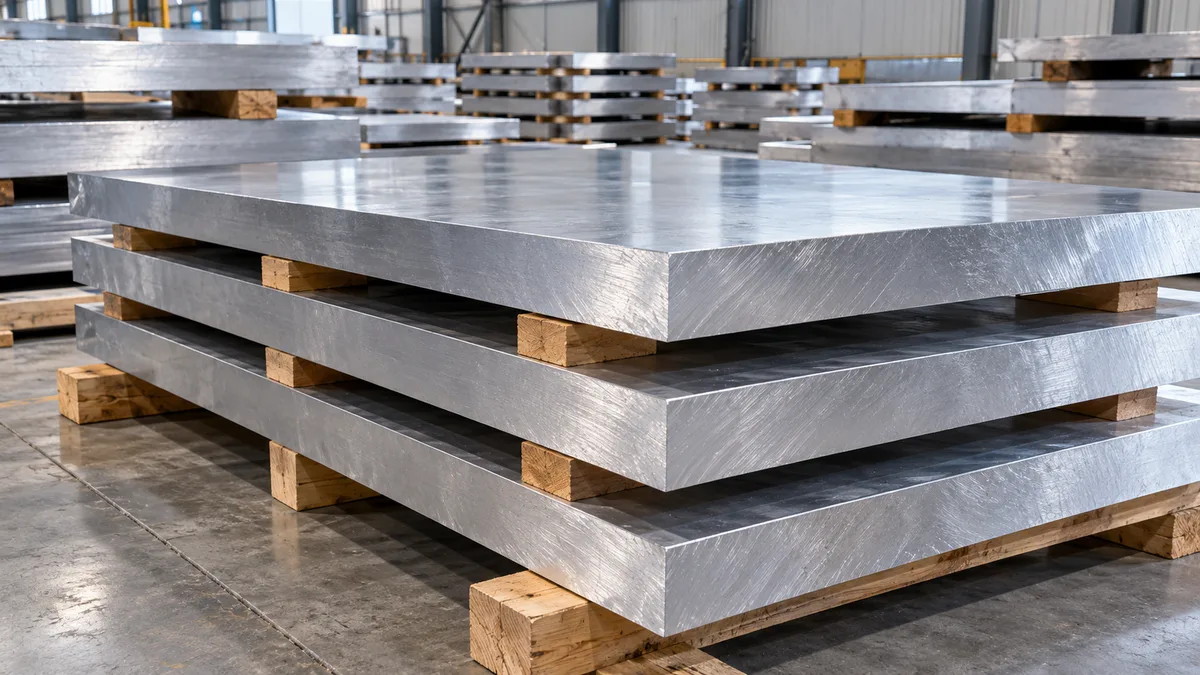
Most rolled plate is ordered between 6 and 100 mm. "Ultra-thick" or "heavy gauge" plate starts where standard stock ranges thin out, around 50 – 100 mm, and continues into blocks several hundred millimetres thick. At these sizes, a single slab replaces bolted or welded stacks, and a large part can be machined in one setup from one piece of metal.
The challenge is metallurgical. A thick plate must be rolled from a very large ingot with enough reduction to give wrought properties at its centre, then quenched fast enough that the core still reaches the required strength, then stress-relieved so it does not move when machined. Each of these steps gets harder as thickness increases, which is why properties, available alloys and prices all change across the thickness range.
| Route | Typical thickness | Strengths | Limitations |
|---|---|---|---|
| Rolled plate (T651, T7451, T351, H112) | Up to about 150 – 200 mm in most heat-treated alloys; thicker in some non-heat-treatable grades | Highest guaranteed properties, good machinability, certified to ASTM B209 / EN 485 / AMS | Centre properties and short-transverse values fall with thickness |
| Cast tooling plate (often 5083-type) | Commonly up to several hundred millimetres | Very low residual stress, excellent dimensional stability, precision-milled faces available | Lower strength and hardness than rolled heat-treated plate; not for structural or fatigue-loaded parts |
| Forged slab or block (T652, T7452) | Several hundred millimetres and above | Worked in more than one direction, sound core, better short-transverse properties | Higher cost; forged-product property tables apply, not plate tables |
If your part needs strength and fatigue resistance, specify rolled plate as far as the alloy's standard thickness range allows and move to a forged block beyond it. If the priority is that a mould or jig stays flat, cast plate is often the better and cheaper choice. Our large forgings guide and forged plate page cover the forged route in detail.
| Alloy and temper | Typical tensile strength* | Typical yield strength* | Why it is chosen |
|---|---|---|---|
| 6061-T651 | 310 MPa | 276 MPa | General engineering, machines, vacuum chambers; weldable, anodises well |
| 6082-T651 | 310 – 340 MPa | 260 – 300 MPa | European equivalent to 6061 for structural and machine parts |
| 7075-T651 | 572 MPa | 503 MPa | Moulds and high-strength parts; quench sensitivity limits properties in very thick sections |
| 7050-T7451 | 524 MPa | 469 MPa | Thick aerospace plate: low quench sensitivity, good toughness and stress-corrosion resistance |
| 2024-T351 | 469 MPa | 324 MPa | Fatigue-critical parts; properties decrease noticeably in thick plate |
| 2017-T4 / T451 | 427 MPa | 276 MPa | Machined mechanical parts that need more strength than 6061 |
| 5083-H112 / O | 270 – 290 MPa | 125 – 145 MPa | Cryogenic and marine blocks, welded vacuum and LNG components |
*Typical values for thin and medium sections from Aluminum Association and ASM data. In ultra-thick plate the guaranteed minimum values are lower and depend on the thickness band and test direction; design to the minimums in the order standard and the mill certificate.
Two physical constants stay the same at any thickness: 6061 and other 6xxx plate weighs 2.70 kg per m² per millimetre, while 7075 is denser at about 2.81. Thermal conductivity of thick 6061-T651 is around 167 W/m·K, which is why it is popular for temperature-controlled moulds and platens.
Stretched 1.5 – 3 % after quenching to relieve residual stress. The standard condition for rolled heat-treated plate that will be machined. Stretching becomes difficult in very large cross-sections.
Stress-relieved by compression instead of stretching. Used for forged slabs and some very thick products where a stretcher cannot pull the section.
Same strength as T651 but with high locked-in quench stress. Thick T6 plate can bow or twist when machined, so avoid it for precision parts.
As-fabricated temper for non-heat-treatable grades such as 5083 and 5052; low residual stress, moderate strength.
Softest condition with the lowest internal stress; used where the block will be heat-treated after rough machining or where formability matters.
No temper stretching needed: the casting and stress-relieving route gives very low stress, at the cost of strength.
Availability of each alloy and thickness combination varies; send your list and we confirm what can be supplied.
| Thickness (mm) | 6061 (kg/m²) | 7075 (kg/m²) | 6061, 1520 × 3020 mm (kg) | 6061, 2000 × 4000 mm (kg) |
|---|---|---|---|---|
| 50 | 135 | 140 | 620 | 1080 |
| 60 | 162 | 169 | 744 | 1296 |
| 80 | 216 | 225 | 992 | 1728 |
| 100 | 270 | 281 | 1239 | 2160 |
| 120 | 324 | 337 | 1487 | 2592 |
| 150 | 405 | 422 | 1859 | 3240 |
| 200 | 540 | 562 | 2479 | 4320 |
| 250 | 675 | 702 | 3099 | 5400 |
| 300 | 810 | 843 | 3718 | 6480 |
| 400 | 1080 | 1124 | 4958 | 8640 |
| 500 | 1350 | 1405 | 6197 | 10800 |
| 600 | 1620 | 1686 | 7436 | 12960 |
A 300 mm 6061 plate at 2000 × 4000 mm weighs more than six tonnes, so handling, packing and crane limits at the receiving site should be confirmed before ordering full mill sizes. Cut blocks reduce freight and waste.
Internal soundness is the main risk in heavy plate, because porosity or inclusions at the centre are invisible until a cutter opens them up, often after many hours of machining. That is why ultrasonic testing is standard practice above about 50 mm for aerospace, vacuum and mould applications.
7075-T651 and 6061-T651 blocks for injection, blow, foam and rubber moulds; cast plate for jigs and fixtures that must stay flat.
6061 and 6082 plates for machine beds, gantries, CNC and milling-machine tables and large robot bases.
6061-T651 and 5083 blocks machined into chamber bodies and wafer-handling platforms.
7050-T7451 and 7075 plate for frames, spars and bulkheads hogged from solid; 2024-T351 for fatigue-critical parts.
5083 blocks for welded LNG and cryogenic fittings and marine structural parts.
Thick 6061 for cooling plates, platens and heat-spreading bases.
Rolled heat-treated plate is normally available up to about 150 – 200 mm, depending on alloy and temper. Cast tooling plate and forged slabs extend the range to several hundred millimetres, and blocks up to about 600 mm can be supplied by those routes.
Yes, guaranteed minimum strength falls as thickness increases, because the centre cools more slowly during quenching and receives less rolling reduction. Low-quench-sensitivity alloys such as 7050 lose less strength than 7075 or 2024.
7075-T651 is harder and stronger, which helps with wear and polish on high-volume moulds. 6061-T651 is cheaper, more weldable for repairs and adequate for prototype and short-run tooling.
Internal porosity or inclusions are invisible from the surface and may only appear after expensive machining. Ultrasonic testing to ASTM B594 or AMS-STD-2154 screens the plate before it is cut.
Both are stress-relieved after quenching: T651 by stretching, T652 by compression. T652 is used for forgings and very large sections that cannot be stretched.
Yes. Thick plate can be saw-cut into blocks to your dimensions, with milled faces on request, which reduces freight weight and machining time.
Send the alloy, temper, thickness, block sizes and testing requirements. Our team will reply with availability and a delivered price anywhere in the world.





